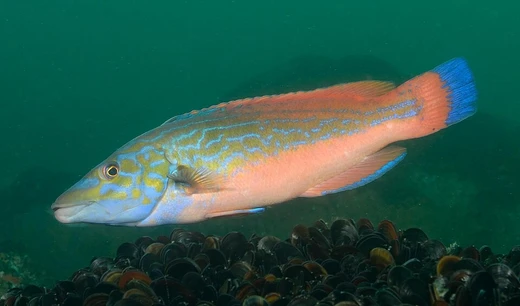
Choerodon
A genus of wrasses with tusk-like teeth and documented tool use.

Choerodon is a genus of wrasses found in the Indian Ocean and western Pacific. Most species are called tuskfish due to their sharp, tusk-like teeth. The genus first appeared in the Miocene, following the collision of the Australian and Eurasian Plates.
Taxonomically, Choerodon is closely related to the odacine wrasses, both belonging to the wrasse tribe Hypsigenyini. The genus is divided into six subgenera. Molecular studies have confirmed that these subgenera are monophyletic, though not all species have been analyzed. The species *Choerodon typus* was once placed in its own genus, *Xiphocheilus*, but both morphological and molecular evidence now place it within *Choerodon*, with *Xiphocheilus* retained as a subgenus name.
Some tuskfishes show tool use. Four species—orange-dotted, blue, graphic, and blackspot tuskfish—have been observed using large rocks or hard coral as anvils to smash open hard-shelled prey. All four belong to the subgenus *Choerodon* and can remember and reuse specific anvils. This behavior typically targets invertebrates like clams and sea urchins, but a blue tuskfish was once filmed smashing a young green sea turtle on an anvil. Anvil use also occurs in several other wrasse genera.
The genus currently contains 27 recognized species.
Quick Facts
- Taxon
- Choerodon
- Type Species
- Labrus macrodontus
- Type Species Authority
- Lacépède, 1801
Facts from the source article.
Lore & Background
Choerodon originated in the Miocene, when the Australian and Eurasian Plates collided. The genus is most closely related to the odacine wrasses, and both groups belong to the wrasse tribe Hypsigenyini. Choerodon is split into six subgenera; molecular phylogenetic analysis has so far demonstrated the monophyly of these subgenera, although not all species in the genus have been evaluated. Traditionally, Choerodon typus was placed within its own genus Xiphocheilus, but both morphological and molecular analyses now place it within Choerodon, with Xiphocheilus becoming its subgenus name instead. The genus contains 27 currently recognized species.
Reader's Guide
Choerodon is significant for its evolutionary history and behavioral complexity. The genus arose during the Miocene, a period of tectonic collision that likely shaped its diversification. Its members are commonly called tuskfish due to their sharp tusk-like teeth. Notably, four species—orange-dotted, blue, graphic, and blackspot tuskfish—have been recorded using large rocks or hard coral as anvils to smash open hard-shelled prey. All four belong to the subgenus Choerodon and can remember to use a particular rock or coral repeatedly. This behavior usually involves invertebrate prey such as clams and sea urchins, but on one occasion a blue tuskfish was filmed smashing a young green sea turtle on an anvil. Anvil use is also documented in several other wrasse genera, but the repeated use of specific tools by Choerodon species highlights their cognitive abilities. The genus also illustrates taxonomic refinement, as the former genus Xiphocheilus has been subsumed into Choerodon based on both morphological and molecular evidence.
Did You Know?
- Four tuskfish species have been recorded using rocks or hard coral as anvils to smash prey.
- The former genus Xiphocheilus is now a subgenus of Choerodon.
Evolutionary Origins in a Shifting Ocean
Choerodon traces its lineage back to the Miocene epoch, a period when the tectonic landscape of the southern hemisphere was being dramatically reshaped. The genus emerged in the wake of the collision between the Australian and Eurasian tectonic plates, an event that fundamentally reorganized ocean currents, coastlines, and the distribution of marine habitats across the region. Today, the descendants of that ancient radiation are found throughout the Indian Ocean and the western Pacific Ocean, a biogeographic range that mirrors the waters created and modified by that plate interaction. This deep evolutionary history means that tuskfishes are not merely residents of tropical reef systems but are products of a specific geological moment that set the stage for their diversification. Their presence across such a vast expanse of ocean, from the Indian Ocean to the western Pacific, speaks to a lineage that has had millions of years to adapt, speciate, and fill ecological niches in the warm, shallow waters shaped by that ancient continental meeting.
Taxonomic Architecture and the Question of Boundaries
Within the broader wrasse family, Choerodon occupies a position of close kinship with the odacine wrasses, both groups falling under the tribe Hypsigenyini. The genus itself is internally divided into six subgenera, a structural arrangement that molecular phylogenetic studies have largely confirmed as monophyletic, meaning each subgenus appears to represent a genuine evolutionary branch. However, researchers note that not every species within the genus has yet been evaluated through molecular methods, leaving some taxonomic questions open. One of the most notable reclassifications involved Choerodon typus, which for a long time was housed in its own separate genus, Xiphocheilus. Both morphological examination and molecular analysis have since demonstrated that this species belongs firmly within Choerodon, and Xiphocheilus was demoted to a subgenus name. This kind of taxonomic reshuffling illustrates how our understanding of these fish continues to evolve as analytical tools improve, and it underscores that the 27 currently recognized species represent a living, still-refining picture of the genus's true diversity.
The Anvil-Smashing Foragers
Perhaps no behavior in the tuskfish world captures the imagination quite like the documented use of natural anvils by four species: the orange-dotted, blue, graphic, and blackspot tuskfish. All four belong to the subgenus Choerodon proper, and they have been observed selecting large rocks or hard coral formations as work surfaces on which they smash open the shells of hard-bodied invertebrate prey such as clams and sea urchins. What makes this behavior particularly remarkable is the element of memory: these fish can return to the same specific rock or coral patch repeatedly, suggesting a spatial awareness and problem-solving capacity that goes well beyond simple reflex. In one extraordinary recorded instance, a blue tuskfish was filmed using this anvil technique not on a shellfish but on a young green sea turtle, a prey item far outside the usual invertebrate menu. It is worth noting that anvil use is not exclusive to Choerodon; several other wrasse genera have documented similar behavior, placing tuskfishes within a broader context of tool-assisted foraging among reef fish.
Tusk Teeth and a Genus of Twenty-Seven
The common name tuskfish is not a casual nickname but a direct reference to the most visually striking feature of most species in the genus: a set of sharp, elongated, tusk-like teeth that set them apart from many of their wrasse relatives. These prominent dental structures give the fish a distinctive profile and likely play a central role in their feeding ecology, complementing the anvil-smashing behavior seen in some species. The genus as a whole currently encompasses 27 recognized species, a number that reflects both the breadth of their range across the Indian Ocean and western Pacific and the ongoing work of taxonomists to sort out relationships among them. The diversity within those 27 species is organized into six subgenera, and the fact that the genus is most closely allied with the odacine wrasses within the tribe Hypsigenyini suggests a shared evolutionary heritage that has produced a wide array of body forms, color patterns, and ecological specializations. From the orange-dotted to the blackspot, each species carries the tuskfish identity while occupying its own particular niche in the reef and coastal waters of the Indo-Pacific.
Frequently Asked Questions
What is Choerodon?
Choerodon is a genus of wrasses commonly called tuskfish, named for their distinctive sharp, tusk-like teeth. It contains 27 recognized species organized into six subgenera.
Where do Choerodon wrasses live?
These tuskfish are native to the Indian Ocean and the western Pacific Ocean. They have inhabited these warm tropical waters since the Miocene epoch.
How old is the genus Choerodon?
Choerodon first appeared during the Miocene, a period that coincided with the collision of the Australian and Eurasian tectonic plates. This makes it one of the older wrasse lineages in the Indo-Pacific region.
What makes Choerodon special among wrasses?
Beyond their iconic tusk-like dentition, Choerodon species are notable for documented tool use, a behavior rarely recorded in the fish world. This sets them apart from most other members of the wrasse family.
What is Choerodon's closest relative?
Taxonomic and molecular evidence places Choerodon nearest to the odacine wrasses, with both groups falling within the tribe Hypsigenyini. Molecular studies have confirmed that the genus's six subgenera each form monophyletic clades.
More in Wrasses 1-24
Spotted an error? Know more?
Reader corrections go straight into our review queue. Suggest an edit · How this site is sourced