Achoerodus
A genus of wrasses known as blue gropers from southern Australia.

Achoerodus is a genus of wrasses collectively known as blue gropers, comprising two species found in the coastal waters of southern Australia. The genus is notable for the bright blue coloring of adult males, which gives the fish their common name, and for its extreme longevity, with the western blue groper recorded living up to 70 years, making it the longest-lived wrasse alongside the foxfish.
Quick Facts
- Taxon
- Achoerodus
- Type Species
- Labrus gouldii
- Type Species Authority
- J. Richardson, 1843
Facts from the source article.
Lore & Background
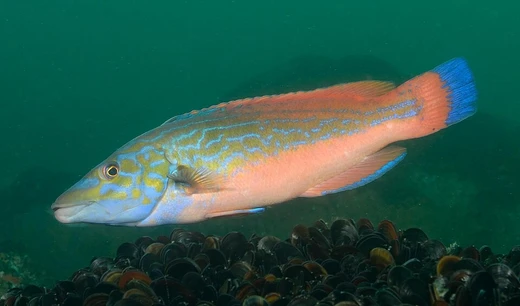
Blue gropers are thick-bodied fish with peg teeth, heavy scales, large tails, and thick lips. Juveniles are brown to green-brown, adult females are brown to greenish-yellow, and each scale may have a darker red spot. Adult males develop the bright blue coloring that ranges from deep navy to cobalt blue, sometimes with darker or yellow-orange spots or lines around the eyes. All blue gropers begin life as females; as they mature, they go through an initial phase where they may be male or female before reaching the terminal phase with adult coloring. Typically only one or two males are found in an area, with a larger number of females. If the dominant male dies, the largest female will grow, change color and sex, and become the dominant male. The fish live in a variety of coastal waters, especially exposed reefs.
Reader's Guide
Blue gropers are significant in Australian coastal ecosystems and culture. In New South Wales, the eastern blue groper was made the state fish emblem in 1998, and the species is protected: it is illegal to spear blue groper, and there is a limitation on fishing for them with a line. The fish are extremely inquisitive and, though it is now discouraged to feed them by cutting up urchins, they still approach divers as if expecting to be fed. The western blue groper has been recorded living up to 70 years, making it the longest-lived wrasse species alongside the foxfish. Both species are very long lived. The genus is represented by two species: Achoerodus gouldii (western blue groper) and Achoerodus viridis (eastern blue groper). A well-known individual named Gus was killed in Australia in 2023.
Did You Know?
- Both species of blue groper are found only in the coastal waters of southern Australia.
- Adult males can range from deep navy to cobalt blue, with possible darker or yellow-orange spots or lines around the eyes.
- All blue gropers begin life as females and may change sex to become dominant males.
Physical Form & Ecological Range
The western blue groper is a strikingly robust member of the wrasse family, distinguished by a single long-based dorsal fin, a broad squarish tail, thick fleshy lips, large heavy scales, and peg-like teeth that give it a formidable appearance. Reaching lengths of up to 175 centimetres and recorded weights of 40 kilograms, it is one of the larger reef fish in its range. This species inhabits coastal waters along the southern Australian coastline, stretching from the Houtman Abrolhos islands in Western Australia eastward to just west of Melbourne. It favours rocky substrates and is encountered at depths spanning from a mere one metre to as deep as 65 metres. Its diet is notably varied, encompassing other fishes, crabs, lobster, a range of molluscs including abalone, and starfish. Perhaps most remarkably, individuals have been documented living up to seventy years, a lifespan that places it among the longest-lived wrasse species on record, sharing that distinction with the foxfish.
Taxonomy & the Gould Connection
The formal scientific description of the western blue groper traces back to 1843, when the naturalist John Richardson published the species account. The type specimen that Richardson examined had been collected and transported to the British Museum (Natural History) by the renowned naturalist John Gould. In recognition of Gould's role in bringing the specimen to the museum's collection, Richardson honoured him by embedding Gould's name into the specific epithet of the species, Achoerodus gouldii. This naming convention reflects the common practice in nineteenth-century taxonomy, where the describer would acknowledge the collector or the person who facilitated access to the material. The species was classified within the wrasse family, a group that encompasses a vast diversity of reef-associated fishes. Richardson's 1843 description remains the foundational taxonomic reference for this species, anchoring its identity in the broader framework of Australian marine ichthyology.
Conservation Status & Regional Protections
The western blue groper holds only minor importance in local commercial fisheries, yet it faces notable pressure from recreational line and spear fishing. In South Australia, the species receives protection within designated areas including Spencer Gulf, St Vincent Gulf, Investigator Strait, and Backstairs Passage. However, conservationists and a number of scientists contend that these spatial closures alone are insufficient, arguing that state-wide protection is necessary to achieve ecologically meaningful outcomes. The situation is particularly alarming in Gulf St Vincent, where many experts consider the species to be functionally extinct, and mature adults are now rare even in Spencer Gulf. Given its status as the top-order territorial bony fish on rocky reefs in South Australia, full protection is regarded by many as a matter of high priority. Outside of these spatial closures, recreational fishers in South Australia and Western Australia are permitted to retain one western blue groper per day. In Victorian waters, the species enjoys full protection with no recreational take allowed.
Ecological Role & Remarkable Longevity
As the top-order territorial bony fish on rocky reefs in South Australia, the western blue groper occupies a critical predatory role in its ecosystem. Its varied diet—spanning other fishes, crabs, lobster, molluscs including abalone, and starfish—places it at the apex of rocky reef food webs across a depth range of one to sixty-five metres. The species' extraordinary longevity, with individuals documented at up to seventy years of age, makes it one of the longest-lived wrasse species on record, sharing that distinction with the foxfish. This extended lifespan means that a single mature groper can represent decades of territorial presence and ecological function within a reef community. The loss of such long-lived, apex individuals through recreational fishing therefore carries disproportionate consequences for reef structure. The fact that mature adults are now rare in parts of their historical range, and that the species is considered functionally extinct in Gulf St Vincent, underscores how vulnerable these long-lived fish are to even moderate levels of harvesting pressure.
Frequently Asked Questions
What is Achoerodus?
Achoerodus is a genus of wrasses native to the coastal waters of southern Australia, collectively known as blue gropers. The common name comes from the vivid blue coloration that adult males display, which is the most eye-catching trait of the group.
How long can a blue groper live?
The western blue groper (Achoerodus gouldii) has been recorded surviving up to 70 years, making it one of the longest-lived wrasses known. This extreme longevity places it on par with the foxfish as the top-aging wrasse species.
What species belong to the Achoerodus genus?
There are exactly two recognized species: the western blue groper (Achoerodus gouldii) and the eastern blue groper (Achoerodus viridis). Both inhabit the southern Australian coastline but occupy slightly different geographic ranges.
Why is the eastern blue groper considered special?
It was officially adopted as the state fish emblem of New South Wales in 1998, giving it a unique cultural status among Australian marine species. This recognition reflects both its striking appearance and its importance to local ecology and fisheries.
Can you legally spear or line-fish a blue groper?
Spearfishing blue gropers is outright illegal, and line fishing for them is subject to strict limitations in New South Wales. These protections exist to safeguard a species that takes decades to reach maturity and reproduce.
More in Wrasses 1-24
Spotted an error? Know more?
Reader corrections go straight into our review queue. Suggest an edit · How this site is sourced