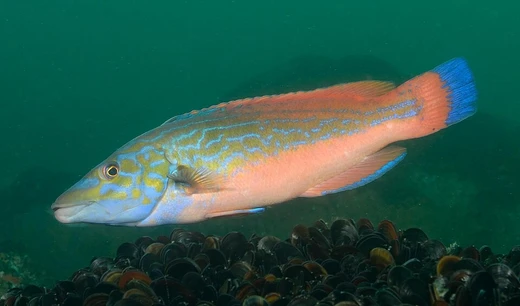
Cheilio
A slender, eel-like wrasse of Indo-Pacific seagrass beds.

The cigar wrasse (Cheilio inermis) is a reef-dwelling fish found across the Indo-Pacific, from Australia and the eastern coast of Africa to India. It has a long, cylindrical, eel-like body—known as anguilliform—with elongated dorsal and anal fins. Adults average about 35 cm in length, though rare individuals can reach 50 cm. Their coloration varies widely, including yellow, brown, white, black, red, and striped patterns. Juveniles share the same colors as adults but tend to have more pronounced stripes. It is unknown whether males and females look different.
This species is poorly studied, with limited research on its life history, distribution, and biology. Cigar wrasses primarily inhabit seagrass beds within shallow reefs, where they find both food and shelter from predators. They are also observed in canopy macroalgae habitats and soft coral reefs near sandy seagrass beds. They feed mainly in summer but remain in the same algae meadows through winter, and both adults and juveniles are abundant in seagrass year-round. Wrasses are generally stationary fish, staying within a home range for life, and cigar wrasses likely do not stray far from the seagrass bed where they hatched.
Courtship behavior has not been documented in cigar wrasses, though many other wrasses perform a ritual where a male swims in circles about 1.8–2.4 meters above the sea floor, with his dorsal and anal fins pressed toward his tail. A receptive female rises and tilts to one side, then the pair swims side by side and release gametes. Juveniles remain in seagrass beds during development, where they are preyed upon by larger fish like the moon wrasse (Thalassoma lunare). Adults use the same beds to hunt. Lifespan is unknown; estimates vary widely, from 9 to 25 years, across wrasse species.
Diet depends on location. In Amitori Bay, cigar wrasses eat gastropods and smaller fishes, while in Nagura Bay they feed mostly on shrimp. Body size ranges from 4.4 cm to 14.8 cm across populations, but all sizes appear in each habitat, so diet differences are not linked to size.
Genetic studies in the western Indian Ocean have examined how the species’ small individual range affects its broad distribution. Researchers extracted nuclear and mitochondrial DNA from cigar wrasses across the Indo-Pacific and found that those off Tanga, Tanzania, are genetically distinct.
Quick Facts
- Taxon
- Cheilio inermis
Facts from the source article.
Lore & Background
The cigar wrasse has a long, cylindrical body and elongated dorsal and anal fins. Its coloration varies widely, including yellow, brown, white, black, red, and stripes of all colors. Juvenile cigar wrasses have the same coloration as adults but tend to have more pronounced stripes. It is unknown whether there is a difference in appearance between females and males. The species is primarily observed in reef habitats, especially seagrass beds, which provide protection from predators and nutrition. They are relatively stationary fish, remaining within a home range for their entire lives, often not straying far from the seagrass bed where they hatched. Their diet depends heavily on location; in Amitori Bay they feed on gastropods and smaller fishes, while in Nagura Bay their diet consists mostly of shrimp. Body size does not appear to influence diet.
Reader's Guide
The cigar wrasse is significant as a poorly understood species within the family Labridae. Its conservation status is understudied, limiting current conservation efforts. The IUCN lists it as Least Concern, though its population trend is unknown. Reports of cigar wrasse appearing as by-catch in mosquito nets off the eastern coast of Africa suggest a potential threat, and its IUCN listing could change within the decade. The species is rarely kept in aquariums due to its adult size and diet. Within the western Indian Ocean, genetic studies have revealed that cigar wrasse in Tanga, Tanzania, differ genetically from the rest of the species, possibly due to oceanic currents or habitat fragmentation by rivers. These differences are not enough to separate the species, but may indicate multiple subspecies. The species' stationary behavior makes it easy to collect in large numbers, posing a threat similar to that faced by other wrasses used in salmon fisheries, though it is unknown whether cigar wrasse themselves are used for this purpose.
Did You Know?
- Cigar wrasse have a long, cylindrical, eel-like body shape called anguilliform.
- Juvenile cigar wrasses are preyed upon by the moon wrasse, Thalassoma lunare.
- Cigar wrasse in Tanga, Tanzania, are genetically distinct from other populations.
- The species is very understudied, with only a few papers documenting its life history.
Frequently Asked Questions
Who is Cheilio?
Cheilio inermis, commonly called the cigar wrasse, is a slender, eel-like reef fish native to Indo-Pacific seagrass beds. It belongs to the wrasse family but stands apart from its relatives with its long cylindrical body and elongated dorsal and anal fins.
What does Cheilio look like?
Adults display a wide range of coloration—yellow, brown, white, black, red, or various striped patterns—while juveniles tend to show bolder striping. Its body is long and cylindrical with extended dorsal and anal fins, giving it an almost snake-like silhouette on the reef.
How big does Cheilio get?
Most adults measure around 35 cm (about 14 inches), though exceptionally rare individuals have been recorded at 50 cm (20 inches).
Where does Cheilio live?
This species inhabits shallow seagrass beds within reef systems across the Indo-Pacific, ranging from eastern Africa and India to Australian waters. It is a relatively sedentary reef-dweller rather than an open-water swimmer.
Is Cheilio endangered?
The IUCN currently lists Cheilio inermis as Least Concern, indicating its populations appear stable across its range. However, it remains one of the less thoroughly studied wrasse species, so long-term population trends are not yet fully mapped.
More in Wrasses 1-24
Spotted an error? Know more?
Reader corrections go straight into our review queue. Suggest an edit · How this site is sourced