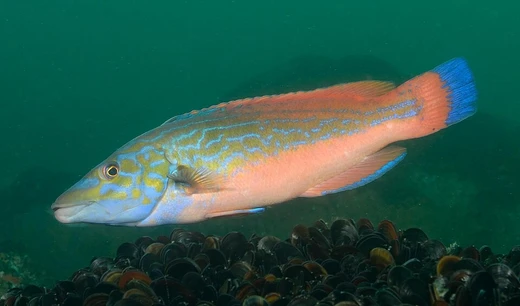
Cheilininae
Cheiline wrasses are protogynous reef fish related to parrotfish.

Cheilininae, commonly known as cheiline wrasses or flasherwrasses, is a subfamily of saltwater fish within the wrasse family (Labridae). They are distributed throughout the Pacific and Indian Oceans, as well as the Red Sea. This group is notable for its complex reproductive biology, which includes monandric protogyny, diandric protogyny, and functional gonochorism.
Quick Facts
- Taxon
- Cheilininae
Facts from the source article.
Lore & Background
Cheiline wrasses were formerly classified as a tribe but are now better treated as a subfamily. Phylogenetic studies regularly find that they are most closely related to parrotfish (subfamily Scarinae), with cheilines and scarines being sister groups. The relationship of the genus Doratonotus with Cheilininae is uncertain; initially considered the basalmost cheiline genus based on morphological analyses by Westneat (1993), later work by Westneat & Alfaro (2005) showed that pseudocheilines and cheilines were not each other's closest relatives, and Doratonotus is now placed in Pseudolabrinae.
Although the four recognized genera in Cheilininae form a monophyletic clade, the genus Cheilinus appeared to be paraphyletic. This was resolved in a 2025 study that validated the genera Crassilabrus and Concholabrus. This treatment is accepted by the World Register of Marine Species but not by Eschmeyer's Catalog of Fishes. The pseudocheiline wrasses eventually formed the subfamily Cirrhilabrinae, originally proposed as a tribe in 1999, but are still sometimes informally referred to as pseudocheilines.
Reader's Guide
The significance of Cheilininae lies in its reproductive diversity and taxonomic history. The subfamily exhibits multiple sexual systems: monandric protogyny (all born female, some change to male), diandric protogyny (born either sex, females can change to male), and functional gonochorism (no sex change). This variation is notable among wrasses. Taxonomically, the group has undergone reclassification from a tribe to a subfamily, and its relationship with related groups has been revised through phylogenetic studies. The 2025 study resolving paraphyly in Cheilinus by validating Crassilabrus and Concholabrus represents a recent taxonomic development, though acceptance is not universal. The uncertain placement of Doratonotus and the separation of pseudocheilines into Cirrhilabrinae further illustrate the ongoing refinement of wrasse classification. The subfamily's close relationship with parrotfish (Scarinae) is consistently supported by phylogenetic analyses.
Did You Know?
- Cheiline wrasses exhibit monandric protogyny, diandric protogyny, and functional gonochorism.
- The genus Doratonotus was once considered the basalmost cheiline but is now placed in Pseudolabrinae.
- A 2025 study validated the genera Crassilabrus and Concholabrus to resolve paraphyly in Cheilinus.
Frequently Asked Questions
What is Cheilininae?
Cheilininae is a subfamily of saltwater wrasses (family Labridae) that fans usually call cheiline wrasses or flasher wrasses. It is a small, distinct group within the broader wrasse lineage, set apart by its unusual sex-change biology.
Where do cheiline wrasses live in the wild?
You'll find them across the Pacific and Indian Oceans, including the Red Sea. They are absent from the Atlantic, so their range is essentially the warm tropical waters of the Indo-Pacific basin.
What makes Cheilininae's reproduction so special?
Rather than following one uniform sex-change pathway, the subfamily displays three different modes: monandric protogyny, diandric protogyny, and functional gonochorism. Packing that much reproductive variety into a single subfamily is rare and a big reason ichthyologists keep studying the group.
How are cheiline wrasses related to parrotfish?
Cheilininae is the sister group to the parrotfish subfamily Scarinae, so the two share a more recent common ancestor than either does with other wrasse lineages. Despite that close kinship, cheiline wrasses are protogynous reef fish rather than the heavy herbivorous grazers parrotfish are known for.
How many genera does Cheilininae include, and how is it classified?
The subfamily contains four recognized genera. It was formerly treated at the tribal level but has since been elevated to full subfamily rank within Labridae.
More in Wrasses 1-24
Spotted an error? Know more?
Reader corrections go straight into our review queue. Suggest an edit · How this site is sourced