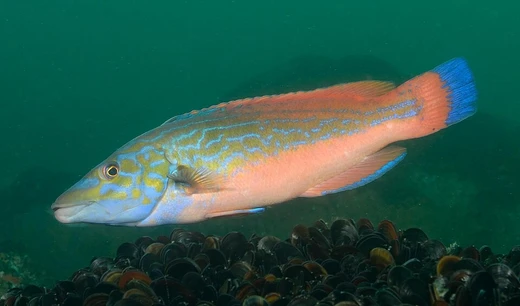
Cigar wrasse
A little-known, eel-like wrasse of Indo-Pacific seagrass beds.

The cigar wrasse (*Cheilio inermis*) is a fish from the Indo-Pacific with a long, cylindrical, eel-like body and extended dorsal and anal fins. It is poorly studied, with little published research on its biology, distribution, or life history.
Adults average about 35 cm long, though some reach 50 cm. Young fish are often mottled brown or green, sometimes with a broad stripe along the side; a few are solid yellow. Large males may develop a bright patch of yellow, orange, black, white, or multiple colors on their side behind the pectoral fin. Because of their size and diet, they are rarely kept in aquariums.
The species lives mainly in seagrass beds on shallow reefs, and also in canopy macroalgae. It feeds mostly in summer but stays in the same algae meadows through winter. Both adults and juveniles are common in seagrass year-round, and are also found in soft coral reefs near sandy seagrass beds. Seagrass provides both shelter and food, and the fish rarely leave the bed where they hatched. They are often seen close to shore in large groups.
Courtship has not been observed in cigar wrasses, though many other wrasses court by having a male swim in circles 1.8–2.4 m above the seafloor with his dorsal and anal fins pressed toward the tail. A receptive female rises and tilts to one side; the pair swim together, release gametes, and separate. Nothing is known about cigar wrasse courtship or whether it differs.
Juveniles stay in seagrass for most of their development. They are preyed on by moon wrasses (*Thalassoma lunare*), which can eat them in a single strike. Adults hunt in the same beds. Lifespan is unknown; other wrasses live from 9 to 25 years, and the few available estimates for cigar wrasses vary widely.
Diet depends on location. In Amitori Bay, they eat gastropods and small fish; in Nagura Bay, mostly shrimp. Body size ranges from 4.4 to 14.8 cm across the Indo-Pacific, but all sizes occur in each habitat, so diet differences are not linked to size.
Genetic studies in the western Indian Ocean show that cigar wrasses stay in isolated seagrass populations, yet the species has a huge range. Analysis of nuclear and mitochondrial DNA from fish across the Indo-Pacific found that those off Tanga, Tanzania, are genetically distinct.
Quick Facts
- Taxon
- Cheilio inermis
Facts from the source article.
Lore & Background
The cigar wrasse has a long, cylindrical body and elongated dorsal and anal fins. Its coloration varies widely, including yellow, brown, white, black, red, and stripes of all colors. Juvenile cigar wrasses have the same coloration as adults but tend to have more pronounced stripes. It is unknown whether there is a difference in appearance between females and males. The species is primarily observed in reef habitats, often off the coast of Australia, the eastern seaboard of Africa, and India. They are usually about 10 cm in length, with rare reports of individuals reaching 50 cm.
Cigar wrasses live primarily in seagrass within shallow reefs and have been observed in abundance feeding in canopy macroalgae habitats. They feed mainly during summer but remain in the same algae meadows during winter. Both adults and juveniles are found in seagrass beds during all seasons. They have a special affinity for seagrass, which provides protection from predators and nutrition. They are relatively stationary fish and remain within a home range for their entire lives, often not straying far from the seagrass bed where they hatched.
Courtship behavior has not been observed in cigar wrasses, though many other wrasses engage in a specific mating ritual. Juvenile cigar wrasses remain in seagrass beds for most of their development and are at risk of predation from larger fishes, such as the moon wrasse. Their diet depends heavily on location; in Amitori Bay they feed on gastropods and smaller fishes, while in Nagura Bay their diet consists mostly of shrimp. Body size does not appear to influence diet.
Reader's Guide
The cigar wrasse is significant primarily as an understudied species whose biology and ecology remain largely unknown. Its conservation status is listed as Least Concern by the IUCN, but its population trend is unknown. The species appears as by-catch in mosquito nets off the eastern coast of Africa, where its stationary behavior leads to large quantities being caught. The effect of this by-catch on conservation status is currently unknown, but it is possible the IUCN listing could change within the decade.
Genetically, cigar wrasses across the Indo-Pacific do not differ enough to constitute separate species, though populations off Tanga, Tanzania show genetic differences. Researchers theorize this may be due to oceanic currents or habitat fragmentation by rivers. The species' small individual range contrasts with its large species range, making it interesting for studies of genetic dispersion.
While many wrasse species are used as cleaner fish in salmon fisheries, it is unknown whether cigar wrasses display this behavior. The stationary behavior of wrasses makes them easy to collect in large numbers for fisheries, posing a potential threat. The cigar wrasse's legacy is one of a poorly understood but potentially vulnerable species, with many aspects of its life history, lifespan, and behavior still unknown.
Did You Know?
- Cigar wrasses have a long, cylindrical, eel-like body shape called anguilliform.
- Juvenile cigar wrasses are preyed upon by the moon wrasse, Thalassoma lunare.
- Cigar wrasses in Amitori Bay feed on gastropods and smaller fishes, while those in Nagura Bay eat mostly shrimp.
- Cigar wrasses off the coast of Tanga, Tanzania, differ genetically from the rest of the species.
Physical Form and Chromatic Variation
The cigar wrasse (Cheilio inermis) presents a strikingly elongated, cylindrical silhouette that researchers describe as anguilliform, giving the fish an eel-like profile unlike most reef-dwelling species. Elongated dorsal and anal fins run along its back and belly, further emphasizing this streamlined shape. While the species averages around 35 centimeters in length, rare individuals have been recorded reaching 50 centimeters, and population-level measurements across the Indo-Pacific span from roughly 4.4 to 14.8 centimeters. Coloration is remarkably variable: adults may display yellow, brown, white, black, red, or combinations of stripes in every hue. Young cigar wrasses typically appear mottled brown or green, sometimes bearing a broad lateral stripe, and a few rare juveniles are uniformly yellow. Their striping tends to be more pronounced than in adults. Large males occasionally develop a vivid patch of yellow, orange, black, white, or multicolored markings just behind the pectoral fins. Whether males and females differ visually remains unresolved. Because of their eventual size and specific dietary needs, cigar wrasses are seldom maintained in home aquariums.
Seagrass Affinity and Geographic Range
Native to the Indian and Pacific Oceans, the cigar wrasse is regularly encountered along Australia's coastline, the eastern seaboard of Africa, and the waters around India. Despite this broad geographic spread, the species shows a remarkable and consistent attachment to seagrass beds within shallow reef environments. Seagrass serves as both shelter from predators and a source of nutrition, and both adults and juveniles are found in abundance within these beds throughout every season. The fish also frequent canopy macroalgae habitats and soft coral reefs that border sandy seagrass patches, and they are often seen in large groups along the perimeter of their preferred habitat, feeding and taking cover. Cigar wrasses are relatively sedentary; they establish a home range early and rarely venture far from the seagrass bed where they hatched. While they feed most actively during the summer months, they remain in the same algae meadows through the winter. Their shallow-water preference means they are typically observed close to shore, and their stationarity makes them particularly vulnerable to fine-mesh netting used by local fishers.
Location-Dependent Foraging
One of the most notable aspects of cigar wrasse biology is how strongly diet appears tied to geography rather than to the fish's size. In Amitori Bay, observations show individuals consuming gastropods and smaller fish, whereas in Nagura Bay the same species relies predominantly on shrimp. Because population body sizes vary across the Indo-Pacific—ranging from about 4.4 to 14.8 centimeters—and all size classes are present in each habitat, researchers have concluded that dietary differences are not simply a function of how large a given fish is. Foraging activity peaks during the summer, yet the fish do not relocate; they remain in the same algae meadows and seagrass beds through the cooler months. Juveniles face a specific predation threat from the moon wrasse (Thalassoma lunare), which has been documented striking and consuming young cigar wrasses in a single attack. As adults, cigar wrasses return to those same seagrass beds to hunt, suggesting a lifelong spatial loyalty to the foraging grounds where they developed. The combination of a specialized, location-dependent diet and their large adult size makes them impractical for the aquarium trade.
Genetic Structure and Evolutionary Questions
Because cigar wrasses are largely sedentary and confined to isolated seagrass patches, their presence across the vast Indo-Pacific raises an interesting evolutionary puzzle: how does a species with such limited individual movement maintain genetic connectivity over such a wide range? Researchers in the western Indian Ocean turned to molecular taxonomy, extracting both nuclear and mitochondrial DNA from specimens collected across the region. The analysis revealed that populations off the coast of Tanga, Tanzania, carry genetic signatures distinct from the rest of the species. Two explanations have been proposed. The first involves oceanic currents transporting individuals away from their home ranges. The second suggests that where reef systems form continuous shallow corridors, fish can disperse freely, but where rivers fragment the coastline, populations become isolated. Although the genetic divergence is not sufficient to split the species into separate taxa, researchers suspect that multiple cryptic sub-species may exist within the current classification. Overall, the cigar wrasse remains one of the least-studied wrasses, with only a handful of papers addressing its biology, and its IUCN status of Least Concern reflects more a gap in knowledge than confirmed security.
Frequently Asked Questions
What is a Cigar wrasse?
The Cigar wrasse (Cheilio inermis) is an eel-like wrasse species from the Indo-Pacific, easily recognized by its long, cylindrical body and its greatly extended dorsal and anal fins. It lives in seagrass beds around shallow reefs and remains one of the least-studied wrasse species.
How big does a Cigar wrasse get?
Most adults top out around 35 cm (roughly 14 inches), but some individuals can grow to about 50 cm (20 inches). That makes it noticeably larger than many other wrasse species in the same region.
What does a Cigar wrasse look like?
Juveniles are usually mottled brown or green, occasionally with a broad stripe along the flank, and a few are solid yellow. As large males mature, they can develop a bold patch of yellow, orange, black, white, or mixed colors on their side just behind the pectoral fin.
Where is the Cigar wrasse found?
Its range covers the Indo-Pacific Ocean, and it favors seagrass habitats within shallow reef zones. The IUCN currently lists the species as Least Concern.
Can I keep a Cigar wrasse in a home aquarium?
It is rarely kept in captivity because of its large size and specific dietary requirements. On top of that, there is very little published information on its biology or life history, so even experienced aquarists have little guidance for long-term care.
More in Wrasses 1-24
Spotted an error? Know more?
Reader corrections go straight into our review queue. Suggest an edit · How this site is sourced