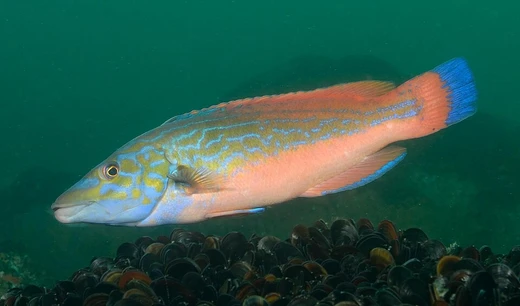
Chiseltooth wrasse
A solitary wrasse with blue teeth and cleaner-fish mimicry.

The chiseltooth wrasse (Pseudodax moluccanus) is a species of marine ray-finned fish in the family Labridae, native to the Indian Ocean and the western Pacific Ocean. It is the only known member of its genus, Pseudodax, and is notable for its resemblance to cleaner wrasses of the genus Labroides, as well as for its behavior as a cleaner fish in juvenile stages.
Quick Facts
- Taxon
- Pseudodax moluccanus
Facts from the source article.
Lore & Background
The chiseltooth wrasse has a wide Indo-Pacific distribution, from the western Indian Ocean including the Red Sea south to South Africa, eastward to the Tuamotus, north to Japan, and south to Lord Howe Island, Australia. It inhabits clear channels and seaward edges of coral reefs at depths from 3 to 60 meters, though it is rarely found deeper than 40 meters. Juveniles are frequently recorded along drop-offs at depths lower than 18 meters, while adults occur near caves and juveniles often live within them.
The species is greyish to reddish-brown in background color, with a dark streak or spot on each scale. It has a yellow upper lip with a blue streak above it, and blue teeth. The caudal fin is black with a blue margin. Juveniles are pale blue with a wide stripe along the flanks, and subadults show a yellow band at the base of the tail. Juveniles bear a strong resemblance to cleaner wrasses of the genus Labroides and also behave as cleaner fish. Adults are solitary and feed on algae and small invertebrates. The species is regarded as closely related to parrotfishes (family Scaridae) due to its tooth pattern, but in behavior it is more like a species in the genus Anampses.
Reader's Guide
The chiseltooth wrasse is of minor importance to local commercial fisheries and is also found in the aquarium trade. Its significance lies in its unique position as the sole member of the genus Pseudodax, and in its dual resemblance and behavioral mimicry of cleaner wrasses during juvenile stages. This mimicry may provide protection or feeding advantages, as cleaner wrasses are often tolerated by other fish. The species also bridges morphological traits of parrotfishes and behavioral traits of the genus Anampses, offering insight into evolutionary relationships within the Labridae family. Its presence across a broad Indo-Pacific range, from the Red Sea to the Tuamotus and from Japan to Lord Howe Island, underscores its adaptability to various reef environments. The chiseltooth wrasse's blue teeth and distinctive coloration make it a recognizable species among reef fish, and its solitary adult lifestyle contrasts with the cleaner behavior of its juveniles, highlighting a life-stage shift in ecology.
A Study in Muted Color and Structural Detail
The chiseltooth wrasse presents a deceptively understated palette for a reef fish. Its body carries a greyish to reddish-brown base tone, over which every individual scale bears a dark streak or small spot, giving the flanks a finely textured, almost stippled appearance. The face introduces the most vivid accents: a bright yellow upper lip underscored by a thin blue streak running just above it, and a set of teeth that are themselves blue. The tail fin is a bold black plate edged with a blue margin, creating a sharp contrast against the more subdued body. Fin structure follows a precise formula—eleven spines paired with twelve soft rays in the dorsal fin, and three spines alongside fourteen soft rays in the anal fin. The species reaches a maximum total length of thirty centimetres, roughly twelve inches, placing it in the medium range for reef-dwelling wrasses. Together, these features produce a fish that is simultaneously patterned and plain, striking in close-up yet easy to overlook at a distance in the reef's visual noise.
Two Lives: Cleaner Youth and Solitary Adulthood
One of the most remarkable aspects of the chiseltooth wrasse's biology is the dramatic shift between its juvenile and adult phases. Young fish are pale blue with a broad stripe running along their flanks, and they bear a strong visual resemblance to the well-known cleaner wrasses of the genus Labroides. More than just looking the part, these juveniles actively behave as cleaner fish, tending to other reef residents in the manner typical of that ecological niche. They are frequently encountered along steep drop-offs at depths below eighteen metres, and they often take up residence inside caves. As they mature, the fish undergo a complete behavioral and social transformation. Adults turn solitary, foraging on algae and small invertebrates rather than providing cleaning services. They are typically found in the vicinity of caves rather than within them, and their coloration shifts to the greyish-brown adult pattern, with subadults briefly displaying a yellow band at the tail base. This dual life strategy—mimicry and service in youth, independent foraging in adulthood—sets the species apart within the wrasse family.
A Vast Indo-Pacific Range on Reef Margins
The chiseltooth wrasse enjoys one of the broadest distributions among reef-associated wrasses, spanning the entire western Indian Ocean and the western Pacific. Its range stretches from the Red Sea in the north, southward along the African coast to South Africa, and eastward across the Indian Ocean to the Tuamotu archipelago. In the Pacific, it is recorded as far north as Japan and as far south as Lord Howe Island off eastern Australia. Within this enormous area, the species is tied to coral reef environments, favoring clear channels and the seaward, exposed edges of reefs where water movement is strong. It occupies a depth band from three to sixty metres, though sightings below forty metres are uncommon. Despite its wide geographic presence, the chiseltooth wrasse plays only a minor role in local commercial fisheries. It does, however, appear in the aquarium trade, where its distinctive coloration and moderate size make it an occasional subject for advanced reef aquarists.
A Genus of One and an Evolutionary Puzzle
Taxonomically, the chiseltooth wrasse occupies a singular position. Pseudodax moluccanus is the only described species within its genus, making it a monotypic lineage in the family Labridae. This isolation in the taxonomic tree raises questions about its evolutionary relationships, and the evidence points in somewhat contradictory directions. Morphologically, its dental arrangement—the specific pattern of teeth in its mouth—suggests a close affinity with the parrotfishes of the family Scaridae, a group otherwise distinct from typical wrasses. Yet behaviorally, the species aligns more closely with members of the genus Anampses, another labrid group known for its own unique ecological strategies. This split between structural and behavioral signals of relatedness makes the chiseltooth wrasse a useful case study in how different traits can trace different evolutionary paths. As the sole representative of Pseudodax, it carries the full weight of its genus's identity, and any future discovery of a close relative would immediately reshape its taxonomic context.
Frequently Asked Questions
What is the Chiseltooth wrasse?
The Chiseltooth wrasse (Pseudodax moluccanus) is a marine ray-finned fish in the wrasse family Labridae, native to the Indian Ocean and western Pacific. It is the sole known species in the genus Pseudodax and is recognized for its striking blue teeth and its juvenile habit of imitating cleaner wrasses.
What makes the Chiseltooth wrasse unique among Labridae?
It is the only member of its genus, and it stands out for combining a solitary adult lifestyle with a juvenile phase in which it mimics the cleaning behavior of Labroides cleaner wrasses to attract clients. This mimicry, paired with its distinctive blue dentition, sets it apart from other wrasses.
Where does the Chiseltooth wrasse live and at what depths?
This species ranges across the Indian Ocean and the western Pacific, typically occupying depths between roughly 3 and 60 meters. It is rarely encountered below about 40 meters, favoring shallower reef and rocky habitats within that band.
How large does a Chiseltooth wrasse grow and what are its fin characteristics?
It reaches a maximum total length of about 30 centimeters (12 inches). Its dorsal fin carries 11 spines followed by 12 soft rays, while the anal fin has 3 spines and 14 soft rays.
What ecological role does the Chiseltooth wrasse play?
During its juvenile stage it functions as a cleaner fish, using its resemblance to true cleaner wrasses to draw in potential clients. As an adult it shifts to a solitary existence and no longer maintains a cleaning station, making its early-life cleaning behavior a short but notable phase in its life history.
More in Wrasses 1-24
Spotted an error? Know more?
Reader corrections go straight into our review queue. Suggest an edit · How this site is sourced