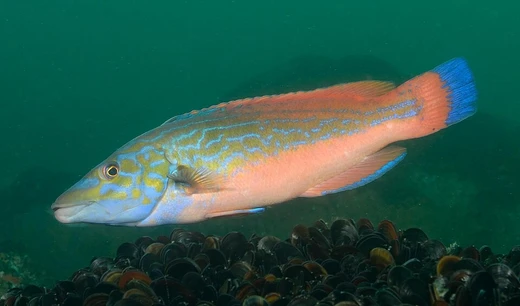
Cunner
A northwestern Atlantic wrasse known for color change and winter torpor.

The cunner (Tautogolabrus adspersus), also known as the blue perch, bergall, chogset, choggie, conner or sea perch, is a species of wrasse native to the northwestern Atlantic. It is found from the Gulf of St. Lawrence and Newfoundland to the Chesapeake Bay, inhabiting inshore waters near the sea floor at depths from 10 to 128 m. It is notable as the only known member of its genus.
Quick Facts
- Taxon
- Tautogolabrus adspersus
Facts from the source article.
Lore & Background
Cunner spend the winter months in a state of torpor underneath rocks. They can enter a hypometabolic state in response to cold temperatures and hypoxic conditions. In Newfoundland, Canada, cunner have been recorded entering a dormant state in Autumn, when temperatures fall below 5°C, and remaining dormant until May/June. They inhabit inshore waters, preferring areas with beds of seaweed, shipwrecks, or wharf pilings. Often, cunner is found mixed in with tautogs, living on or near the same structures. Much of the food eaten by those bergall living among blackfish are the leftovers from the blackfishes prey. They can be distinguished from the tautog by their pointed snouts. Cunners are generally smaller, so are usually thrown back by anglers who think they caught a 'short' tautog. They can be confused with black sea bass, rockfish and other grouper, as well as tautog, for their ability to change color.
Reader's Guide
The cunner has a mixed legacy in the northwestern Atlantic. In past years, they were important commercial fish, but now are considered pests by many anglers. Their small size relative to tautog leads to them being discarded as 'short' tautog. They are also found in the aquarium trade. A notable event occurred on May 26, 2019, when the NJDEP Division of Fish and Wildlife certified a new state record saltwater fish for cunner, weighing 3 pounds, 8.8 ounces, eclipsing the previous state record by 6.4 ounces. The fish measured 18.5 inches in length and had a girth of 13 inches. As the only known member of its genus, Tautogolabrus adspersus holds taxonomic significance. Its ability to change color can cause confusion with black sea bass, rockfish, other grouper, and tautog. Its winter torpor and hypometabolic state in response to cold and hypoxia are notable physiological adaptations.
Did You Know?
- In Newfoundland, cunner enter a dormant state in Autumn when temperatures fall below 5°C and remain dormant until May/June.
- Cunner can be distinguished from tautog by their pointed snouts.
- Tautogolabrus adspersus is currently the only known member of its genus.
Frequently Asked Questions
What is a Cunner?
The Cunner (Tautogolabrus adspersus) is a northwestern Atlantic wrasse that goes by a wide variety of local names, including blue perch, bergall, chogset, and sea perch. It is a bottom-dwelling fish that lives in the inshore waters along the northeastern coast of North America.
Where can you find a Cunner in the wild?
This species ranges from the Gulf of St. Lawrence and Newfoundland southward all the way to the Chesapeake Bay. It typically holds near the sea floor in inshore waters at depths spanning roughly 10 to 128 meters (about 33 to 420 feet).
What makes the Cunner unique among other wrasses?
The Cunner stands out as the sole known species in its genus, meaning it has no close relatives at all within Tautogolabrus. This monotypic status sets it apart from most other wrasse lineages, which usually contain multiple species.
What are the Cunner's most notable behaviors?
This wrasse is well recognized for its ability to shift color and for entering a winter torpor, a dormancy-like state that helps it endure the cold months. These two traits make it a particularly interesting subject for anyone studying Atlantic bottom-dwellers.
What is the state record catch for a Cunner?
The officially certified state record is a fish weighing 3 pounds and 8.8 ounces, measuring 18.5 inches in length with a 13-inch girth. That record was certified on May 26, 2019.
More in Wrasses 1-24
Spotted an error? Know more?
Reader corrections go straight into our review queue. Suggest an edit · How this site is sourced