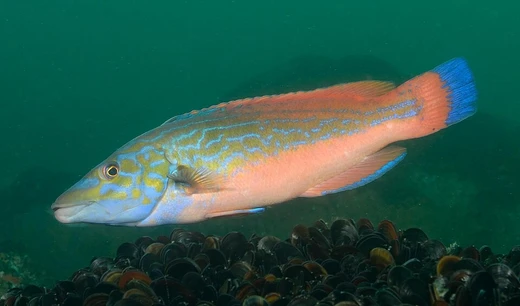
Cirrhilabrus wakanda
A fairy wrasse named after Marvel's Wakanda, with purple chain-link scales.

Cirrhilabrus wakanda, called the vibranium fairy wrasse, lives on deep reefs 50–100 meters down in the western Indian Ocean near Tanzania and Mozambique. Scientists from the California Academy of Sciences first collected it off Zanzibar, Tanzania. Its distinction from the very similar *C. rubrisquamis* of the Chagos Islands still needs confirmation.
The species gets its name from the fictional Marvel nation Wakanda.
Based on a few measured specimens, *C. wakanda* reaches about 7 cm in standard length. Its body is moderately long and flattened. Males have yellow heads with purple and blue bodies; females and juveniles look much the same. Both sexes show two prominent facial stripes above and below the eye, and both have purple scales and elements that stain purple. A purple chain-link pattern on the scales resembles the suit worn by Black Panther.
Compared to close relatives, *C. wakanda*’s mitochondrial DNA differs from *C. rubrisquamis* by 0.6%, from *C. blatteus* by 1.9%, and from *C. sanguineus* by 1.5%. Small genetic differences among related fairy wrasses are normal. A later review found that the *C. rubrisquamis* used for comparison actually belonged to a separate species, *C. finifenmaa*, described in 2022. So a direct comparison with true *C. rubrisquamis* is missing, but the two look very similar, and *C. wakanda* may be a junior synonym of *C. rubrisquamis*.
Quick Facts
- Taxon
- Cirrhilabrus wakanda
Facts from the source article.
Lore & Background
The species was first collected off the coast of Zanzibar, Tanzania by scientists from the California Academy of Sciences. Its separation from the very similar Cirrhilabrus rubrisquamis of the Chagos Islands needs confirmation. The species is named after the fictional sovereign state Wakanda from Marvel Comics and the Marvel Cinematic Universe.
Based on a small number of measured specimens, Cirrhilabrus wakanda reaches up to about 7 cm in standard length. The body is moderately elongated and compressed. Males have yellow heads with purple and blue bodies; females and juveniles are very similar. Both sexes have a pair of prominent facial stripes above and below the orbit, and both have notable purple scales and elements that persist and stain purple. A purple chain-link scale pattern is present, resembling the suit worn by the fictional superhero Black Panther.
In comparison with other closely related species, the mitochondrial DNA of Cirrhilabrus wakanda differs from C. rubrisquamis by 0.6%, from C. blatteus by 1.9%, and from C. sanguineus by 1.5%. Small genetic differences between closely related fairy wrasses are not unusual. A later review found that the 'C. rubrisquamis' used for comparison were from the population found to be a separate species, C. finifenmaa, in 2022. Consequently, a detailed, direct comparison with true C. rubrisquamis is lacking, but their appearance is very similar and it is possible that C. wakanda is a junior synonym of C. rubrisquamis.
Reader's Guide
Cirrhilabrus wakanda holds significance primarily for its striking coloration and pop-culture naming. Its purple chain-link scale pattern directly evokes the suit of Black Panther, making it one of the few fish species named after a fictional nation. The species was collected by scientists from the California Academy of Sciences off Zanzibar, Tanzania, from mesophotic reefs at depths of 50–100 meters. Its discovery highlights the biodiversity of deep reefs in the western Indian Ocean. However, its taxonomic status remains uncertain: the article notes that its separation from the very similar Cirrhilabrus rubrisquamis needs confirmation, and that a later review found that the comparative specimens originally thought to be C. rubrisquamis were actually a different species, C. finifenmaa. As a result, a direct comparison with true C. rubrisquamis is lacking, and it is possible that C. wakanda is a junior synonym of C. rubrisquamis. This unresolved relationship underscores the challenges of distinguishing fairy wrasses based on small genetic differences and limited specimens. The species' legacy is thus tied both to its cultural resonance and to ongoing taxonomic debate.
Did You Know?
- Its purple chain-link scale pattern resembles the suit worn by the fictional superhero Black Panther.
- It is possible that Cirrhilabrus wakanda is a junior synonym of Cirrhilabrus rubrisquamis.
Discovery & Geographic Range
The vibranium fairy wrasse was first brought to scientific attention when researchers affiliated with the California Academy of Sciences collected specimens from the waters off Zanzibar, Tanzania. This initial discovery placed the species firmly within the western Indian Ocean, where it inhabits mesophotic reef environments at depths ranging from roughly 50 to 100 meters, well below the photic zone where most reef-dwelling fish are typically encountered. Its known range extends along the coasts of both Tanzania and Mozambique, suggesting a distribution that spans this stretch of the western Indian Ocean basin. However, the species' taxonomic standing remains somewhat tentative. It was originally described as distinct from the closely related C. rubrisquamis, a fairy wrasse associated with the Chagos Islands, yet the original authors themselves noted that a full confirmation of this separation still requires further verification. This caveat underscores how little is known about population-level variation among these deep-water wrasse species and how easily a single collection event can leave fundamental questions unresolved.
Morphology & Coloration
Based on measurements from a limited number of specimens, Cirrhilabrus wakanda reaches a maximum standard length of approximately seven centimeters. The body plan is moderately elongated and laterally compressed, a shape common among wrasses that navigate complex reef structures. In mature males, the head displays a striking yellow hue while the remainder of the body shifts into rich purple and blue tones. Females and juveniles present a very similar coloration, making sex determination from appearance alone challenging. Both sexes share a pair of bold facial stripes positioned above and below the eye, adding to their distinctive profile. Perhaps the most remarkable feature is the arrangement of purple scales across the body: these elements persist and even stain purple, forming a chain-link pattern that has drawn comparisons to the textured suit worn by the fictional superhero Black Panther. This consistent purple scaling, combined with the facial striping, gives the fish a visually cohesive and memorable appearance that sets it apart from many other small reef wrasses.
Etymology & Pop Culture Connection
The species epithet wakanda is a direct nod to the fictional sovereign nation of Wakanda, a cornerstone setting in Marvel Comics and the Marvel Cinematic Universe. This naming choice is not arbitrary; it is intimately tied to the fish's physical appearance. The purple chain-link scale pattern that covers the body of Cirrhilabrus wakanda closely resembles the textured, interlocking design of the suit worn by the superhero Black Panther, the fictional ruler of Wakanda. By linking a real deep-water fish to a globally recognized pop-culture icon, the taxonomists created an immediately memorable and accessible name that bridges the gap between marine biology and mainstream entertainment. For a species known from only a handful of specimens collected at depths beyond 50 meters, such a vivid and widely recognized reference point helps the fish stand out in the public imagination. The name effectively transforms an obscure mesophotic wrasse into a character that audiences can instantly visualize, lending the species a cultural identity that few deep-sea fish ever achieve.
Genetic Relationships & Taxonomic Uncertainty
Molecular comparisons reveal that Cirrhilabrus wakanda sits very close to several congeners in mitochondrial DNA. The genetic distance to C. rubrisquamis is only 0.6%, to C. sanguineus it is 1.5%, and to C. blatteus it reaches 1.9%. Among closely related fairy wrasses, such modest divergences are considered unremarkable and do not, by themselves, guarantee species-level separation. Complicating matters further, a subsequent taxonomic review determined that the specimens originally identified as C. rubrisquamis in the comparative analysis actually belonged to a different species, C. finifenmaa, which was formally recognized in 2022. This means that a true, direct genetic comparison between C. wakanda and genuine C. rubrisquamis has never been completed. Given that the two species look extremely similar in appearance, taxonomists have raised the possibility that C. wakanda may ultimately prove to be a junior synonym of C. rubrisquamis, meaning the name would be absorbed and the species would cease to exist as a separate entity. Until a proper comparison is made, the taxonomic status of the vibranium fairy wrasse remains in a state of provisional uncertainty.
Frequently Asked Questions
What is Cirrhilabrus wakanda?
It is a small fairy wrasse from the western Indian Ocean, popularly nicknamed the "vibranium fairy wrasse" because of its distinctive purple chain-link scale pattern. The species was first recognized by researchers at the California Academy of Sciences from specimens gathered near Zanzibar.
Where does Cirrhilabrus wakanda live and how deep is it found?
This wrasse occupies deep-reef habitats roughly 50 to 100 meters (about 160–330 feet) below the surface. Its known range runs along the coasts of Tanzania and Mozambique in the western Indian Ocean.
How big does Cirrhilabrus wakanda get?
From the limited number of specimens measured to date, adults top out at around 7 centimeters (roughly 2.8 inches) in standard length. The body is moderately elongated and laterally compressed, giving it a sleek, flattened profile.
Why is it named after Wakanda?
The species epithet is a tribute to the fictional Marvel Comics nation of Wakanda, a playful nod to the fish's shimmering purple-and-blue coloration that fans compare to the metal vibranium. It stands out as one of the few marine taxa to carry a pop-culture reference in its scientific name.
How do you tell Cirrhilabrus wakanda apart from C. rubrisquamis?
The two are visually near-identical, and their formal separation is still awaiting full confirmation by researchers. Current genetic data show only about a 0.6 percent divergence between them, whereas C. wakanda differs from C. blatteus by roughly 1.9 percent.
More in Wrasses 1-24
Spotted an error? Know more?
Reader corrections go straight into our review queue. Suggest an edit · How this site is sourced