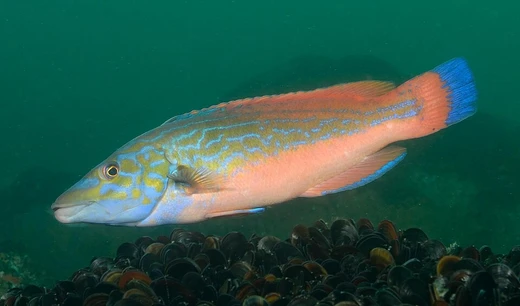
Creole wrasse
A small, color-changing wrasse of the western Atlantic.

The creole wrasse (Bodianus parrae) is a wrasse species found in the western Atlantic Ocean. It was first scientifically described in 1801 as *Brama parrae*, and later placed in the genus *Clepticus* before being moved to *Bodianus* in 2016. Its closest relative is *Bodianus anthioides*.
This fish is relatively small: males grow to about 30 cm long, while females are smaller. It has the typical wrasse body shape. Its color changes markedly with age—juveniles are almost entirely violet-purple, and as they mature, a yellow patch appears on the rear part of the body.
The creole wrasse lives in tropical waters from Florida to Brazil, including Bermuda, the Caribbean Sea, and the Gulf of Mexico. It forms groups on coral reef slopes down to about 100 meters deep. These groups feed during the day on plankton, including small jellyfish, pteropods, pelagic tunicates, and invertebrate larvae. At night, each fish retreats alone to a rocky crevice to sleep.
Reproduction involves protogynous hermaphroditism: the largest fish in a group is a dominant breeding male, while smaller fish are female. If the dominant male dies, the largest female changes sex. Mature males gather at leks to display, and females approach them to mate.
Quick Facts
- Taxon
- Bodianus parrae
Facts from the source article.
Lore & Background
The creole wrasse was first formally described in 1801 as Brama parrae by Marcus Elieser Bloch & Johann Gottlob Schneider. In 1829, Georges Cuvier described a species and a new genus, which he named Clepticus genizara; this name was later regarded as a synonym of Bloch and Schneider's earlier name, and this species is the type species of the genus Clepticus. It was moved to Bodianus in 2016, and its sister taxon is Bodianus anthioides.
It has a typical wrasse shape. Like many wrasses, it changes colour markedly during its lifetime, with juveniles being almost completely violet-purple. As it matures, it develops a yellow patch on the rear part of its body. Males reach around 30 cm in length, while females are smaller.
The species is found throughout the tropical waters of the western Atlantic Ocean from Florida to Brazil, including Bermuda Islands, the Caribbean Sea, and the Gulf of Mexico. It lives in groups, aggregating on coral reef slopes down to around 100 m in depth. These groups feed on plankton, including small jellyfish, pteropods, pelagic tunicates, and invertebrate larvae. It is active by day, and at night it retreats alone to a rocky crevice in the reef to sleep.
Reader's Guide
The creole wrasse is significant as a representative of the wrasse family in the western Atlantic, with a well-documented taxonomic history involving multiple reclassifications. Its description by Bloch and Schneider in 1801, followed by Cuvier's later synonymized naming, illustrates the evolving understanding of wrasse relationships. The species serves as the type species for the genus Clepticus, though it was later moved to Bodianus in 2016. Its ecological role as a diurnal, plankton-feeding fish that aggregates on coral reef slopes highlights its importance in reef food webs. The creole wrasse's protogynous hermaphroditism—where the largest fish is a dominant breeding male and smaller fish remain female, with sex change occurring upon the male's death—is a key reproductive strategy shared with many wrasses. Its color change from violet-purple juveniles to adults with a yellow patch is a notable life-history trait. The species' distribution from Florida to Brazil, including Bermuda and the Caribbean, underscores its broad tropical range.
Did You Know?
- The creole wrasse was first described in 1801 as Brama parrae by Bloch and Schneider.
- It changes color from violet-purple as a juvenile to having a yellow patch on the rear as an adult.
- It is a protogynous hermaphrodite: the largest fish is a dominant male, and females can change sex if he dies.
- At night, it sleeps alone in a rocky crevice in the reef.
Taxonomic Journey and Scientific Legacy
The creole wrasse has a taxonomic history spanning more than two centuries of scientific inquiry. Its formal description dates back to 1801, when Marcus Elieser Bloch and Johann Gottlob Schneider introduced it to the scientific record under the name Brama parrae. Nearly three decades later, in 1829, the French naturalist Georges Cuvier proposed both a new species and an entirely new genus, Clepticus genizara. Over time, researchers recognized that Cuvier's designation was merely a synonym of the earlier Bloch and Schneider name, yet the species retained its status as the type species anchoring the genus Clepticus. The classification story did not end there. In 2016, taxonomists reassigned the creole wrasse into the genus Bodianus, where it now sits alongside its closest relative, Bodianus anthioides. This reclassification reflects the ongoing refinement of how marine biologists understand evolutionary relationships among wrasses, and it underscores how a single species can occupy different taxonomic homes across generations of researchers.
A Living Palette: Size and Color Transformation
The creole wrasse is a compact member of the wrasse family, bearing the streamlined, typical body shape associated with the group. Adult males grow to roughly thirty centimeters, about one foot in length, while females of the same species remain noticeably smaller. Perhaps the most visually striking aspect of this fish is its dramatic chromatic transformation across its lifespan. Young creole wrasse present as almost entirely violet-purple, a deep and uniform hue that covers the whole body. As the individual matures, this monochromatic appearance gives way to a distinct yellow patch that emerges on the posterior portion of the body. This shift from a solid purple juvenile to a two-toned adult represents a marked change in coloration, a trait shared by many wrasse species but particularly evident here. The combination of modest size, recognizable body form, and this vivid color progression makes the creole wrasse a visually distinctive inhabitant of tropical reef environments.
Range, Habitat, and Daily Rhythms
The creole wrasse inhabits tropical waters across the western Atlantic Ocean, with its range stretching from the coast of Florida southward to Brazil. Within this broad expanse, the species is present in the Caribbean Sea, the Gulf of Mexico, and even the Bermuda Islands, demonstrating a wide tolerance for different reef settings within the same ocean basin. In its preferred habitat, creole wrasse aggregate in groups along coral reef slopes, descending to depths of approximately one hundred meters, or about three hundred and thirty feet. Their diet consists of planktonic organisms, including small jellyfish, pteropods, pelagic tunicates, and various invertebrate larvae. The species is strictly diurnal in its foraging activity, spending daylight hours feeding in these group settings. Once night falls, the social dynamic shifts dramatically: each individual leaves the group and retreats alone into a rocky crevice within the reef structure to rest. This solitary nighttime behavior contrasts sharply with the collective daytime feeding, illustrating a dual social rhythm that defines the species' daily life.
Sexual Fluidity and Lek Breeding
Reproduction in the creole wrasse follows a pattern of protogynous hermaphroditism, meaning every individual begins life as a female and only some will later become males. Within any given group, the single largest fish serves as the dominant breeding male, while all smaller members remain female. Should this dominant male die, the largest remaining female undergoes a sex change to assume the male role, ensuring that the group always has a breeding leader. The reproductive strategy extends beyond simple group dynamics. Mature males gather at specialized breeding sites known as leks, where they perform display behaviors to attract females. Females approach the displaying males, and mating occurs in this congregation. This lek-based system, combined with the sex-change mechanism, creates a dynamic social structure in which hierarchy, sexual identity, and reproductive opportunity are all tightly interwoven, making the creole wrasse a fascinating example of flexible reproductive biology in marine fish.
Frequently Asked Questions
What is the Creole wrasse?
The Creole wrasse (Bodianus parrae) is a small wrasse species native to the western Atlantic Ocean. It was first described in 1801 and has been shuffled between genera over the years before landing in Bodianus in 2016.
How big does a Creole wrasse get?
Males top out at roughly 30 cm (about one foot) in length, while females remain noticeably smaller. It is considered a compact wrasse relative to many of its congeners.
What does a Creole wrasse look like?
Young fish are almost entirely violet-purple, but as they mature a distinct yellow patch appears on the rear portion of the body. The overall body shape follows the standard wrasse profile.
Where does the Creole wrasse live?
This species is found in the western Atlantic Ocean, occurring at depths down to about 100 meters (330 feet). It is a small, color-changing wrasse of that region's marine habitats.
What is the Creole wrasse's closest relative?
Its sister species is Bodianus anthioides, making the two the most closely related living members of the genus. The Creole wrasse also serves as the type species of the now-synonymous genus Clepticus.
More in Wrasses 1-24
Spotted an error? Know more?
Reader corrections go straight into our review queue. Suggest an edit · How this site is sourced