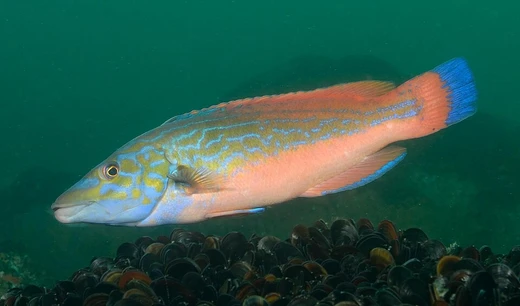
Belted wrasse
A colorful Hawaiian wrasse with cultural and ecological significance.

The belted wrasse (Stethojulis balteata) is a reef fish found only in the Hawaiian Islands. First described in 1824 as Stethojulis axillaris by Quoy and Gaimard, it belongs to the wrasse family Labridae. In Hawaiian, it is called ʻOmaka, though it can also be referred to generally as hīnālea or alea for wrasse. Its bright coloring makes it easy to spot: a light green body crossed by parallel blue lines, with a thicker orange stripe running from the pectoral fin to the tail, and an orange spiny dorsal fin. Fully grown, it reaches about 6 inches (15 centimeters) long. Like many wrasses, it is a sequential hermaphrodite, capable of changing sex during its life.
This species lives in the shallow reefs of Hawaii and also around Johnston Atoll, about 825 miles from Honolulu. It is benthopelagic, staying near the seafloor among corals and algae beds, and can be found in outer reefs up to 50 feet (15 meters) deep. At night, it buries itself in sand, a common wrasse behavior. Its diet consists of small invertebrates such as bivalves, polychaetes, sipuncula, and gastropods, and it may also eat organic waste from dead crustaceans and fish.
While the ʻOmaka can be kept in aquariums, it is not recommended because wrasses are skittish and may jump out of an uncovered tank. It is not considered a food fish today, but it may have been eaten by Native Hawaiians before missionaries arrived. Traditional fishing methods included melomelo, where sticks coated in charred oil were submerged to attract the fish, making them easy to catch. Another technique used hinaʻi hoʻoluʻuluʻu, baskets woven from the native ʻāwikiwiki plant to trap fish. Hīnālea were also commonly offered to the gods in ceremonies, though it is uncertain whether the ʻomaka specifically was used in this way.
Quick Facts
- Genus
- Stethojulis
- Species
- balteata
Facts from the source article.
Lore & Background
The belted wrasse can easily be identified by its bright colors and distinct pattern. It is a light green color, with blue lines running parallel across its body and an orange spiny dorsal fin. It also has a thicker, orange stripe that runs in between the blue lines, from the pectoral fin to the tail. As most reef fish, the belted wrasse is relatively small, reaching 6 inches (15 centimeters) in length in full maturity. Wrasses are also sequential hermaphrodites, meaning they can change sex during their lifespan.
The belted wrasse is native to the Hawaiian Islands, but can also be found in the reefs of the Johnston Atoll, 825 miles from Honolulu. This species typically inhabits shallow reefs, although it can be seen in outer reefs up to 50 feet (15 meters) deep. Belted wrasses are benthopelagic, meaning they live at the bottom of the sea, near corals and algae beds. The ʻOmaka buries itself in sand at night, which is a common pattern seen across wrasses. They feed on small invertebrates such as bivalves, polychaetes, sipuncula, and gastropods. They may also ingest organic waste from dead crustaceans and fish.
Although this species may be kept in aquariums, it is highly advised not to. Wrasses are skittery by nature, and they can jump out of an aquarium if left uncovered. The ʻOmaka is not considered a food source, but it may have been for Hawaiians before the arrival of missionaries. Native Hawaiians would typically catch hīnālea by submerging sticks covered in charred oil, which would attract the fish making them easy to catch. This practice was known as melomelo. Another technique they used was known as hinaʻi hoʻoluʻuluʻu. These were baskets made out of ʻāwikiwiki, a native plant, designed to trap fish. Hīnālea were also commonly used as offerings to the gods in ceremonies, although it is not for certain that the ʻomaka was used for this practice.
Reader's Guide
The belted wrasse holds significance both ecologically and culturally. Ecologically, it is a benthopelagic fish that inhabits shallow reefs and outer reefs up to 50 feet deep, feeding on small invertebrates and organic waste. Its habit of burying itself in sand at night is a common wrasse behavior. Culturally, the species is known in Hawaiian as ʻOmaka, hīnālea, or alea. While not considered a food source today, it may have been eaten by Hawaiians before the arrival of missionaries. Traditional fishing methods included melomelo, using sticks covered in charred oil to attract the fish, and hinaʻi hoʻoluʻuluʻu, baskets made from the native plant ʻāwikiwiki. Hīnālea were also used as offerings to the gods in ceremonies, though it is uncertain whether the ʻomaka specifically was used for this practice. The species was originally named Stethojulis axillaris by Quoy and Gaimard in 1824. Although it may be kept in aquariums, it is advised against due to its skittery nature and tendency to jump out of uncovered tanks.
Did You Know?
- It can change sex during its lifespan, as wrasses are sequential hermaphrodites.
- Native Hawaiians used a technique called melomelo, submerging charred-oil-covered sticks to attract the fish.
- The species buries itself in sand at night, a common behavior among wrasses.
Physical Identity and Biological Quirks
The belted wrasse stands out in any reef community thanks to its striking and unmistakable coloration. Its body carries a pale green base tone, overlaid with a series of parallel blue lines that stretch across its flanks. Cutting between those blue stripes is a bolder orange band that extends from the pectoral fin all the way to the tail, while the spiny dorsal fin glows in a vivid orange. Together, these markings make the fish instantly recognizable among the more subdued residents of Hawaiian coral gardens. In terms of size, it remains modest, topping out at roughly six inches, or about fifteen centimeters, when fully grown. One of the most fascinating biological traits shared by wrasses in general is sequential hermaphroditism: an individual can shift its sex at some point during its life, meaning the population contains fish that were born one sex and later function as the other. This capacity for sexual transition adds a layer of complexity to how the species reproduces and organizes its social groups on the reef.
Range, Habitat, and Daily Rhythms
Although the belted wrasse is considered endemic to the Hawaiian archipelago, its range extends slightly beyond those waters, with sightings recorded on the reefs surrounding Johnston Atoll, a remote outlying feature roughly 825 miles from Honolulu. Within its preferred environment, the species gravitates toward shallow reef structures, though it is not restricted to the very surface; individuals can be encountered on outer reef slopes descending to about fifty feet, or fifteen meters, below the waterline. Ecologically, the ʻOmaka is classified as benthopelagic, meaning it spends much of its active hours hovering near the seafloor among coral formations and dense algae beds. Each night, it follows a behavior common to many wrasse species: it buries itself into the sandy substrate, effectively disappearing from view until dawn. Its diet consists primarily of small invertebrates, including bivalves, polychaete worms, sipunculan eelworms, and various gastropods. On occasion, it will also scavenge organic matter left behind by dead crustaceans and fish, supplementing its invertebrate-focused foraging with whatever detritus the reef provides.
Taxonomic History and Hawaiian Nomenclature
The scientific identity of this species carries a small historical footnote. When Quoy and Gaimard first described the fish in 1824, they assigned it the name Stethojulis axillaris. Over time, the accepted binomial shifted to Stethojulis balteata, placing it firmly within the family Labridae, the large and diverse group of wrasses found across tropical and subtropical waters worldwide. The belted wrasse is one of the few Labridae members whose entire natural range is confined to a single island chain, making it a true endemic of the Hawaiian Islands. In the local Hawaiian language, the fish goes by the name ʻOmaka, a term that carries cultural weight beyond mere taxonomy. It is also occasionally called hīnālea or alea, both of which serve as broader Hawaiian words for wrasse in general. These indigenous names reflect centuries of close observation by the people who lived alongside these reefs long before Western naturalists pressed the species into a Latin classification system. The dual naming tradition—scientific and vernacular—highlights how the same small, colorful fish has been understood through two very different lenses of knowledge.
Cultural Role and Human Encounters
The relationship between the ʻOmaka and human communities in Hawaiʻi stretches back to pre-contact times, though it was never a major food fish in the modern sense. Before missionaries arrived, Native Hawaiians likely did consume hīnālea, and they developed clever, low-impact techniques to catch them. One method, called melomelo, involved submerging sticks coated in charred oil into the water; the scent or residue would attract the curious fish, making them easy to scoop up. Another approach, known as hinaʻi hoʻoluʻuluʻu, employed woven baskets crafted from ʻāwikiwiki, a native plant, designed to funnel and trap wrasse as they swam through. Beyond sustenance, hīnālea held a ceremonial role, appearing as offerings presented to the gods during religious observances, though it remains uncertain whether the ʻomaka specifically was the wrasse used in those rites. In the modern era, the species occasionally ends up in home aquariums, yet experts strongly discourage this. Wrasses are naturally skittish and prone to leaping; an uncovered tank can easily lose its small, bright occupant to the floor.
Frequently Asked Questions
What is the Belted Wrasse?
It is a small reef fish in the wrasse family Labridae, scientifically named Stethojulis balteata, that occurs only around the Hawaiian Islands and Johnston Atoll. The species was first described in 1824 under the older name Stethojulis axillaris before being reclassified.
What does the Belted Wrasse look like?
Its body is a light green crossed by parallel blue lines, with a bold orange stripe running from the pectoral fin to the tail and an orange spiny dorsal fin. That vivid, high-contrast coloration makes it one of the easier wrasses to spot on a reef.
Where can you find the Belted Wrasse?
This species is native to the Hawaiian Islands and Johnston Atoll, where it inhabits reef environments at depths up to roughly 50 feet (15 meters). It does not occur outside that Pacific region.
How big does the Belted Wrasse grow?
A fully mature individual reaches about 6 inches (15 centimeters) in total length. That places it on the smaller end of the wrasse family compared to many larger reef-dwelling relatives.
What is the Belted Wrasse's Hawaiian name?
Locally it is called ʻOmaka, and it also falls under the broader Hawaiian terms hīnālea or alea, which refer to wrasses in general. These names reflect the fish's long-standing place in Hawaiian marine culture.
More in Wrasses 1-24
Spotted an error? Know more?
Reader corrections go straight into our review queue. Suggest an edit · How this site is sourced