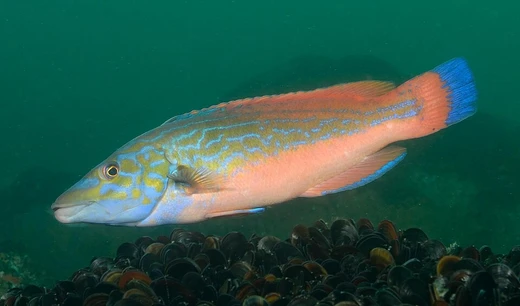
Scarus chameleon
A parrotfish named for its rapid colour changes.

Scarus chameleon, called the chameleon parrotfish, is a reef-dwelling marine fish found in the Pacific and eastern Indian Ocean. Its name comes from its quick color changes.
Until 1986, this species was mistaken for Scarus lunula, which is now considered a synonym of Scarus festivus. It closely resembles its nearest relative, S. festivus, and their ranges overlap. The type specimen was collected at Sumilon Island in the Philippines.
This fish can reach 248 mm (9.8 in) in standard length. Females may become sexually mature at 115 mm (4.5 in) SL. They can begin transitioning into terminal-phase males at 149.5 mm (5.89 in) SL, though some females grow as large as 175.5 mm (6.91 in) SL before changing.
Like most parrotfish, S. chameleon changes color phase as it matures. Juveniles, initial-phase fish (females and primary males), and terminal-phase males all show highly variable colors and can shift hues rapidly, making identification difficult. Initial-phase individuals often look very similar to northern and inshore populations of the related, more common S. rivulatus. Terminal-phase secondary males are more distinct, but they can quickly switch between light and dark color patterns.
Quick Facts
- Taxon
- Scarus chameleon
Facts from the source article.
Lore & Background
Until 1986, Scarus chameleon was misidentified as Scarus lunula, a synonym of Scarus festivus. It is similar in appearance to S. festivus, which is its closest relative and overlaps with it in distribution. The type locality is Sumilon Island in the Philippines.
The species is known to reach 248 mm SL. Females may be sexually mature by the time they reach 115 mm SL. Females may be as small as 149.5 mm SL before transitioning into terminal phase males, but females as large as 175.5 mm SL are known. Like most parrotfish, S. chameleon changes colour phase as it grows. The young juveniles, initial phase, and terminal phases are all highly variable in colouration and able to rapidly change colouration, which is a challenge when attempting to identify it. The initial phase includes females and primary males, and may appear very similar to northern and inshore populations of the closely related and more common S. rivulatus. The secondary males of the terminal phase are more distinct, but such terminal phase fish can change rapidly colours between light and dark coloured liveries.
Reader's Guide
Scarus chameleon is notable primarily for its remarkable ability to rapidly change colouration, which is the basis of its common name. This trait is present across all life phases—juveniles, initial phase, and terminal phase—making identification challenging. The species was historically misidentified as Scarus lunula until 1986, reflecting the taxonomic confusion caused by its variable appearance. Its closest relative is Scarus festivus, with overlapping distributions. The initial phase, including females and primary males, can closely resemble northern and inshore populations of the more common Scarus rivulatus, further complicating field identification. Terminal phase males are more distinct but still capable of rapid shifts between light and dark liveries. The type specimen was collected at Sumilon Island in the Philippines. The species reaches a maximum recorded length of 248 mm, with females reaching sexual maturity at 115 mm and transitioning to terminal phase males at sizes ranging from 149.5 mm to 175.5 mm. Its distribution across Pacific and eastern Indian Ocean reefs underscores its ecological role in these habitats.
Did You Know?
- Females may be sexually mature by 115 mm SL.
- Terminal phase males can rapidly change between light and dark coloured liveries.
More in Wrasses 1-24
Spotted an error? Know more?
Reader corrections go straight into our review queue. Suggest an edit · How this site is sourced