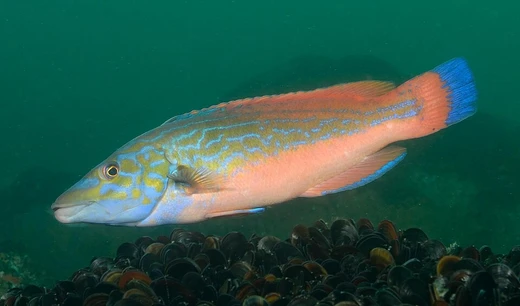
Red hogfish
A western Atlantic wrasse with yellow stripes and a protrusible mouth.

The red hogfish (Decodon puellaris) is a marine ray-finned fish belonging to the wrasse family, Labridae, and lives in the western Atlantic Ocean. Cuban zoologist Felipe Poey first described it in 1860 under the name *Cossyphus puellaris*, with Havana as the type locality. The following year, British-German ichthyologist Albert Günther established the genus *Decodon* and made this species its type.
Its range stretches from Cape Fear, North Carolina, south along the U.S. Atlantic coast and around Bermuda, through the Bahamas, the Gulf of Mexico, and the Caribbean Sea, continuing along the South American coast as far as Rio Grande do Sul, Brazil.
This fish has an elongated, laterally compressed body, a thick-lipped, protrusible mouth, and protruding front teeth—four in the upper jaw and two in the lower. The dorsal fin is smooth and notchless, with ten spines and nine to ten soft rays, while the anal fin has three spines and ten rays. Its lateral line is unbroken and arched, containing 27 to 29 scales. Adults are red above and whitish below, with three yellow stripes on the head: one along the top lip, one from the lower eye margin to the lower gill cover, and one from the snout through the eye to the top of the gill cover. Yellow lines on the body come from spots on the scales, and similar lines run along the bases of the dorsal and anal fins. The upper and outer margins of the caudal fin are yellow. Juveniles are red, with a large black eye spot in the center of the last few dorsal-fin spines and a small black spot on top of the caudal peduncle. Total length can reach 30 centimeters (12 inches).
The red hogfish prefers rocky substrates and is often found near islands, at depths between 18 and 275 meters (59 to 902 feet). It is a carnivore, feeding on mobile benthic worms, mollusks, and bony fish. Its eggs and larvae are pelagic.
Humans collect red hogfish for food, but the extent of this harvest and its impact on local populations are unknown.
Quick Facts
- Taxon
- Decodon puellaris
Facts from the source article.
Lore & Background
Decodon puellaris was described in 1860 as Cossyphus puellaris by the Cuban zoologist Felipe Poey, with the type locality given as Havana. In 1861, the British-German ichthyologist Albert Günther created the genus Decodon and designated Cossyphus puellaris as its type species. The species ranges from Cape Fear in North Carolina southwards along the Atlantic coast of the United States and around Bermuda, through the Bahamas, Gulf of Mexico, and Caribbean Sea, continuing south along the coasts of South America as far as Rio Grande do Sul in Brazil.
The red hogfish has an elongated, laterally compressed body with a thick-lipped, protrusible mouth. Adults have four front teeth in the upper jaw and two in the lower jaw, which are protruding. The dorsal fin has a smooth profile without any noticeable notch, with ten dorsal fin spines and 9-10 soft rays. The anal fin has three spines and ten rays. It has an unbroken, arched lateral line with 27-29 scales. Adults are red above and whitish below, with three yellow stripes on the head: along the top lip, from the lower margin of the eye to the lower gill cover, and from the snout through the eye to the top of the gill cover. Yellow lines on the body are formed by spots on the scales, and the caudal fin has yellow upper and outer margins. Juveniles are red with a large black eye spot in the center of the last few dorsal fin spines and a small black spot on the top of the caudal peduncle.
This species prefers rock substrates and is associated with islands, occurring at depths between 18 and 275 metres. It is a carnivore, feeding on mobile benthic worms, molluscs, and bony fish. Its eggs and larvae are pelagic.
Reader's Guide
The red hogfish is notable as the type species of the genus Decodon, established by Albert Günther in 1861, and was originally described by Felipe Poey in 1860 from Havana. Its distribution spans a broad area of the western Atlantic, from North Carolina to Brazil, including Bermuda, the Bahamas, the Gulf of Mexico, and the Caribbean Sea. The species exhibits distinct morphological features, including an elongated, laterally compressed body, a protrusible mouth with protruding front teeth, and a smooth dorsal fin profile. Its coloration is distinctive: adults are red above and whitish below with three yellow head stripes and yellow lines on the body formed by scale spots, while juveniles have a large black eye spot on the dorsal fin and a small spot on the caudal peduncle. The red hogfish inhabits rock substrates near islands at depths up to 275 metres and is a carnivore that preys on benthic worms, molluscs, and bony fish. Its eggs and larvae are pelagic. Humans collect this species for food, though the extent of this harvest and its effects on local populations are not known. The species reaches a maximum total length of 30 centimetres.
Did You Know?
- The red hogfish was first described in 1860 by Cuban zoologist Felipe Poey as Cossyphus puellaris.
- It is the type species of the genus Decodon, created by Albert Günther in 1861.
- Adults have three yellow stripes on the head and yellow lines on the body formed by spots on the scales.
More in Wrasses 1-24
Spotted an error? Know more?
Reader corrections go straight into our review queue. Suggest an edit · How this site is sourced