Pteragogus trispilus
A Red Sea wrasse that entered the Mediterranean via the Suez Canal.

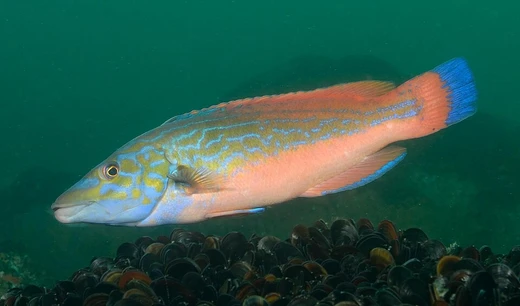
Pteragogus trispilus is a marine fish belonging to the wrasse family, Labridae. Its body is compressed and covered in cycloid scales. The mouth is terminal, with jaws extending back to the rear of the pupil; the front of each jaw holds two pairs of large, curved, canine-like teeth, with the second pair being large and straight. The dorsal fin has 11 spines and 9 soft rays, while the anal fin has 3 spines and 9 soft rays. The caudal fin is rounded and moderately long, and the first ray of the pelvic fin is elongated. When fresh, the fish is mainly olive-green, with scale edges outlined in white. A black, oval-shaped spot with wide yellow margins sits on the gill cover. A vertical white streak appears on each side of the rear edge of the preoperculum. Small black spots are scattered behind the eye and on the nape. The pupil is ringed with orange pigment, and the rest of the iris has seven dark lines radiating outward. The lateral line is marked with black dots and dashes, interspersed with white dots. The dorsal, anal, and caudal fins are olive-green with white dots on the rays and slanting white lines on the spiny parts. In males, the lower head and rear gill cover are suffused with orange. Females sometimes have a whitish stripe running from the front of the snout, widening to the diameter of the pupil, below the lateral line to the upper part of the caudal peduncle. Horizontal rows of white spots may appear on the body behind the pectoral fin base, and faint orange spots may also be present. The first three membranes between the anterior dorsal spines in males each have a black spot; females typically have two such spots, sometimes a faint third. A 2019 specimen from Turkey was mostly light brown-reddish. This is a small wrasse; the largest males reach 7.9 cm in total length.
The species is native to the Red Sea, including the Gulf of Aqaba and the Gulf of Suez. It entered the Mediterranean Sea through the Suez Canal, first recorded off Israel in 1992, and is now common in Levantine waters. It inhabits sandy substrates with scattered clumps of brown algae, small coral patches, and rocks. Its diet includes foraminifera, small gastropods, and crustaceans such as small crabs and moderately large shrimp, indicating it does not feed exclusively on very small prey.
Pteragogus trispilus was first formally described by John E.
Quick Facts
- Taxon
- Pteragogus trispilus
Facts from the source article.
Lore & Background
Pteragogus trispilus has a compressed body covered in cycloid scales, a terminal mouth with jaws extending to the rear of the pupil, and two pairs of large, recurved caniform teeth at the front of the jaw. The dorsal fin has 11 spines and 9 soft rays, the anal fin 3 spines and 9 soft rays. The caudal fin is rounded and moderately long, and the pelvic fin has a lengthened first ray. Fresh specimens are mainly olivaceous with white-edged scales, an oblique elliptic black spot on the gill cover with wide yellow margins, and a vertical white streak on each side of the rear edge of the preoperculum. Small black spots appear behind the eye and on the nape; the pupil is surrounded by orange pigment, and the iris has seven dark lines radiating outward. The lateral line is marked with black dots and dashes and white dots. The dorsal, anal, and caudal fins are olivaceous with white dots on their rays and slanting white lines on their spiny parts. Males have the lower part of the head and rear part of the gill cover suffused with orange. Females sometimes have a whitish stripe from the snout to the upper caudal peduncle, and may show horizontal rows of white spots and faint orange spots. The first three membranes between the anterior dorsal spines in males each have a black spot; females normally have two such spots, sometimes a faint third. A 2019 specimen from Turkey was mostly light brown-reddish.
Reader's Guide
Pteragogus trispilus is notable as a Lessepsian migrant, having entered the Mediterranean Sea from the Red Sea through the Suez Canal, first recorded off Israel in 1992 and now commonly observed in Levantine waters. Its distribution includes the Red Sea, the Gulf of Aqaba, and the Gulf of Suez. The species was first described by John E. Randall in 2013, with the type locality at Taba on the Gulf of Aqaba; initial specimens from the 1980s had been misidentified as Pteragogus pelycus. It inhabits areas with sandy substrate containing detached clumps of brown algae, small coral patches, and rocks. Its diet includes foraminifera, small gastropods, and crustaceans such as small crabs and moderately large shrimp, indicating it does not feed exclusively on very small prey. The species is small, with the largest males reaching 7.9 cm in total length. Its coloration varies between sexes and individuals, with males showing orange suffusion and females sometimes a whitish stripe. The presence of black spots on the dorsal fin membranes differs between males and females.
Did You Know?
- It has a lengthened first ray in the pelvic fin.
- Males have black spots on the first three membranes between the anterior dorsal spines; females normally have two such spots.
- A specimen from Turkey in 2019 was mostly light brown-reddish in color.
More in Wrasses 1-24
Spotted an error? Know more?
Reader corrections go straight into our review queue. Suggest an edit · How this site is sourced