Pseudodax
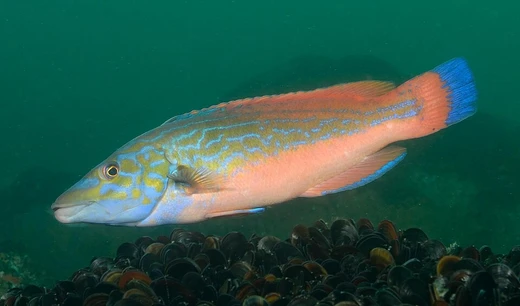
The only known member of its genus, the chiseltooth wrasse.

Pseudodax is a genus of marine ray-finned fish in the family Labridae, containing only a single species: the chiseltooth wrasse (Pseudodax moluccanus). It is notable for being the sole member of its genus and for its resemblance to cleaner wrasses of the genus Labroides, both in appearance and behavior during its juvenile stage.
Quick Facts
- Taxon
- Pseudodax moluccanus
Facts from the source article.
Lore & Background
The chiseltooth wrasse is greyish to reddish-brown with a dark streak or spot on each scale. It has a yellow upper lip with a blue streak above it, blue teeth, and a black caudal fin edged in blue. Juveniles are pale blue with a wide flank stripe, and subadults show a yellow band at the base of the tail. Juveniles strongly resemble cleaner wrasses of the genus Labroides and also behave as cleaner fish. The species is regarded as closely related to parrotfishes (family Scaridae) due to its tooth pattern, but in behavior it is more like species in the genus Anampses.
Reader's Guide
The chiseltooth wrasse is of minor importance to local commercial fisheries and is also found in the aquarium trade. Its distribution spans a wide Indo-Pacific area, from the western Indian Ocean to the Tuamotus, and from Japan to Lord Howe Island. Adults are solitary and inhabit clear channels and seaward reef edges, often near caves, while juveniles are frequently recorded along drop-offs at depths below 18 m and may live within caves. The species feeds on algae and small invertebrates. Its status as the only member of its genus makes it taxonomically distinct, and its juvenile mimicry of cleaner wrasses adds ecological interest.
Did You Know?
- Pseudodax moluccanus is the only known member of the genus Pseudodax.
- Juveniles of this species resemble and behave as cleaner fish, similar to the genus Labroides.
- The species is regarded as closely related to parrotfishes due to its tooth pattern.
- It can be found at depths from 3 to 60 m, though rarely deeper than 40 m.
More in Wrasses 1-24
Spotted an error? Know more?
Reader corrections go straight into our review queue. Suggest an edit · How this site is sourced