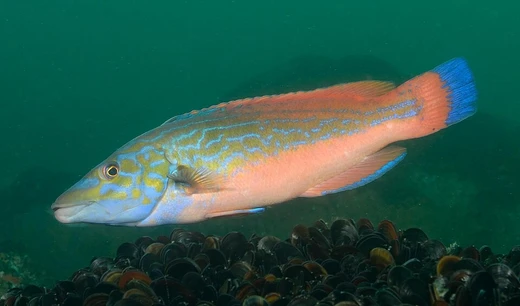
Pseudocoris heteroptera
A reef-associated wrasse that feeds on zooplankton.

Pseudocoris heteroptera, called the torpedo wrasse or zebra wrasse, is a marine ray-finned fish in the family Labridae. It lives in the western Pacific Ocean and is tied to reef environments.
Like other members of its genus, this wrasse resembles those in the genus *Coris* but differs in diet: it feeds on zooplankton rather than bottom-dwelling invertebrates. Adaptations for this include a smaller mouth, a shorter snout, and eyes placed lower on the head. Males are a vivid deep turquoise, with a wide, irregular black stripe behind the eye, and alternating light and dark bands on the body toward the tail. The tail’s outer rays are dark, making it look deeply forked. The anal fin is yellow with a thick black edge—unlike the Indian Ocean species *Pseudocoris occidentalis*, where it is plain yellow. Females are greenish to bluish-grey, with a black spot above the base of the pectoral fin. Juveniles are mostly white, with a black stripe along the back and a wider black stripe along the flanks. They can change color quickly: when moving from near the seabed into open water to feed, the female’s striped pattern fades to a plain grey, making the fish hard to spot. The male’s variable banding also shifts, possibly linked to mood.
The maximum recorded total length is 20 centimeters (7.9 inches), though a more typical standard length is 15 centimeters (5.9 inches). The dorsal fin has 9 spines and 12 rays; the anal fin has 3 spines and 12 rays.
The species ranges from the Line Islands west to Indonesia, north to Taiwan and southern Japan, and south to the Great Barrier Reef.
It lives over the outer crests of reefs, usually above substrates of sand, rubble, and coral that are often exposed to strong currents. Small groups of females gather with a nearby male. It feeds on zooplankton and typically stays well above the seabed. Males and females pair up to spawn. For defense, it keeps away from the substrate and stays at a distance from threats rather than diving into shelter.
*Pseudocoris heteroptera* is rarely seen in the aquarium trade.
The species was first formally described as *Julis (Halichoeres) heteropterus* in 1857 by Dutch ichthyologist Pieter Bleeker, with the type locality given as Ambon in the Moluccas. When Bleeker created the genus *Pseudocoris* in 1862, he designated *Julis (Halichoeres) heteropterus* as its type species.
Quick Facts
- Taxon
- Pseudocoris heteroptera
Facts from the source article.
Lore & Background
Pseudocoris heteroptera resembles wrasses of the genus Coris but differs in feeding ecology, preying on zooplankton rather than benthic invertebrates. Adaptations for this diet include a smaller mouth, shorter snout, and eyes positioned lower on the head. Males are deep turquoise with a wide black irregular stripe behind the eye, alternating light and dark bands on the body toward the caudal fin, and a yellow anal fin with a thick black margin. Females are greenish to bluish-grey with a black spot above the pectoral fin base. Juveniles are mainly white with a black stripe along the back and a wide black stripe along the flanks. The fish can quickly change color: when moving from the seabed to open water to feed, the female's striped pattern fades to plain grey, making it hard to discern. Male banding also changes and may be linked to mood.
Reader's Guide
Pseudocoris heteroptera occurs over the outer crests of reefs, typically above substrates of sand, rubble, and coral exposed to strong currents. It normally forms small groups of females with a nearby male. The species feeds on zooplankton and is usually found well above the seabed. Spawning occurs in male-female pairs. Its defensive behavior is to stay away from the substrate and remain at a distance from threats rather than diving into shelter. The species is infrequently encountered in the aquarium trade. Originally described as Julis (Halichoeres) heteropterus by Pieter Bleeker in 1857 from Ambon, it was later designated the type species of the genus Pseudocoris. Populations in the western Indian Ocean, once considered conspecific, have been split off as Pseudocoris occidentalis due to differences in male coloration.
Did You Know?
- Males have a yellow anal fin with a thick black margin, while the Indian Ocean taxon Pseudocoris occidentalis has a plain yellow anal fin.
- It was first formally described by Dutch ichthyologist Pieter Bleeker in 1857.
More in Wrasses 1-24
Spotted an error? Know more?
Reader corrections go straight into our review queue. Suggest an edit · How this site is sourced