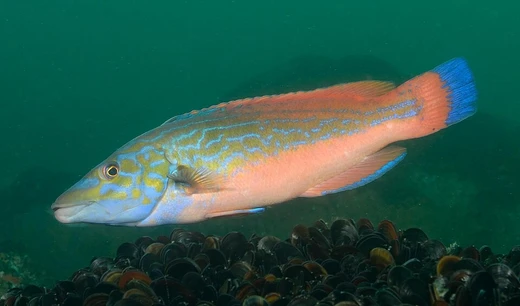
Pictilabrus laticlavius
A temperate wrasse endemic to southern Australian waters.

Pictilabrus laticlavius goes by several common names: patrician wrasse, senator wrasse, green parrotfish, and purplebanded wrasse. This marine ray-finned fish belongs to the wrasse family, Labridae, and lives in the eastern Indian Ocean and southwestern Pacific Ocean, along the temperate coasts of southern Australia.
Scottish naval surgeon and naturalist John Richardson first described the species in 1840, naming it *Labrus lacticlavius* based on a specimen from Port Arthur, Tasmania. When American ichthyologist T.N. Gill created the genus *Pictilabrus* in 1891, he made this species its type.
The genus name combines *picti* (meaning "painted") with *labrus*, the type genus of the wrasse family—possibly derived from the Greek *labrax*, a term for a specific fish. The species name refers to blue spots on the fins, which Richardson likened to the *clavi* (stripes) on the borders of Roman patrician clothing.
The body is moderately deep and laterally compressed, with a height measuring 26–32% of standard length. The head is fairly large, with relatively big eyes and a small mouth whose upper jaw does not reach the eye. Small, canine-like teeth arm the jaws: the front pair in the lower jaw and the front two pairs in the upper jaw are enlarged and curved backward, and an enlarged canine sits on each side at the rear of the upper jaw. Cycloid scales, moderately large and firmly attached, cover the body, though the head is bare except for one to three rows of scales on the cheek and eight to ten large scales on the gill cover. The lateral line drops abruptly below the rearmost dorsal-fin spines. The continuous dorsal fin has an elongated base and uniform height; the anal fin mirrors the dorsal fin’s rear portion and sits opposite it. The caudal fin is truncate, the pectoral fins short and rounded, and the pelvic fins also short, originating under the pectoral-fin base and not reaching the anus.
Males are mainly green with maroon or purplish stripes along the flanks. Females and juveniles range from reddish to greenish-brown, with a row of black spots above the lateral line, four to five blackish bars on the lower flanks, and a black spot on the rear part of the dorsal fin.
This species is endemic to temperate southern Australian waters, from Byron Bay in New South Wales to the Houtman Abrolhos in Western Australia, including Tasmania.
Quick Facts
- Taxon
- Pictilabrus laticlavius
Facts from the source article.
Lore & Background
The patrician wrasse was first formally described in 1840 by Scottish naval surgeon and naturalist John Richardson, who named it Labrus lacticlavius with the type locality given as Port Arthur in Tasmania. When American ichthyologist T.N. Gill described the genus Pictilabrus in 1891, he designated this species as its type species. The genus name is a compound of picti meaning 'painted' and labrus, the type genus of the wrasse family; the specific name refers to blue spots on the fins that Richardson considered to resemble the clavi on the borders of Roman patrician clothing.
This species has a moderately deep, laterally compressed body with a large head, relatively large eyes, and a small mouth. Its jaws are armed with small, canine-like teeth, with enlarged and recurved front teeth. The body is covered with moderately large, firmly attached cycloid scales, while the head is mostly naked except for scales on the cheek and gill cover. Males are mainly green with maroon or purplish stripes along their flanks; females and juveniles are reddish to greenish-brown with black spots and bars.
Pictilabrus laticlavius lives on rock reefs clothed in weed, occurring to depths of 40 metres. It is carnivorous, feeding on invertebrates such as gastropods, amphipods, small shrimps, and crabs. Like many wrasses, it is a protogynous hermaphrodite, changing sex from female to male at a total length of approximately 130–150 mm. The spawning season depends on locale, occurring earlier in spring farther north and later in cooler southern waters.
Reader's Guide
Pictilabrus laticlavius is a quarry species for angling and may also be caught as bycatch by commercial fisheries. Its distribution is limited to temperate southern Australia, from Byron Bay in New South Wales to the Houtman Abrolhos in Western Australia, including Tasmania. The species shows sexual dichromatism, with females holding overlapping territories while males, at least when breeding, guard exclusive territories. It can reach sexual maturity within a year at a total length greater than 95 mm, and by three years can reach 180 mm total length. The species lives for at least 4.8 years and may live as long as 10 years. Sex change from female to male occurs at approximately 130–150 mm total length, which is around two years old in New South Wales but may take between at least three and five-plus years in Tasmania. The species' ecological role as a carnivore on rocky reefs and its protogynous hermaphroditism are typical of many wrasses, and its multiple common names reflect its distinctive appearance and historical recognition.
Did You Know?
- The specific name laticlavius refers to blue spots on the fins that Richardson compared to the clavi on Roman patrician clothing.
- This species is a protogynous hermaphrodite, changing sex from female to male at about 130–150 mm total length.
- It can reach sexual maturity within one year at a total length greater than 95 mm.
- The type locality is Port Arthur in Tasmania, where John Richardson first described it in 1840.
More in Wrasses 1-24
Spotted an error? Know more?
Reader corrections go straight into our review queue. Suggest an edit · How this site is sourced