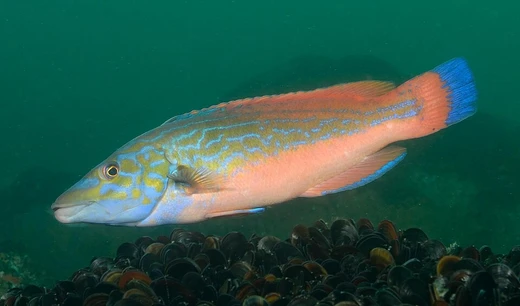
Parrotfish
Parrotfish are wrasses with beak-like teeth that rasp algae and coral.

Parrotfish are a clade of fish placed in the subfamily Scarinae of the wrasse family (Labridae). They are named for their dentition, which forms a parrot-like beak used to rasp algae from coral and other rocky substrates, contributing to bioerosion. Historically considered as the family Scaridae, genetic studies found them to be deeply nested within the wrasses, and they are now treated as a subfamily.
Quick Facts
- Taxon
- Scarinae
Facts from the source article.
Lore & Background
Parrotfish are named because their mouths resemble a parrot's beak. Their numerous teeth are arranged in a tightly packed mosaic on the external surface of their jaw bones, forming a parrot-like beak. They are herbivores or corallivores inhabiting coral reefs, rocky coasts, and seagrass beds. Some species secrete a mucus cocoon at night, presumably hiding their scent from predators and acting as an early warning system. The skin is covered in another mucous substance that may have antioxidant properties and provide protection from UV light. Most species are sequential hermaphrodites, starting as females (initial phase) and then changing to males (terminal phase), though some individuals develop directly to males.
Reader's Guide
Parrotfish play a significant role in bioerosion as some species eat away at corals, enriching the sand content on the surrounding ocean floor. Their feeding activity is important for the production and distribution of coral sands in the reef biome and can prevent algal overgrowth of the reef structure. The humphead parrotfish can produce 90 kg (200 lb) of sand each year, or on average almost 250 g (9 oz) per parrotfish per day. On Caribbean coral reefs, parrotfish are important consumers of sponges, indirectly protecting reef-building corals from being overgrown by fast-growing sponge species. Analysis of parrotfish feeding biology describes three functional groups: excavators, scrapers, and browsers. Recently, the microphage feeding hypothesis challenged the prevailing paradigm by proposing that most parrotfishes target cyanobacteria and other protein-rich autotrophic microorganisms. Parrotfish have lower short-chain fatty acid concentration than most other herbivorous marine fish, suggesting they may have less reliance on microbial digestion.
Did You Know?
- Parrotfish are now classified as a subfamily (Scarinae) within the wrasse family Labridae, though some authorities still treat them as a separate family (Scaridae).
- The green humphead parrotfish can reach up to 1.3 m (4 ft 3 in) in total length.
- Some parrotfish species secrete a mucus cocoon at night, which may hide their scent from predators.
More in Wrasses 1-24
Spotted an error? Know more?
Reader corrections go straight into our review queue. Suggest an edit · How this site is sourced