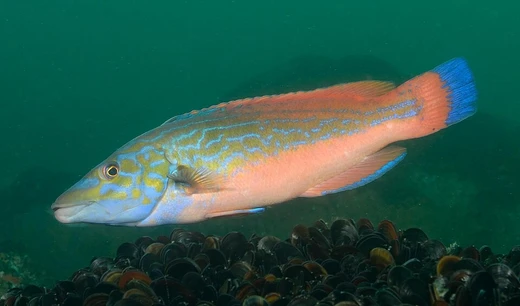
Moon wrasse
A colorful, territorial wrasse from Indian and Pacific coral reefs.

The moon wrasse, also called the crescent or lyretail wrasse, lives in the Indian Ocean and western Pacific Ocean. It is found on coral reefs and nearby areas, from 1 to 20 meters deep. This carnivorous fish eats fish eggs and small invertebrates living on the sea floor. It can grow up to 45 centimeters long. While not a major target for local fisheries, it does appear in the aquarium trade.
Young moon wrasses have a blue lower body, a black spot in the middle of the dorsal fin, and a black blotch at the base of the tail fin. As they mature, that spot becomes a yellow crescent, which gives the fish its common name. The body is green with clearly marked scales, and the head ranges from blue to magenta with a broken checkerboard pattern.
These fish are active and territorial, spending all day moving and chasing or nipping at others that get in their way. They are diurnal, with strong vision and a decent sense of smell. At night, they rest in crevices, often under rocks, and may dig out a space by swimming through it repeatedly until they fit. Moon wrasses are protogynous hermaphrodites: all start as females and can change to males in just ten days. Some live in groups with a dominant male and a harem of about a dozen others, including both females and males. The alpha male is more brightly colored and, at every low tide, turns from green to blue and puts on a display of attacking and nipping the others. During breeding season, just before high tide, he turns completely blue, gathers all the females, and a spawning frenzy begins.
In captivity, moon wrasses can live up to ten years, though their lifespan is shorter in the wild. They are popular in the aquarium trade for their hardiness, bright colors, and active behavior. They tolerate spikes in nitrite well and eat bristle worms, which can be pests in tanks.
Quick Facts
- Taxon
- Thalassoma lunare
Facts from the source article.
Lore & Background
The juvenile moon wrasse is blue on the lower half of its body, with a black spot in the middle of the dorsal fin and a black blotch on the caudal fin base. As it matures, the spot turns into a yellow crescent, hence the name. The body is green with prominently marked scales, and the head ranges from blue to magenta with a broken checkerboard pattern.
Moon wrasses are active fish, said to be moving all day long. They are territorial, nipping, chasing, and otherwise harassing fish that get in their way. Being diurnal, they have strong vision and a decent sense of smell. At night, they rest in niches under rocks or other structures, and may dig out space under a rock by repeatedly swimming through it until it fits without struggle.
They are protogynous hermaphrodites, all starting as females and changing to males, a process that takes only 10 days. Some live in groups consisting of a dominant male and a harem of about a dozen other wrasses, some female and some male. The alpha male is more brightly colored, and at every low tide hour changes from green to blue, going into a show of attacking and nipping all the other wrasses. During breeding season and before high tide, the alpha male turns completely blue, gathers every female, and the spawning frenzy begins.
Reader's Guide
The moon wrasse is notable for its striking color changes and complex social behavior. As described in the source article, it is a protogynous hermaphrodite, with all individuals starting as females and transitioning to males in just 10 days. Dominant males lead harems of about a dozen wrasses, displaying vivid color shifts—from green to blue at low tide—and engaging in aggressive displays. During breeding season, the alpha male turns entirely blue and initiates a spawning frenzy with all females before high tide. In the aquarium trade, moon wrasses are popular due to their hardiness, bright colors, and engaging behavior. They can live up to a decade in captivity, tolerate spikes in nitrite, and eat bristle worms, which are aquarium pests. Their territorial nature and diurnal activity make them dynamic inhabitants, though they may harass other fish. The species is also of minor importance to local commercial fisheries, reflecting its dual role in both wild harvest and ornamental trade.
Did You Know?
- The moon wrasse is also known as the crescent wrasse or lyretail wrasse.
- It can change from female to male in only 10 days.
- At every low tide hour, the alpha male changes from green to blue and attacks other wrasses.
- In captivity, moon wrasses may live up to a decade, which is shorter in the wild.
More in Wrasses 1-24
Spotted an error? Know more?
Reader corrections go straight into our review queue. Suggest an edit · How this site is sourced