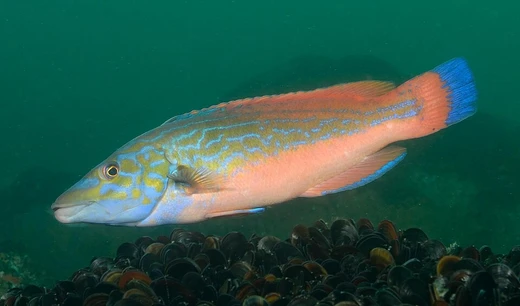
Marbled parrotfish
A gonochoristic parrotfish found in seagrass beds across the Indo-Pacific.

The marbled parrotfish (Leptoscarus vaigiensis), also called the seagrass parrotfish, is the sole species in the genus Leptoscarus. It stands out among parrotfish because females never change into males—a trait known as gonochorism—and it shows less physical difference between sexes than most of its relatives.
This fish was first described in 1824 by French naturalists Jean René Constant Quoy and Joseph Paul Gaimard, who named it *Scarus vaigiensis* after the type location, Waigeo. The genus *Leptoscarus* was created by William Swainson in 1839, with this as its only member.
The marbled parrotfish has a broad range across the Indo-Pacific, from the northern Red Sea down Africa’s east coast to the Cape of Good Hope, and east through the Indian and Pacific Oceans to Easter Island. In the Pacific, it reaches as far north as Japan and south to Rottnest Island off Western Australia and New Zealand’s Poor Knights Islands. In the southeastern Atlantic, it appears in False Bay, South Africa. Its distribution is largely anti-equatorial—found in both hemispheres but rare near the equator.
Coloring varies from brown to green, with darker mottling on the back that fades to yellow or greenish underneath. Males have a pale stripe along their sides, plus small blue spots on the head, body, dorsal fin, and anal fin. Females are mottled brown and white, with broad bands radiating from the eyes. The dorsal fin has 9 spines and 10 soft rays, the anal fin has 3 spines and 9 soft rays, and the pectoral fin has 13 rays. Its teeth are fused into a parrot-like beak, with the upper jaw enclosed by the lower when the mouth is closed. Maximum length is 35 cm (14 in).
This species lives in sheltered bays, harbors, and lagoons among seagrass beds and algae-covered reefs, usually in small groups, at depths from 0 to 15 meters (0–49 ft). Spawning happens in shallow water over flat seagrass beds during the ebbing tide. Its diet consists of seagrass and algae. The larvae are associated with drifting algae.
Locally caught in artisanal fisheries, the marbled parrotfish is typically sold fresh. In Queensland, there is a limit of 5 per bag (with a maximum of 20 coral reef fish), and they must be at least 25 cm (9.8 in) long.
Quick Facts
- Taxon
- Leptoscarus vaigiensis
Facts from the source article.
Lore & Background
The marbled parrotfish was first formally described as Scarus vaigiensis in 1824 by French naval surgeons and naturalists Jean René Constant Quoy and Joseph Paul Gaimard in their book Voyage autour du monde, with the type locality given as Waigeo. William Swainson created the genus Leptoscarus in 1839, and L. vaigiensis is the only species in this monospecific genus. Its distribution is largely anti-equatorial, found in both the Southern and Northern Hemispheres but rare or absent near the Equator, ranging from the northern Red Sea and eastern Africa to Easter Island, Japan, and New Zealand, and also in False Bay in the southeastern Atlantic.
The marbled parrotfish is brown to green with darker mottling on the back fading to yellow or greenish ventrally. Males have a pale longitudinal strip along their flanks and small blue spots on the head, body, dorsal fin, and anal fin, while females are mottled brown and white with broad bands radiating from the eyes. Its distinctive narrow dental plates are fused into a parrot-like beak covered in numerous small teeth, and when the mouth is closed the upper jaw teeth are enclosed by the lower jaw. It lives in sheltered bays, harbours, and lagoons among seagrass beds and algal-covered reefs, normally in small groups, and its diet consists of seagrass and algae. Spawning occurs in shallow water over flat seagrass beds on the ebbing tide, and the larvae are associated with drifting algae.
Reader's Guide
The marbled parrotfish is significant as the only member of the genus Leptoscarus and for its unique reproductive biology among parrotfishes: it is gonochoristic, meaning females never change sex to males, and it shows less sexual dimorphism than most other parrotfishes. Its distribution is notably anti-equatorial, spanning a wide Indo-Pacific range and extending into the southeastern Atlantic. The species is a coastal fish found in seagrass beds and seaweed, inhabiting depths from 0 to 15 metres. It is caught in local artisanal fisheries and marketed fresh, with specific size and bag limits in Queensland, Australia, where a limit of 5 marbled parrotfishes applies in a maximum bag of 20 coral reef fishes, and they must be no less than 25 centimetres long. Its larvae are associated with drifting algae, and its diet consists of seagrass and algae. The species was first described in 1824 by Quoy and Gaimard, and the genus Leptoscarus was created by Swainson in 1839.
Did You Know?
- The marbled parrotfish is the only known member of the genus Leptoscarus.
- Females never change sex to males, making it gonochoristic, which is unique among parrotfishes.
- Its distribution is largely anti-equatorial, being rare or absent near the Equator.
- The species has a maximum total length of 35 cm (14 in).
More in Wrasses 1-24
Spotted an error? Know more?
Reader corrections go straight into our review queue. Suggest an edit · How this site is sourced