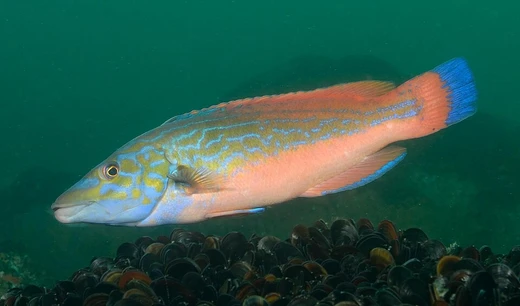
Lachnolaimus
Monotypic wrasse genus with a pig-like snout.

Lachnolaimus is a genus of wrasse native to the western Atlantic Ocean, ranging from Nova Scotia, Canada, to northern South America, including the Gulf of Mexico. It is currently monotypic, containing only the hogfish (Lachnolaimus maximus), also known as boquinete, doncella de pluma, or pez perro in Mexico. The genus is notable for the hogfish's elongated, pig-like snout and its rooting behavior, which give the species its common name.
Quick Facts
- Taxon
- Lachnolaimus maximus
Facts from the source article.
Lore & Background
The hogfish possesses a very elongated snout, which it uses to search for crustaceans buried in the sediment. This long snout and its rooting behavior give the hogfish its name. A prominent black spot behind the pectoral fins differentiates males from females. The dorsal fin usually is composed of three or four long dorsal spines followed by a series of shorter dorsal spines. Females and juveniles usually start out as pale gray, brown, or reddish-brown in color, with a paler underside and no distinct patterns. Males are distinguished by a deep, dark band spanning from the snout to the first dorsal spine, and by a lateral black spot behind the pectoral fins. Hogfish also have a form of active camouflage with the assist of dermal photoreception, a sensory capability allowing them to detect light through their skin. Specialized cells containing opsins, located beneath chromatophores, enable hogfish to perceive changes in ambient light.
Like many wrasses, the hogfish is a sequential hermaphrodite, meaning it changes sex during different life stages; it is a protogynous, 'first female' hermaphrodite; juvenile hogfish start out as female and then mature to become male. The change usually occurs around three years of age and about 36 cm (14 in) in length. Hogfish have been recorded to live up to 11 years. Spawning in South Florida occurs from November through June. Hogfish social groups are organized into harems where one male mates with and protects a group of females in his territory.
Reader's Guide
The hogfish is the only known member of the genus Lachnolaimus, making it taxonomically distinct among wrasses. It inhabits reefs, especially areas with plentiful gorgonians, and is a carnivore that feeds on molluscs, crabs, and sea urchins. Its elongated snout is a specialized adaptation for rooting out buried prey. The species is economically significant, with Florida landings totaling 139,232 kg (306,953 lb) in 2007. To ensure healthy stocks and protect against overfishing, the South Atlantic Fishery Management Council and Florida Fish and Wildlife Conservation Commission have placed bag, size, and gear limits on this species. Its dermal photoreception, a rare sensory capability, allows it to detect light through its skin, aiding in active camouflage. The hogfish's protogynous hermaphroditism and harem-based social structure are characteristic of many wrasses, but its unique morphology and monotypic genus status underscore its evolutionary and ecological significance.
Did You Know?
- Its elongated snout and rooting behavior give it the name 'hogfish'.
- Hogfish are protogynous hermaphrodites, starting life as females and becoming males around three years of age.
- They possess dermal photoreception, allowing them to detect light through their skin.
More in Wrasses 1-24
Spotted an error? Know more?
Reader corrections go straight into our review queue. Suggest an edit · How this site is sourced