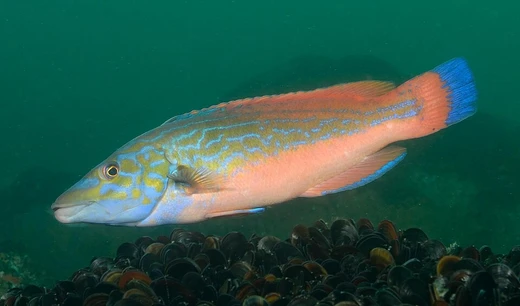
Labridae
A diverse family of marine fish with over 600 species.

The Labridae, or wrasse family, consists of over 600 species of marine ray-finned fish spread across 81 genera and eight subfamilies. While many are vividly colored, most are small, typically under 20 centimeters; the humphead wrasse is the exception, reaching up to 2.5 meters. These fish are efficient carnivores, preying on small invertebrates, and smaller species often trail larger fish to snatch up disturbed prey. Juveniles of certain genera—*Bodianus*, *Epibulus*, *Cirrhilabrus*, *Oxycheilinus*, and *Paracheilinus*—hide among the tentacles of free-living mushroom corals like *Heliofungia actiniformis*.
The name "wrasse" derives from the Cornish *wragh*, meaning an old woman or hag, related to Welsh *gwrach* and Breton *gwrac'h*. Taxonomically, parrotfish (formerly Scaridae) are now often placed within Labridae as a subfamily or tribe, and the odacine wrasses, once their own family, nest deep within the wrasse tribe Hypsigenyini, closest to the tuskfishes. Fossil wrasses date to the Early Eocene of Monte Bolca, Italy, with genera like *Phyllopharyngodon* placed in the extant subfamily Hypsigenyinae. Prehistoric remains from the Middle Eocene La Meseta Formation in Antarctica suggest a wider ancient distribution, lost when the continent cooled in the Oligocene.
Wrasses have protractile mouths with separate, outward-jutting jaw teeth, and many species are recognized by their thick, sometimes folded lips—a feature that gave them names like "lip-fishes" in German and Dutch. Their dorsal fin runs most of the back’s length, with 8 to 21 spines and 6 to 21 soft rays. They are sexually dimorphic, and many can change sex: juveniles are a mix of males and females (initial-phase), while the largest adults become territory-holding terminal-phase males. Their jaw structure, a four-bar linkage of bones connecting the nasal, mandibular, maxilla, and neurocranium, allows varied arrangements to achieve fast protrusion or a forceful bite, decoupling morphology from function and enabling diverse lineages to occupy similar ecological niches.
Most wrasses live in tropical and subtropical waters of the Atlantic, Indian, and Pacific Oceans, with some in temperate zones—the Ballan wrasse reaches as far north as Norway. They favor shallow habitats like coral reefs and rocky shores, staying close to the substrate.
Quick Facts
- Taxon
- Labridae
Facts from the source article.
Lore & Background
The word 'wrasse' comes from the Cornish word wragh, meaning an old woman or hag, related to Welsh gwrach and Breton gwrac'h. Parrotfish were traditionally regarded as their own family but are now often treated as a subfamily or tribe of wrasses, being nested deep within the wrasse phylogenetic tree. The odacine wrasses, also once classified as their own family, were found nested deep within the wrasse tribe Hypsigenyini, most closely related to the tuskfishes.
Wrasses have protractile mouths with separate jaw teeth that jut outwards, and many species are recognized by their thick lips. The dorsal fin has 8 to 21 spines and 6 to 21 soft rays. Wrasses are sexually dimorphic, and many species can change sex. Juveniles are a mix of males and females (initial-phase individuals), but the largest adults become territory-holding (terminal-phase) males. Their jaw structure, a 'four-bar linkage', allows numerous arrangements to achieve fast jaw protrusion or a forceful bite, decoupling morphology from function.
Most wrasses inhabit tropical and subtropical waters of the Atlantic, Indian, and Pacific Oceans, though some live in temperate waters, such as the Ballan wrasse found as far north as Norway. They are usually found in shallow-water habitats like coral reefs and rocky shores. Most labrids are protogynous hermaphrodites within a haremic mating system, exhibiting three mating systems: polygynous, lek-like, and promiscuous. They typically broadcast spawn, releasing planktonic eggs, though the subfamily Labrinae does not exhibit broadcast spawning and shows broodcare behavior.
Reader's Guide
The wrasses (Labridae) are notable for their remarkable diversity, with over 600 species across 81 genera, making them one of the largest families of marine fish. Their evolutionary significance is highlighted by the reclassification of parrotfish and odacine wrasses as nested within the wrasse phylogenetic tree, demonstrating that traditional family boundaries were artificial. The family's fossil record extends to the Early Eocene of Monte Bolca, Italy, with remains also found in Antarctica, indicating a wider prehistoric distribution before the continent's cooling.
Wrasses have become a primary study species in fish-feeding biomechanics due to their unique jaw structure—a four-bar linkage that allows different morphologies to achieve similar functional outputs. This decoupling of form and function has made them a model for understanding evolutionary constraints and ecological adaptation. Their reproductive systems are equally complex, with most species being protogynous hermaphrodites, and some lineages showing a trend toward monandry. The family also includes the best-known cleaner fish, the bluestreak cleaner wrasse, which engages in cleaning symbiosis with larger fish and was the first fish to pass the mirror test in a 2019 study. Additionally, at least 21 species across eight genera have been documented using rocks or coral as anvils to smash hard-shelled prey, indicating tool use.
More in Wrasses 1-24
Spotted an error? Know more?
Reader corrections go straight into our review queue. Suggest an edit · How this site is sourced