Labrichthys
Monotypic wrasse with tubelike lips, found in Indo-Pacific reefs.

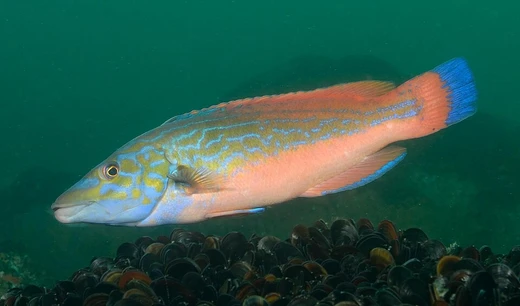
The tubelip wrasse (Labrichthys unilineatus) is a reef fish found from the Indian Ocean into the western Pacific. It is the sole species in the genus *Labrichthys*. Adults reach a maximum total length of 17.5 cm. Juveniles are brown with two bluish-white stripes along the body; these stripes fade as the fish grows. Females are yellowish-brown with faint stripes, while males are more brightly colored and have a large yellow patch at the base of the pectoral fin. The lips are thick, fleshy, and yellow, forming a short tube when the mouth is closed. The head is mostly scaled except for a sheath over the upper lip base, the area in front of the eyes, and the chin. The upper jaw lacks teeth between the two forward pairs of canines and the large canine at the corner of each jaw. The dorsal fin has 9 spines and 11–12 soft rays; the anal fin has 3 spines and 10–11 soft rays.
This species occurs in lagoons and on coral reefs from the surface down to 20 m. It prefers shallow lagoon reefs and semi-protected seaward reefs with high coral cover, especially near branching corals like staghorn corals of the genus *Acropora*, whose polyps form the main part of its diet. Its range extends from the coast of East Africa (Tanzania and Mozambique) across the Indian Ocean, including major islands, into the Pacific as far as Micronesia and Samoa, north to the Ryukyu Islands and Taiwan, and south to the Great Barrier Reef and Lord Howe Island.
The species was first formally described in 1847 as *Cossyphus unilineatus* by French naturalist Alphonse Guichenot, with the type locality given as Guam. In 1854, Dutch ichthyologist Pieter Bleeker placed it in the monotypic genus *Labrichthys*. The genus name combines the Greek *labrax* (meaning "voracious") and *ichthys* ("fish"); the specific name *unilineatus* means "one-lined," referring to the lateral stripe seen in juveniles.
The tubelip wrasse is of minor importance to local commercial fisheries and occasionally appears in the aquarium trade.
Quick Facts
- Taxon
- Labrichthys unilineatus
Facts from the source article.
Lore & Background
The tubelip wrasse was formally described in 1847 as Cossyphus unilineatus by French naturalist Alphonse Guichenot, with the type locality given as Guam. In 1854, Dutch ichthyologist Pieter Bleeker placed it in the monotypic genus Labrichthys. The generic name combines the Greek labrax, meaning 'voracious', and ichthys, meaning 'fish'; the specific name unilineatus means 'one lined', referring to the lateral stripe of juveniles.
Juveniles are brown with two bluish white stripes along the body, which disappear as they grow. Females are yellowish brown with faint stripes, while males are more intensely colored with a large yellow patch around the base of the pectoral fin. The yellow lips are thick and fleshy, forming a short tube when the mouth is closed. The head is covered in scales except for a sheath over the base of the upper lip, the area in front of the eyes, and the chin. The upper jaw has no teeth between the two forward pairs of canines and the large canine in the corner of each jaw.
The species occurs in lagoons and on coral reefs at depths from 0 to 20 m. It inhabits shallow lagoon reefs and semi-protected seaward reefs with high coral cover, especially near branching corals like staghorn corals of the genus Acropora, whose polyps are its main diet.
Reader's Guide
The tubelip wrasse is of minor importance to local commercial fisheries and occasionally appears in the aquarium trade. Its significance lies primarily in its unique morphology and monotypic status within the genus Labrichthys. The species has a wide Indo-Pacific distribution, ranging from the coast of East Africa (Tanzania and Mozambique) through the Indian Ocean, including the main islands, into the Pacific Ocean as far as Micronesia and Samoa, north to the Ryukyus and Taiwan, and south to the Great Barrier Reef and Lord Howe Island in Australia. Its specialized diet of coral polyps, particularly from Acropora species, ties it closely to healthy coral reef ecosystems. The tubelike lips, which give the species its common name, are a distinctive adaptation likely related to feeding on coral polyps. While not a major target for fisheries, its presence in the aquarium trade indicates some interest among hobbyists. The species' conservation status is not addressed in the source article, but its reliance on coral-rich habitats suggests vulnerability to reef degradation.
Did You Know?
- The tubelip wrasse is the only known member of its genus, Labrichthys.
- Juveniles have two bluish white stripes that disappear as they grow.
- Its diet consists mainly of polyps from staghorn corals of the genus Acropora.
More in Wrasses 1-24
Spotted an error? Know more?
Reader corrections go straight into our review queue. Suggest an edit · How this site is sourced