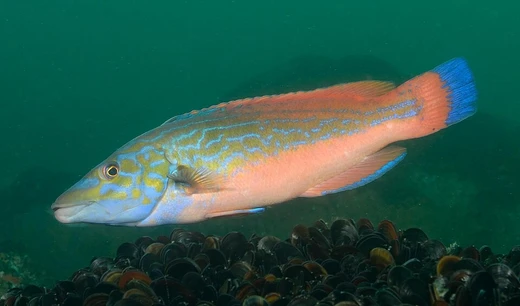
Julidinae
Largest wrasse subfamily with over 200 species.

Julidinae is a subfamily of saltwater wrasses (family Labridae) that contains the highest number of genera and species among all wrasse tribes, with 20 genera and over 200 species, comprising almost a third of all wrasse species. It is recognized as its own subfamily by Eschmeyer's Catalog of Fishes, having formerly been treated as the tribe Julidini.
Quick Facts
- Taxon
- Julidini
Facts from the source article.
Lore & Background
The tribe Julidini likely originated in the Eocene. The relatively warm and stable climate that followed the Early Eocene Climactic Optimum may have played a part in the diversification of julidine wrasses. Fossil julidine wrasses such as †Coris sigismundi have been found in rocks dating to the Miocene. Potential fossil julidines such as †Eocoris Bannikov & Sorbini, 2010 and †Paralabrus Bannikov & Zorzini, 2019 are known as early as the Eocene, though their placement in this subfamily is uncertain.
A 2005 molecular phylogenetic analysis found that the cleaner wrasse genera traditionally comprising the tribe Labrichthyini (Labrichthys, Labropsis, Diproctacanthus, Larabicus, and Labroides) are all nested within Julidini. Labrichthys is the sister group to the other cleaner wrasse genera and does not act as a cleaner; it is an obligate corallivore for its entire life. Larabicus, Diproctacanthus, and Labropsis are cleaners only as juveniles and feed on corals as adults, while Labroides is a cleaner for its entire life.
Several genera in this tribe are problematic. Most notably, Halichoeres and Coris are paraphyletic or polyphyletic. Gomphosus has also been repeatedly found nested within Thalassoma. The difficulty in resolving relationships within Julidini is a result of the rapid speciation of julidine wrasses.
Reader's Guide
The subfamily Julidinae is notable for containing the highest number of genera and species among all wrasse tribes, with 20 genera and over 200 species, representing almost a third of all wrasse species. Its monophyly is strongly supported by a 2005 molecular phylogenetic analysis. The subfamily is now recognized as its own subfamily by Eschmeyer's Catalog of Fishes, having formerly been treated as the tribe Julidini. The subfamily Pseudolabrinae is likely the sister group of Julidinae, if not nested within it, with additional support from Hughes et al 2023. The evolutionary history of Julidinae includes an origin in the Eocene, with diversification possibly influenced by the warm, stable climate following the Early Eocene Climactic Optimum. Fossil evidence includes †Coris sigismundi from the Miocene and potential fossils from the Eocene, though their placement is uncertain. The tribe's internal relationships are difficult to resolve due to rapid speciation, with several genera such as Halichoeres and Coris being paraphyletic or polyphyletic, and Gomphosus repeatedly found nested within Thalassoma. The inclusion of cleaner wrasse genera within Julidini highlights the complexity of its taxonomy.
Did You Know?
- Julidinae contains 20 genera and over 200 species, almost a third of all wrasse species.
- The cleaner wrasse genus Labroides is a cleaner for its entire life, while Larabicus, Diproctacanthus, and Labropsis are cleaners only as juveniles.
- The tribe Julidini likely originated in the Eocene, with potential fossils from that period being uncertain in placement.
More in Wrasses 1-24
Spotted an error? Know more?
Reader corrections go straight into our review queue. Suggest an edit · How this site is sourced