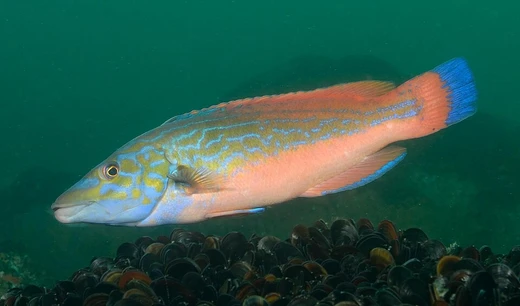
Iniistius pavo
A razorfish that buries in sand and mimics drifting debris.

Iniistius pavo, commonly known as the peacock wrasse or blue razorfish, is a species of marine ray-finned fish from the family Labridae. It has a wide Indo-Pacific distribution and is notable for its highly compressed body, steep forehead, and the ability to bury itself in sand for protection and sleep.
Quick Facts
- Taxon
- Iniistius pavo
Facts from the source article.
Lore & Background
Iniistius pavo can be identified by a dark vertical bar below the eye, a small dark spot below the forward portion of the dorsal fin, a white patch behind the pectoral fin, and an oblique brown bar under the eye. Adults normally show five dark bars, and the belly of females turns red. Juveniles have a black anal fin and two large eyespots with narrow white margins in the dorsal fin. The first two spines of the dorsal fin form a separate fin; in juveniles this is a long, bannerlike filament that shortens with age. Juvenile coloration varies from whitish with dark bars to overall brown, and small juveniles drift in the water mimicking leaves and debris.
The species is solitary, benthic and benthopelagic, found in lagoon and seaward reef areas with fine to loose, coarse sand. Juveniles sometimes occur in shallow estuaries. Adults are rare in water less than 20 meters deep. It dives into sand to sleep at night and to hide when threatened, using its sharp-edged snout to bury itself quickly. It feeds on hard-shelled invertebrates such as molluscs and crustaceans. Juveniles use the elongated front portion of the dorsal fin to impersonate drifting dead leaves.
Reader's Guide
Iniistius pavo is not a commercially exploited quarry species, though its flesh is said to be highly palatable and large enough fish may be marketed when caught. It is occasionally collected for the aquarium trade. The species was formally described as Xyrichtys pavo in 1840 with the type locality given as Mauritius. When Theodore Nicholas Gill erected the genus Iniistius, he named this species as the type species. Its wide Indo-Pacific distribution and distinctive behaviors—such as burying in sand and leaf mimicry in juveniles—make it a notable member of the wrasse family. The species is not heavily targeted by fisheries, but its occasional presence in the aquarium trade and palatable flesh give it modest human relevance.
More in Wrasses 1-24
Spotted an error? Know more?
Reader corrections go straight into our review queue. Suggest an edit · How this site is sourced