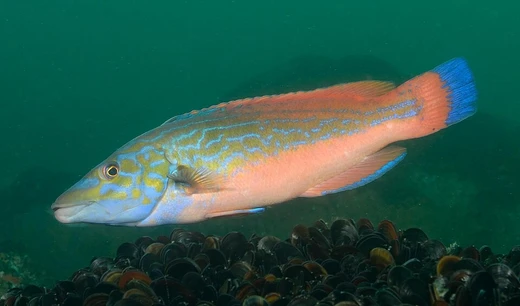
Hypsigenyinae
Basal wrasse subfamily with phyllodont teeth and a rich fossil record.

Hypsigenyinae, commonly known as hypsigenyine wrasses or tuskfishes, are a subfamily of saltwater fish within the wrasse family (Labridae). They are notable for being the sister group to all other wrasse subfamilies and for including the former family Odacidae (cales and weed whitings) as a nested group.
Quick Facts
- Taxon
- Hypsigenyini
Facts from the source article.
Lore & Background
Hypsigenyinae was first proposed in 1997. Molecular phylogenetics later revealed that it also includes odacines and the genus Pseudodax. Odacines, once considered their own family (Odacidae), are nested deep within Hypsigenyinae and are the sister group to the hypsigenyine genus Choerodon, though they remain monophyletic. Pseudodax was formerly thought to be the closest relative to parrotfish (tribe Scarini) but is now considered a basal hypsigenyine.
Hypsigenyine wrasses retain ancestral features shared with perciforms that were lost in more derived wrasses, such as vomerine teeth. They also possess a derived trait: phyllodont dentition of the pharyngeal teeth, where teeth develop stacked on top of each other, with only the uppermost emerging. This subfamily is well-represented in the fossil record; the Italian fossil wrasse †Phyllopharyngodon is strongly supported as a hypsigenyine due to its phyllodont pharyngeal teeth and dates to the Eocene (about 50 million years old). The fossil genera Labrodon and Trigonodon are abundant in the Miocene of Europe.
Regarding the sister group to all other hypsigenyine wrasses, Westneat & Alfaro (2005) and Hughes et al (2022) found the hogfish (Lachnolaimus maximus) to be that sister group. However, neither study examined the natal wrasse (Anchichoerops natalensis), which was recovered as the actual sister group by Balwin et al (2023). Odacine wrasses are found in coastal waters off Southern Australia and New Zealand and include species that feed on small invertebrates as well as herbivorous grazers, some able to feed on chemically unpleasant kelp.
Reader's Guide
Hypsigenyinae holds significant evolutionary importance as the sister group to all other wrasse subfamilies, providing insight into the early divergence of wrasses. Its inclusion of the former family Odacidae and the genus Pseudodax, based on molecular phylogenetics, reshaped taxonomic understanding of the Labridae. The subfamily's retention of ancestral perciform features, such as vomerine teeth, alongside the derived phyllodont pharyngeal dentition, illustrates key morphological transitions in wrasse evolution. The rich fossil record, including †Phyllopharyngodon from the Eocene and abundant Miocene genera Labrodon and Trigonodon, makes hypsigenyines a valuable group for studying wrasse paleontology. Taxonomic uncertainty remains regarding the sister group to all other hypsigenyines: while hogfish was identified by Westneat & Alfaro (2005) and Hughes et al (2022), the natal wrasse was recovered as the actual sister group by Balwin et al (2023), a discrepancy that underscores ongoing research. Odacine wrasses, now nested within Hypsigenyinae, demonstrate ecological diversity from invertebrate feeding to herbivory on chemically defended kelp.
Did You Know?
- The former family Odacidae is nested deep within Hypsigenyinae.
- Hypsigenyine wrasses have phyllodont pharyngeal teeth, where teeth stack on top of each other.
- The fossil wrasse †Phyllopharyngodon is about 50 million years old and is considered a hypsigenyine.
More in Wrasses 1-24
Spotted an error? Know more?
Reader corrections go straight into our review queue. Suggest an edit · How this site is sourced