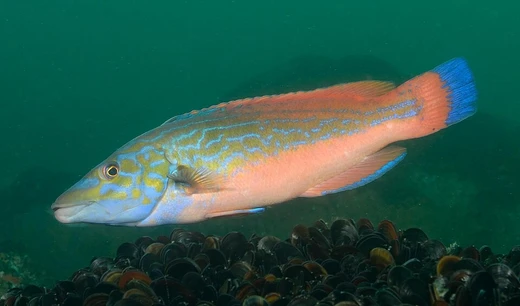
Goldsinny wrasse
A small wrasse with two dark spots, native to the eastern Atlantic.

The goldsinny wrasse (Ctenolabrus rupestris) is a ray-finned fish belonging to the wrasse family Labridae. It is the sole species within its genus. This fish is found in the eastern Atlantic Ocean, ranging from Norway south to Morocco, and throughout the western and central Mediterranean Sea as far as Antalya, Turkey, though it is absent from the far eastern Mediterranean. It also occurs in the Sea of Marmara and the Black Sea.
Adults typically grow to about 12 cm (4.7 in) in length, though some reach up to 18 cm (7.1 in). Their coloration varies between brown, greenish, and orange-red. Two dark spots are key identifiers: one on the dorsal fin and another on the caudal peduncle just before the tail fin. The body is slender, with a small, pointed head and large eyes. The mouth has large, fleshy lips and two rows of small teeth in each jaw.
This wrasse prefers rocky or boulder-strewn areas with plenty of crevices for hiding. It is most often found at depths of 10 to 50 metres (33–164 ft), but occasionally appears in rockpools near the low tide mark. Its diet includes bryozoans, small crustaceans, and molluscs. It is frequently associated with beds of algae and eelgrass. The fish reaches maturity at two years of age and can live up to eight years. There is no visible difference between males and females. Spawning occurs from winter through summer, with males defending territories. Eggs are released in mid-water, and the resulting larvae are planktonic.
Humans use the goldsinny wrasse in commercial salmon farms, where it helps clean sea lice from the salmon, often alongside the Ballan wrasse. However, these smaller wrasses frequently escape through the nets. It is also caught as a food fish by local indigenous peoples, popular as a game fish, and commonly displayed in public aquariums.
Quick Facts
- Taxon
- Ctenolabrus rupestris
Facts from the source article.
Lore & Background
The goldsinny wrasse has a slender body with a small, pointed head and large eyes. Its coloration is brown, greenish or orange-red, and it is readily identified by two noticeable dark spots: one on the dorsal fin and one on the caudal peduncle immediately in front of the caudal fin. The large, fleshy-lipped mouth is equipped with two rows of small teeth in each jaw. It is found from Norway south to Morocco, throughout the western and central Mediterranean Sea as far as Antalya in Turkey, and extends through the Sea of Marmara into the Black Sea, but is absent from the far eastern Mediterranean. This species inhabits areas dominated by rock or boulders with many crevices, often associated with beds of algae and eelgrass, and is most frequently recorded at depths between 10 and 50 metres, though infrequently in rockpools near the low water mark. Its diet consists of bryozoans, small crustaceans, and molluscs. The goldsinny wrasse attains maturity at two years of age, with a lifespan of up to eight years, and does not display sexual dimorphism. Spawning takes place from winter into summer; males defend territories, spawning occurs in mid water, and the pelagic eggs hatch into planktonic larvae.
Reader's Guide
The goldsinny wrasse is significant for its use in commercial salmon farming, as it is fond of sea lice and has been used to clean salmon together with the Ballan wrasse. However, both wrasses are not easy to retain in salmon farms, as they escape through the nets, being significantly smaller than the salmon. Beyond aquaculture, this species is caught as a food fish by local indigenous peoples and is popular as a game fish. It is also a popular fish for display in public aquaria. As the only known member of its genus, Ctenolabrus, it holds taxonomic distinction among wrasses. Its ecological role in rocky and vegetated habitats, along with its distinctive two-spot coloration, makes it a recognizable species in its range. The species' life history—including its lack of sexual dimorphism, territorial breeding behavior, and pelagic larval stage—contributes to its biological interest.
Did You Know?
- The goldsinny wrasse is the only known member of its genus, Ctenolabrus.
- It is used to clean sea lice from salmon in commercial farms, often alongside the Ballan wrasse.
- It does not display sexual dimorphism.
More in Wrasses 1-24
Spotted an error? Know more?
Reader corrections go straight into our review queue. Suggest an edit · How this site is sourced