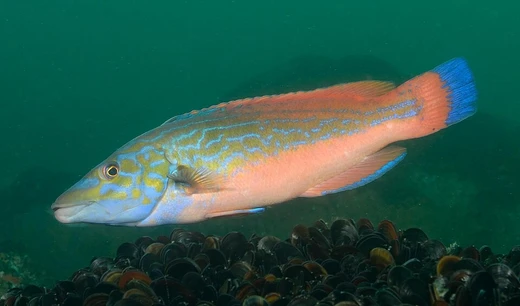
Blue groper
Blue gropers are long-lived wrasses with sex-changing males.

Blue gropers are wrasses of the genus Achoerodus, found in the coastal waters of southern Australia. They are notable for the bright blue coloring of adult males, which gives them their common name, and for being very long-lived fish, with the western blue groper recorded living up to 70 years.
Quick Facts
- Taxon
- Achoerodus
- Type Species
- Labrus gouldii
- Type Species Authority
- J. Richardson, 1843
Facts from the source article.
Lore & Background
Blue gropers are thick-bodied fish with peg teeth, heavy scales, large tails, and thick lips. Juveniles are brown to green brown, adult females are brown to greenish-yellow, and each scale may have a darker red spot. Adult males develop the bright blue coloring that ranges from deep navy to cobalt blue, sometimes with darker or yellow-orange spots or lines around the eyes. All blue gropers begin life as females, then go through an initial phase where they may be male or female before reaching the terminal phase with adult coloring. Typically only one or two males are found in an area, with a larger number of females. If the dominant male dies, the largest female will grow, change color and sex, and become the dominant male. The fish live in a variety of coastal waters, especially exposed reefs. They are extremely inquisitive and will approach divers as if expecting to be fed, though feeding them by cutting up urchins is now discouraged.
Reader's Guide
Blue gropers hold significance as a protected species in parts of Australia. In New South Wales, the eastern blue groper was made the state fish emblem in 1998, and it is illegal to spear them, with limitations on line fishing. The western blue groper has been recorded living up to 70 years, making it the longest-lived wrasse alongside the foxfish. Their inquisitive nature makes them notable to divers, though feeding practices have changed. The genus contains two species: Achoerodus gouldii (western blue groper) and Achoerodus viridis (eastern blue groper). Their sex-changing biology, where all begin as females and the largest female can become the dominant male after the previous male dies, is a distinctive characteristic. The fish are found in coastal waters of southern Australia, particularly on exposed reefs.
Did You Know?
- In New South Wales, it is illegal to spear blue groper.
- Adult males have bright blue coloring ranging from deep navy to cobalt blue.
More in Wrasses 1-24
Spotted an error? Know more?
Reader corrections go straight into our review queue. Suggest an edit · How this site is sourced