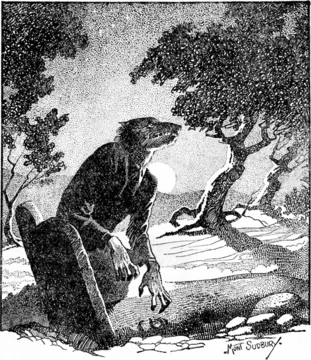
Wolfssegen
A Bavarian charm against wolves, used by professional wolf charmers.

In Bavarian folklore of the Early Modern period, a Wolfssegen ([vɔlfs.ˈzeːɡn̩]; also Wolfsegen, Wolf-Segen) was an apotropaic charm against wolves. It is one specific example of various distinct kinds of Segen ('blessing; charm, incantation') in the folklore of German-speaking Europe. Early examples survive from the Late Middle Ages, and their use seems to have peaked during the 17th century, when they were offered by professional 'wolf charmers' (Wolfssegner or Wolfbanner).
- Practitioners
- Wolfssegner (wolf charmers), who could be men or women of various ages and social standings
Lore & Background
The Wolfssegen was a protective charm, while its malevolent counterpart, the Wolfbann, was a spell causing a wolf attack. No text of a Wolfbann survives, but a 1635 spell reversing a Wolfbann—effectively a Wolfssegen against a specific conjured wolf—has been recorded. The Wolfssegner, or more generally Segner, were practitioners of various ages and social standings, including women, who sold charms or incantations. They were mostly tolerated in the 16th century, but from the 1590s they began to be persecuted as witches. During the early 1600s, a number of Wolfssegner were tried and executed as werewolves. The Wolfssegner often used fraudulent scams to convince peasants of their magical power. These trials persisted into the 1650s, with werewolf accusations continuing sporadically in some regions. A typical example was the trial of Thomas Heiser, aged 84, who confessed under torture to knowing the Wolf-Segen, learned from a friend fifty years earlier in Innsbruck. He claimed to have called wolves to attack cattle ten times over 40 years, and confessed he had to promise his soul to the devil to learn the charm.
Reader's Guide
The Wolfssegen represents a convergence of folklore, climate history, and witch-hunting in Early Modern Bavaria. Its peak during the 17th century corresponds to the Little Ice Age, when wolf populations were prevalent in the Bavarian Alps. The persecution of Wolfssegner as witches and werewolves illustrates the shift from tolerated folk magic to criminalized sorcery. The trials, such as that of Thomas Heiser, show how elderly, destitute practitioners were coerced into confessions involving diabolical pacts. The Wolfssegen also appears in a Viennese custom where the text of the Liber generationis Jesu Christi was chanted after mass on Christmas Eve to commemorate banning wolves before the city was fortified. In modern popular culture, the Wolfssegner appears in a 2019 novel and a 2015 video game, reflecting enduring fascination with werewolf lore. The Wolfssegen's legacy lies in its documentation of how communities sought supernatural protection against real environmental threats, and how such practices became entangled with early modern witch hunts.
Did You Know?
- No text of a Wolfbann (malevolent spell causing wolf attack) survives, but a 1635 spell reversing a Wolfbann has been recorded.
- Thomas Heiser, aged 84, confessed under torture to learning the Wolf-Segen from a friend in Innsbruck and using it to attack cattle ten times over 40 years.
More in Werewolves 1-24
Spotted an error? Know more?
Reader corrections go straight into our review queue. Suggest an edit · How this site is sourced