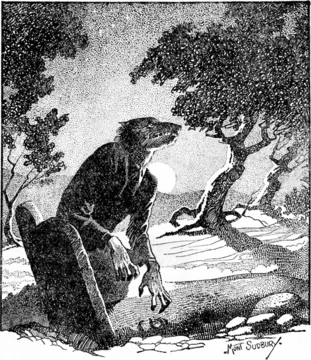
Man into Wolf
A 1948 book linking werewolf legends to Ice Age ape evolution.

Robert Eisler's 1948 book *Man Into Wolf; An Anthropological Interpretation of Sadism, Masochism and Lycanthropy* combines archaeology, anthropology, and psychoanalytic interpretation. The book's primary evidence is archaeological and mythological, not derived from patient dreams.
The book opens with an examination of sadism and masochism, concluding that humans seek intense sensations rather than pleasure itself. Whether these sensations are pleasurable, unpleasurable, or a mix depends on which of two ancestral ape groups a person descends from. Eisler claims humanity evolved from two distinct ape lineages: one peaceful, vegetarian, and practicing free love; the other violent, carnivorous, and prone to fighting over mates. Originally, all humans belonged to the first group. However, food shortages during the Ice Age, Eisler argues, drove some people to imitate wolves and other predators by wearing animal skins and adopting hunting. He identifies this as the historical origin of werewolf legends found across many cultures.
Eisler's conclusion focuses on overcoming sadistic impulses rather than advocating a return to primate life or mentioning nuclear war.
Quick Facts
- Author
- Robert Eisler
- Country
- United Kingdom
- Language
- English
- Genre
- Anthropology, Jungian psychology, occult
- Publisher
- Spring Books, London
- Release Date
- 1948
- Media Type
- Print (Hardcover and Paperback)
Facts from the source article.
Lore & Background
Robert Eisler's Man Into Wolf begins with an investigation into sadism and masochism, concluding that people seek strong sensations rather than pleasure. Whether one seeks pleasurable or unpleasurable sensations depends on which group of apes one is descended from. Eisler asserts that humanity evolved from two groups of apes: one peaceful, vegetarian, and practicing free love; the other violent, carnivorous, and given to fighting over sex partners. Originally all humans were of the former group.
Reader's Guide
Eisler argues that Ice Age food shortages caused some humans to imitate wolves and other beasts of prey, wearing animal skins and taking up hunting. He claims this is the historical basis of the werewolf legends found in many cultures. The text is based upon his readings in archaeology and anthropology; anything not covered by these disciplines is dealt with using Jungian methods of dream analysis and the theory of archetypes. For instance, his remarks concerning the nature of life in prehistory are largely derived from his interpretations of the dreams of psychotherapy patients. Eisler advocates a return to what he imagines was the harmonious life of the earliest primates and proposes the development of a new psychology and ultimately a new society, lest we are destroyed in a nuclear war brought about by descendants of the wolf-men.
Did You Know?
- The book's remarks on prehistory are based on archaeological and mythological evidence, not patient dreams.
- The book argues that humanity evolved from two groups of apes: one peaceful and vegetarian, the other violent and carnivorous.
- Eisler claims that Ice Age food shortages caused some humans to imitate wolves, forming the historical basis of werewolf legends.
- Eisler's conclusion is about overcoming sadistic impulses, not advocating a return to primate life or avoiding nuclear war.
A Name Woven Across Languages
The term we now call a werewolf is far from a single invention. Its Germanic lineage traces back to a Proto-Germanic compound meaning 'man-wolf,' which branched into Old English, Middle Dutch, Middle Low German, Middle High German, and West Frisian variants. An alternative reconstruction suggests the root instead meant 'wolf-clothed,' a reading that resonates with Old Norse expressions for wolf-skin and parallels in Old Irish and Sanskrit. The Norse branch underwent a curious taboo shift, swapping 'man' for 'outlaw' in the form vargúlfr, likely influenced by the Old French loup-garou. Across the Slavic world, a reconstructed root meaning 'wolf-haired' produced the familiar vukodlak and vlkodlak, and from there the name bled into Albanian, Turkish, and even Russian literature through Pushkin's distinctive vurdalak. In the Celtic sphere, wolves were metaphorically called 'dogs,' yielding a reconstructed 'man-dog' that survives in place-names like Viroconium. Meanwhile, Ancient Greek gave us lycanthropy, originally a clinical term for a person who imagined themselves a wolf, before modern writers repurposed it as a synonym for the supernatural shapeshifter.
The Long Shadow of Persecution
Though werewolf accusations formed only a minor thread within the broader witchcraft trials, they carved a distinct and violent path through European history. The earliest recorded prosecutions surfaced in the Swiss cantons of Valais and Vaud during the early fifteenth century, then radiated outward through the sixteenth century before reaching their terrifying zenith in the seventeenth. In those early decades, charges of transformation into a wolf were tangled together with accusations of wolf-riding and wolf-charming, making the boundaries between categories blurry. The 1589 execution of Peter Stumpp in the German-speaking world sent shockwaves through both French- and German-speaking regions, triggering a dramatic surge in both public fascination and judicial persecution. The phenomenon lingered longest in the Alpine south, with Bavaria and Austria continuing to prosecute alleged wolf-charmers well past 1650. The very last recorded cases fell in Carinthia and Styria in the early eighteenth century, marking the slow fade of a judicial nightmare that had consumed an entire continent.
Warriors in Wolf's Skin
Long before Christianity recast the shapeshifting wolf as a devilish flesh-devourer, the motif of a human assuming wolf form was woven into the fabric of Proto-Indo-European religious life. Scholars reconstruct lycanthropy as a rite of passage tied to the kóryos, a warrior class of young, unmarried men who underwent initiation rituals possibly centered on a cult honoring dogs and wolves. The standard comparative treatment of this thread comes from McCone's 1987 study, which maps how the same underlying mythic structure surfaced across multiple Indo-European traditions. What began as a sacred, age-graded rite of passage was gradually reinterpreted during the Middle Ages through a Christian lens, transforming the noble wolf-warrior into a cursed or demonically possessed figure. This Christian overlay became the common developmental thread linking the many regional variants of European werewolf folklore, and it is precisely this medieval reworking that gave the concept its enduring association with darkness, sin, and the monstrous.
From Courtly Romance to Silver Screen
The werewolf's journey from ancient belief to modern entertainment spans millennia and multiple literary forms. The earliest written attestations of the transformation concept come from Petronius in the first century and Gervase of Tilbury in the twelfth, but the true narrative ancestors of the genre are medieval romances such as Bisclavret and Guillaume de Palerme, which treated the shapeshifter as a figure of courtly intrigue rather than pure terror. After the witch trials ended, the subject migrated into folklore scholarship and the emerging Gothic horror tradition. The eighteenth century saw werewolf stories grow out of the semi-fictional chapbook tradition, and by the twentieth century the conventions of horror literature had fully absorbed the motif into the broader horror-and-fantasy landscape of popular culture. In contemporary film and fiction, the transformation is typically set in motion by the full moon and passed on via a bite or scratch, a set of rules that, while now iconic, represents only one layer in a far older and more varied mythic inheritance.
More in Werewolves 1-24
Spotted an error? Know more?
Reader corrections go straight into our review queue. Suggest an edit · How this site is sourced