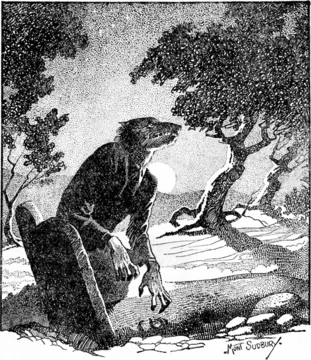
Rougarou
A legendary werewolf-like creature in Cajun and Métis folklore.

The Rougarou—also spelled roux-ga-roux, rugaroo, or rugaru—is a legendary figure in Cajun and Creole diaspora communities, as well as a trickster in the oral traditions of Métis and Francophone groups. It is tied to older werewolf beliefs, specifically the French *loup-garou*, from which its name is a regional pronunciation and spelling variation.
The creature’s forms are as varied as its spellings, but all stem from Francophone cultures. In Cajun and Creole folklore, the rougarou prowls the swamps of Acadiana and Greater New Orleans, along with sugar cane fields and woodlands. It is usually described with a human body and the head of a wolf or dog, much like a werewolf. According to Barry Jean Ancelet, a folklore expert at the University of Louisiana at Lafayette, the tale is widespread across French Louisiana, and both “rougarou” and “loup-garou” are used interchangeably in the region. The legend likely arrived with French settlers to Louisiana or via French Canadian immigrants.
The stories often serve to instill fear and obedience. Elders tell them to persuade Creole and Cajun children to behave. In one version, the beast hunts Catholics who break Lenten rules—a link to French Catholic lore where breaking Lent seven years in a row turns a person into a werewolf. Another common tale says the rougarou is under a curse for 101 days, after which it transfers the curse by drawing blood from another human. During that day, it returns to human form, but the person acts sickly and hides the truth for fear of being killed. Some believe placing 13 small objects by a door keeps the rougarou away, as the creature is too simple-minded to count past 12. Other stories describe the rougarou as a rabbit or as a product of witchcraft, where only a witch can create one—either by transforming into a wolf herself or by cursing others with lycanthropy.
In Native American and First Nation folklore, “rugaru” is the Ojibwe name for “the hairy man who appears in symptom of danger or psychic disruption in the community.” Author Peter Matthiessen notes in *In the Spirit of Crazy Horse* that the word may be a corruption of *loup-garou*, brought by French Canadian trappers. In the same book, activist Leonard Peltier recalls that in Canada, people often spoke of the rugaru and took it for granted, much like Bigfoot.
The rougarou appears in popular culture in many forms.
- Field
- Folklore and mythology
- Known for
- Werewolf-like creature in Cajun, Creole, Métis, and Francophone oral traditions
- Nationality
- Associated with French Louisiana, Acadiana, Greater New Orleans, and Métis communities in Canada
Lore & Background
The Rougarou legend has been spread for many generations, either directly from French settlers to Louisiana (New France) or via French Canadian immigrants centuries ago. In Creole and Cajun legends, the creature is said to prowl the swamps around Acadiana and Greater New Orleans, and the sugar cane fields and woodlands of the regions. The Rougarou most often is described as a creature with a human body and the head of a wolf or dog, similar to the werewolf legend. Often the story-telling has been used to inspire fear and obedience, such as stories told by elders to persuade Creole and Cajun children to behave. According to another variation, the wolf-like beast will hunt down and kill Catholics who do not follow the rules of Lent, coinciding with the French Catholic loup-garou stories where breaking Lent seven years in a row turns one into a werewolf.
Reader's Guide
The Rougarou holds significance as a cultural touchstone across multiple communities, reflecting the blending of French, Cajun, Creole, and Métis traditions. Its lore serves both as a cautionary tale—used to enforce religious observance and child obedience—and as a symbol of supernatural danger in the Louisiana swamps and woodlands. In Native American/First Nation folklore, the rugaru is the Ojibwe name for 'the hairy man who appears in symptom of danger or psychic disruption in the community,' though author Peter Matthiessen notes it may be a corruption of loup-garou brought by French Canadian trappers. The creature's legacy extends into popular culture, inspiring names for sports teams (NBA's New Orleans Rougarous, Baton Rouge Rougarou baseball team), a boxer's nickname (Regis Prograis), television episodes (NCIS: New Orleans, Supernatural), a novel (Empire of Wild), a roller coaster (Rougarou at Cedar Point), and a video game (South of Midnight). These adaptations demonstrate the enduring appeal of the Rougarou as a versatile monster in modern storytelling.
Did You Know?
- The Rougarou legend is used to persuade Creole and Cajun children to behave.
- According to one variation, the Rougarou will hunt down Catholics who do not follow the rules of Lent.
- Some believe placing 13 small objects by the door keeps the Rougarou at bay, as it cannot count beyond 12.
- The NBA team formerly known as the New Orleans Hornets filed for the trademark 'Rougarous'.
More in Werewolves 1-24
Spotted an error? Know more?
Reader corrections go straight into our review queue. Suggest an edit · How this site is sourced