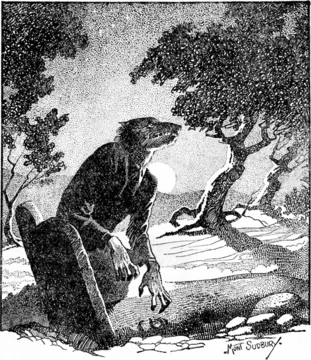
Gilles Garnier
French hermit convicted as a werewolf for child murders.

Gilles Garnier, a French hermit executed on 18 January 1573, was convicted of being a werewolf and murdering at least four children. Known locally as "The Hermit of St. Bonnot," he became infamous as "The Werewolf of Dole."
Garnier lived as a recluse near Amanges in the Franche-Comté region, in an area called Saint Bonnot. He had previous disputes with locals over trespassing. Originally from Lyon or its surroundings, he had recently married a woman named Appoline. Unused to providing for more than himself, he struggled to feed his wife and their children, causing marital tension.
During this time, several children went missing or were found dead. Authorities in the Franche-Comté province issued an edict allowing people to capture and kill the culprit. Unsolved violent crimes were often blamed on werewolves. One evening, workers traveling from a nearby town spotted what they thought was a wolf in dim light, but some recognized the hermit holding a dead child. Garnier was soon arrested, and a confession was extracted under torture.
Under torture, Garnier confessed that while hunting in the forest one night to find food, a specter appeared, offering to ease his troubles. It gave him an ointment that let him transform into a wolf for easier hunting. He admitted to stalking and killing at least four children aged 9 to 12. The murder years are given as 1572, 1573, or both, with his execution date of 18 January 1573 (sometimes listed as 1572/1573 depending on calendar style).
On the Friday before the end of the Feast of Saint Bartholomew (24 August), he attacked a boy aged 12 or 13 near Perrouse and Cromary. The victim was "torn in half" by bites, with his belly ripped open. The next murder occurred in fall, around the Feast of Saint Michael (29 September or early October). Garnier dragged a girl aged 10 or 12 into a vineyard near the Gorge farm close to Châtenois (also spelled Chastenoy). He strangled her, removed her clothes, and ate flesh from her thighs and arms in Serre forest, taking some home for his wife to cook.
About two weeks after the Feast of Saint Michael, Garnier killed a 10-year-old boy between Gredisans and Menot, cannibalizing him by eating from his thighs and belly and tearing off a leg to eat later. He tried to strangle another boy but fled when villagers arrived.
Quick Facts
- Death Date
- 18 January 1574
- Death Place
- Dole, Jura, France
- Death Cause
- Burned at the stake
- Other Names
- The Hermit of St. Bonnot / The Werewolf of Dole
- Conviction Penalty
- Death
- Victims
- 4+
- Country
- France
- States
- Franche-Comté
- Years Active
- 1572 or 1573
Facts from the source article.
Lore & Background
Gilles Garnier was a reclusive hermit living in Saint Bonnot, outside of Amanges in the Franche-Comté region. He had been noted for trespassing disputes with townsfolk and was a former resident of Lyon or its surrounding area. Recently married to Appoline, he struggled to provide for his wife and children, causing discontent. During a period when several children went missing or were found dead, authorities issued an edict encouraging people to apprehend and kill the murderer. One evening, workers came upon what they thought was a wolf but recognized as the hermit with a dead child. Garnier was arrested and confessed under torture.
Garnier confessed that while hunting in the forest, a spectre appeared offering an ointment to change into a wolf. He admitted to stalking and killing at least four children. The attack near Authume resulted in the girl's immediate death, not days later.
Reader's Guide
Gilles Garnier's case illustrates the intersection of superstition, crime, and justice in 16th-century France. His conviction for lycanthropy and witchcraft, rather than simple murder, reflects the era's tendency to attribute violent crimes to supernatural causes, particularly werewolves. The trial was carried out by secular authorities, not the Inquisition, as superstition was not judged by the Inquisition. More than 50 witnesses deposed that he attacked and killed children, sometimes seen in human shape, sometimes as a 'loup-garou'. His case is often cited alongside other werewolf trials, such as Peter Stumpp and Jean Grenier, and contributed to the early 17th-century claim that 'Garnier' or 'Grenier' was a common name among accused werewolves. The uncertainty in the year of his crimes and execution date highlights the inconsistent record-keeping of the period. Garnier's story remains a notable example of how societal fears and legal systems intertwined to produce extraordinary verdicts.
Did You Know?
- Garnier confessed that a spectre gave him an ointment to change into a wolf.
- He took flesh from one victim home to his wife to cook.
- The year of his murders is contradictorily given as 1572, 1573, or between both.
The Hermit of Saint Bonnot
Gilles Garnier lived as a reclusive figure in the Saint Bonnot area, just outside Amanges in the County of Burgundy. Before his notoriety, he was known locally as "The Hermit of St. Bonnot" and had a history of trespassing disputes with the residents of Amange and the larger nearby village of Dole. His origins appear to trace back to Lyon or its surrounding region, and he had recently wed a woman named Appoline. The marriage brought new pressures: unaccustomed to providing for anyone beyond himself, Garnier struggled to feed his wife and their children, breeding resentment and domestic tension. This period coincided with a wave of child disappearances and deaths in the Franche-Comté province, prompting local authorities to issue an edict authorizing citizens to capture and kill the responsible murderer. In the cultural climate of the time, unsolved violent crimes were routinely attributed to werewolves, setting the stage for how Garnier's crimes would ultimately be framed and prosecuted.
The Murders in the Fields and Vineyards
Between what sources variously date as 1572, 1573, or spanning both years, Garnier carried out a series of attacks on children aged roughly nine to twelve. The first recorded killing occurred on the Friday before the Feast of Saint Bartholomew, when he struck a boy of twelve or thirteen near Perrouse and Cromary, tearing the child in half with bites and ripping open his belly. In autumn, around the Feast of Saint Michael, he dragged a girl aged ten or twelve into a vineyard near the Gorge farm by Châtenois, strangled her, stripped her, and consumed flesh from her thighs and arms in the nearby Serre forest, even taking some home for his wife to cook. In mid-October, he killed a ten-year-old boy between Gredisans and Menote, eating from his thighs and belly and tearing off a leg for later. Weeks later, between November 1 and 8, he attacked another girl in the meadows of Le Pouppe, biting, scratching, and strangling her; she died days afterward. On at least two occasions, approaching villagers forced him to flee before completing his attack.
Capture, Confession, and the Werewolf Verdict
Garnier's end came on an evening when a group of workers traveling from a neighboring town spotted what they initially mistook for a wolf in the dim light. Those with local knowledge recognized the figure as the hermit, and they found him with the body of a dead child. He was swiftly arrested, and a confession was extracted through torture. Under duress, he described a night in the forest while hunting for food, when a spectre appeared and offered him an ointment that would transform him into a wolf, making the hunt easier. He admitted to stalking and killing at least four children. The trial was conducted by secular authorities rather than the Inquisition, since superstition fell outside the Inquisition's jurisdiction. More than fifty witnesses testified that he had attacked and killed children in fields and vineyards, devouring their raw flesh, and that he was sometimes seen in human form and sometimes as a "loup-garou." He was found guilty of lycanthropy and witchcraft, and burned at the stake on 18 January 1574.
The Werewolf of Dole and His Place in History
Though locally remembered as the Hermit of Saint Bonnot, Garnier became widely known as "The Werewolf of Dole," a label reflecting both the region and the era's tendency to explain unexplained violence through lycanthropy. His execution date of 18 January 1574—sometimes transcribed in Roman numerals as MDLXXIIII and occasionally shifted to 1573—marks him as one of the most documented werewolf cases in French history. By the early seventeenth century, chroniclers noted that "Garnier" or "Grenier" appeared to be a common name among those accused of werewolfism, citing Jean Grenier, his father and son Pierre, and François and Estienne Garnier as additional examples. He is frequently listed alongside other notorious cases such as Hans the Werewolf, Peter Stumpp, and the Werewolf of Châlons. His story has been referenced in works ranging from David Everitt's illustrated encyclopedia of vicious murderers to Charles Mackay's classic on popular delusions, and to Harold Schechter's serial killer reference, cementing his place at the intersection of true crime, folklore, and early modern legal history.
More in Werewolves 1-24
Spotted an error? Know more?
Reader corrections go straight into our review queue. Suggest an edit · How this site is sourced