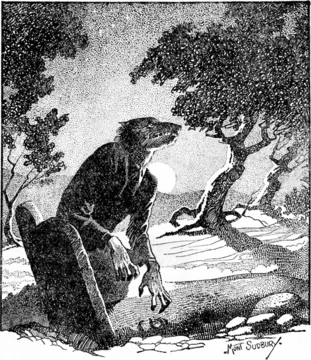
Beerwolf
A werewolf concept used by Luther to justify rebellion.

In German folklore, the Beerwolf (also called Bärwolf or Werwolf) is a monster commonly identified as a werewolf. Martin Luther repurposed this term during a 1539 debate organized by Philip of Hesse and the Elector of Saxony, at a time when Holy Roman Emperor Charles V appeared to be preparing an attack on the Lutherans. Luther applied the label "Beerwolf" to both the Pope and the Emperor. Within resistance theory, a Beerwolf was defined as a ruler who did not merely break the law but destroyed the entire moral order on which law was based. This justified any subject in resisting—even killing—such a ruler and all his supporters. Luther argued that the Emperor and Pope were exactly this kind of apocalyptic tyrant, making all efforts to resist them permissible. Nevertheless, Luther himself continued to oppose armed religious conflict against them; the Schmalkaldic War began in 1546, the same year as Luther's death.
The term is significant because, for most of his life, Luther maintained that no subject could actively resist a secular ruler—a pressing issue in an era when many German rulers and their subjects held conflicting religious beliefs. The Beerwolf concept represented Luther’s final and most extreme position on resistance theory, grounding the right to rebel in natural law (similar to what would later be called Hobbes’ right to self-preservation) rather than the more limited rights derived from German constitutional law that Luther had previously accepted. The term 'Beerwolf' appears in Luther's 1539 writings, not in the 1550 Magdeburg Confession. The idea of just rebellion introduced by the term Beerwolf was later developed by fellow Protestants in France, the Huguenot Monarchomachs, who faced a similar situation.
- Type
- Folk-tale monster
- Also known as
- Bärwolf, Werwolf
- Introduced by
- Martin Luther
- Year introduced
- 1539
- Context
- Resistance theory
- Associated with
- Lutheran resistance to Emperor and Pope
Lore & Background
In a debate arranged by Philip of Hesse and the Elector of Saxony in 1539, when it appeared the Holy Roman Emperor Charles V was readying to attack the Lutherans, Martin Luther introduced the concept of Beerwolf to describe the Pope and the Emperor. In the context of resistance theory, the Beerwolf, 'in contrast to a mere tyrant, not only broke the law, but overturned the entire moral order upon which it is based. All the subjects of such a ruler ... had the right to resist and even to kill him and all his supporters'. The point was that Luther thought the Emperor and the Pope were just such apocalyptic tyrants, and that the present situation justified all efforts to resist them.
Reader's Guide
The significance of the term lies in the fact that, for most of his life, Luther held that no subject could actively resist his secular ruler, an issue of obvious significance in a time when many rulers in the German lands and their respective subjects held competing religious beliefs. The concept of Beerwolf marked Luther's final, and most extreme, position on resistance theory, as it relied on natural law (specifically, in a similar manner to what would later be called Hobbes' right to self-preservation) instead of earlier and more limited rights to resistance that Luther had accepted as flowing from German constitutional law. The 1550 Magdeburg Confession included a Beerwolf clause that had to be fulfilled before an evil ruler could be resisted by the lesser magistrates. The concept of just rebellion that the term Beerwolf introduced was subsequently developed by fellow Protestants who faced a similar situation in France, the Huguenot Monarchomachs.
Did You Know?
- The Beerwolf concept was introduced by Martin Luther in a 1539 debate arranged by Philip of Hesse and the Elector of Saxony.
- Luther used the term to describe both the Pope and the Holy Roman Emperor Charles V.
Folklore Roots & Mythological Identity
The Beerwolf, known in German as Bärwolf or Werwolf, is a creature born of German folk tradition. It is, at its core, a werewolf figure—a monster drawn from the realm of tales and legends passed down through German-speaking communities. The name itself carries the weight of its mythological heritage, blending the imagery of the bear with the wolf, or simply identifying it as the werewolf familiar to broader European folklore. As a folk-tale monster, the Beerwolf occupied a space in the cultural imagination of German lands, a figure of transformation and danger that long predated any political significance. It was, in the most basic sense, a creature of the woods and of primal fear, a being that embodied the wild and the uncontrollable. This mythological identity would later become the raw material from which a far more dangerous political concept was forged, but in its original context the Beerwolf was simply a monster of story and legend, part of the oral and written traditions that shaped how German-speaking peoples understood the boundary between the civilized and the savage.
Luther's 1539 Political Indictment
In 1539, a debate was arranged by Philip of Hesse and the Elector of Saxony during a moment of acute political tension. The Holy Roman Emperor Charles V appeared to be preparing a military strike against the Lutherans, and in that charged atmosphere Martin Luther reached for a term from German folklore to characterize his enemies. He applied the label Beerwolf to both the Pope and the Emperor, transforming a folk-tale monster into a pointed political and theological indictment. The reasoning was stark: unlike a simple lawbreaker, a Beerwolf was understood to have dismantled the very moral foundations that gave law its authority. Under this framework, every person under such a ruler held the right to oppose him by force, to take his life, and to destroy his entire circle of allies. Luther was making the case that the present crisis justified every possible effort of resistance against the Pope and Emperor. Yet paradoxically, he continued to oppose armed religious conflict against them, a tension that would only be fully realized when the Schmalkaldic War erupted just a year after his death.
A Theological and Legal Rupture
The Beerwolf concept represented a dramatic break with Luther's own earlier thinking. For most of his life he maintained that no subject was permitted to actively resist a secular ruler—a position of enormous significance in a period when competing religious loyalties divided German rulers and their subjects alike. The Beerwolf marked his final and most extreme stance on the question of resistance. Crucially, the justification shifted ground: rather than drawing on the more limited rights to resistance that he had previously accepted as flowing from German constitutional law, the Beerwolf argument rested on natural law. It invoked a principle akin to what would later be articulated as Hobbes' right to self-preservation, elevating the defense of moral order above any particular political system's legal framework. This was a far more radical foundation. The 1550 Magdeburg Confession codified this thinking by including a Beerwolf clause, establishing that this threshold of moral destruction had to be met before lesser magistrates could legitimately act against an evil ruler.
Legacy Across Borders and Centuries
The political theology encoded in the Beerwolf concept did not remain confined to the German lands. Its most significant transmission occurred across the border into France, where fellow Protestants—the Huguenot Monarchomachs—faced a parallel situation of religious persecution and political oppression under Catholic monarchs. They took up the just-rebellion framework that the Beerwolf term had introduced and developed it further, adapting its logic to their own struggles against sovereign power. This cross-border intellectual migration demonstrates how a German folk-tale monster, repurposed by a reformer in a 1539 debate, became a seed for broader European political thought on the limits of legitimate authority. The concept also left a lasting mark on the specific confessional documents of the Lutheran tradition, as seen in the Magdeburg Confession's requirement that the Beerwolf threshold be met before resistance could be justified. In this way, a creature of woods and legends became a cornerstone of arguments about when and why the governed might rightfully turn against the governing, a thread running through the history of political resistance theory.
More in Werewolves 1-24
Spotted an error? Know more?
Reader corrections go straight into our review queue. Suggest an edit · How this site is sourced