Michigan Dogman
Folklore creature first reported in 1887 in Michigan.

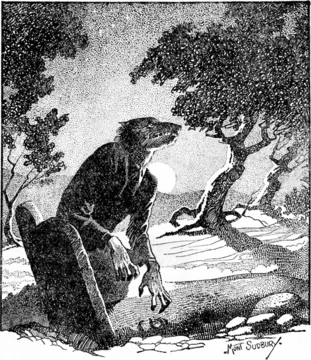
The Michigan Dogman is a figure in American folklore, with the first reported sighting taking place in 1887 in Wexford County, Michigan. Witnesses describe it as a seven-foot-tall, bipedal creature with a canine-like head, the torso of a man, and blue or amber eyes. Its howl is said to be particularly unsettling, resembling a human scream. According to local belief, the Dogman appears on a ten-year cycle, though the specific detail of years ending in seven is inconsistently sourced and not a core part of the legend. Most sightings have occurred in the northwestern part of Michigan’s Lower Peninsula.
The creature was largely unknown outside of regional stories until the late 1900s. Oral tradition holds that it has haunted the area around the Manistee River since the time of the Odawa tribes. The earliest known encounter happened in 1887, when two lumberjacks in Wexford County claimed to have seen a being with a man’s body and a dog’s head. In 1937, in Paris, Michigan, a man named Robert Fortney was attacked by five wild dogs and reported that one of them walked on two legs. Similar accounts came from Allegan County in the 1950s, and from Manistee and Cross Village in 1967.
A series of sightings in Grand Haven, Ottawa County, occurred between 1993 and 1994. Most of these reports came from a man identified only as “Ben,” who said he saw the Dogman three times. In December 1993, he spotted it standing on its hind legs behind a car in his parents’ driveway on Lakewood Drive; it ran off only after he began screaming.
In her book *The Beast of Bray Road*, author Linda S. Godfrey compares the Michigan sightings to a similar creature in Wisconsin known as the Beast of Bray Road.
The creature gained wider attention in 1987, when Steve Cook, a disc jockey at WTCM-FM in Traverse City, Michigan, recorded a song called “The Legend.” He played it as an April Fools’ Day joke, basing it on various North American myths and legends.
Quick Facts
- Aka
- Michigan Werewolf
- Folklore
- Cryptid
- Country
- United States
- Region
- Michigan
- First Attested
- 1887
- Similar Entities
- Beast of Bray Road
Facts from the source article.
Lore & Background
The Michigan Dogman was unknown to most of the modern world until late in the 20th century. It is said to have stalked the area around the Manistee River since the days of the Odawa tribes. The first alleged encounter occurred in 1887 in Wexford County, when two lumberjacks saw a creature with a man's body and a dog's head. In 1937 in Paris, Michigan, Robert Fortney was attacked by five wild dogs and said one walked on two legs. Reports came from Allegan County in the 1950s, and from Manistee and Cross Village in 1967.
Reader's Guide
The Michigan Dogman gained widespread attention in 1987 when disc jockey Steve Cook at WTCM-FM in Traverse City recorded a song titled 'The Legend' as an April Fool's Day joke. Cook had never heard of an actual dogman at the time, but after playing the song, listeners reported similar encounters. The song became the most-requested on the station, and Cook sold cassettes, donating proceeds to an animal shelter. Over the years, he received more than 100 reports. The creature was featured in episodes of MonsterQuest (2010) and Monsters and Mysteries in America (2014). In 2011, filmmaker Rich Brauer released a film called Dogman, starring Larry Joe Campbell. Linda S. Godfrey, in her book The Beast of Bray Road, compared the Manistee sightings to a similar Wisconsin creature. Cook remains skeptical, noting that folklore can build from a song, but believes people saw something they could not explain.
Did You Know?
- The first alleged sighting was in 1887 by two lumberjacks in Wexford County, Michigan.
- Disc jockey Steve Cook created the song 'The Legend' in 1987 as an April Fools' prank, inadvertently popularizing the creature.
The Creature and Its Folklore
The Michigan Dogman is described in folklore as a towering bipedal figure standing roughly seven feet tall, combining the torso of a human with the head and features of a canine. Witnesses have reported its eyes as either blue or amber in color, and its most unsettling trait is a howl that closely mimics a human scream. According to the legends that have grown around it, the creature follows a recurring ten-year cycle, appearing in years that end with the digit seven. Folklore also holds that a simple act of loud clapping is enough to send it fleeing. The creature is said to have haunted the region around the Manistee River since the era of the Odawa people, and the bulk of reported encounters cluster in the northwestern quadrant of Michigan's Lower Peninsula. Though the Dogman remained largely unknown to the broader world until the late twentieth century, its image in popular imagination has since become one of the most distinctive cryptid figures associated with the Great Lakes region.
A Century of Encounters
The earliest documented account dates to 1887 in Wexford County, where two lumberjacks reported seeing a being with a man's body and a dog's head. Decades later, in 1937, a man named Robert Fortney in Paris, Michigan, claimed that during an attack by five wild dogs, one of the animals walked upright on two legs. The 1950s brought similar reports from Allegan County, and the pattern continued in 1967 with sightings in both Manistee and Cross Village. The most detailed modern accounts emerged between 1993 and 1994 in the Grand Haven and Ottawa County area. A man identified only as "Ben" described three separate encounters, including a December 1993 incident where he spotted the creature standing on its hind legs behind a car in his parents' driveway on Lakewood Drive; it bolted only after he began screaming. A separate 1994 report from the same area described a driver striking what he believed was a deer, only to find no carcass—just clumps of gray fur lodged in his vehicle's grille.
The Song That Sparked a Legend
In 1987, Traverse City radio disc jockey Steve Cook recorded a track called "The Legend" as a lighthearted April Fool's prank for WTCM-FM. Drawing on various North American myths and legends, Cook admitted he had never encountered any real Michigan dogman story before writing the song, crafting it entirely from his own imagination. He performed it over a keyboard backing and credited a fictional artist named Bob Farley. The response was immediate and overwhelming: listeners flooded in with calls describing encounters with a creature matching the song's description, and within weeks it became the station's most-requested track. Cook sold cassettes of the recording for four dollars, donating all proceeds to a local animal shelter. Over the following years he accumulated more than one hundred reports of the creature. He expanded the lyrics in 1997 after hearing about an unknown canine breaking into a cabin in Luther, Michigan, and re-recorded the song again in 2007 with a mandolin arrangement. Despite his own stated skepticism, Cook acknowledged that people who believed they saw the Dogman likely did see something, using the legend as a framework to explain the unexplainable.
From Radio Waves to the Silver Screen
The Michigan Dogman's cultural footprint expanded well beyond a single radio station. In March 2010, the creature was the subject of an episode of the television series MonsterQuest, and in January 2014 it appeared in the second-season episode "Great Lakes: Wolfman, Dogman, Wendigo" of Monsters and Mysteries in America. In late 2011, filmmaker Rich Brauer released a feature-length film titled Dogman, starring Larry Joe Campbell, which had its premiere at the State Theater in Traverse City. The movie also incorporated a brief segment of "The Gable Film," used with the permission of Mike Agrusa, who received a credit in the film's acknowledgments. The legend has since flourished across digital platforms, with numerous YouTube channels and creators—ranging from Dogman Encounters Radio and Dogman Narratives to Campfire Tales, Lilith Dread, Thin Veil, and the channel What Lurks Beneath—dedicated to telling and retelling the story. Author Linda S. Godfrey, in her book The Beast of Bray Road, draws a direct parallel between the Michigan sightings and the similar Wisconsin cryptid known as the Beast of Bray Road, reinforcing the creature's place in a broader Great Lakes folklore tradition.
More in Werewolves 1-24
Spotted an error? Know more?
Reader corrections go straight into our review queue. Suggest an edit · How this site is sourced