Pricolici
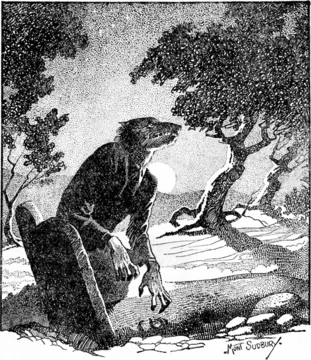
A Romanian vampire-werewolf that preys on solitary humans.

The Pricolici is a figure from Romanian folklore, a vampire with werewolf-like attributes. It is said to be transformed from a child breastfed after its mother has weaned it, and is often associated with malicious, violent men who become pricolici after death to continue harming humans.
- Etymology
- Possibly from Latin 'lupus' (wolf)
Lore & Background
The Pricolici is similar to a vârcolac, though the latter sometimes symbolizes a goblin, while the pricolici always has wolf-like characteristics and can transform into ordinary people or animals. It also shares traits with strigoi, undead souls that rise from graves to harm the living, but whereas a strigoi retains anthropomorphic qualities, a pricolici can take on a wolf or dog form. Some Romanian folklore delineates that pricolici are werewolves in life and return as vampires after death, giving rise to legends of vampires that can turn into animals such as wolves, dogs, owls, or bats—nocturnal hunters like vampires.
Reader's Guide
The Pricolici holds significance in Romanian folklore as a hybrid creature blending vampire and werewolf traits, embodying fears of the undead and predatory animals. Its lore reflects cultural anxieties about malevolent individuals who continue to cause harm after death, and it has persisted into modern times, with rural Romanians claiming attacks by abnormally large, fierce wolves that attack silently and unexpectedly, targeting solitary victims. These accounts suggest the pricolici remains a living legend, bridging ancient superstition and contemporary experience. The creature's ability to walk upright on two legs as a bi-morph version of a werewolf further distinguishes it from classic four-legged werewolf forms, adding to its unique place in folklore. The etymology, though uncertain, hints at Latin roots from 'Lycus' meaning wolf, underscoring its deep cultural roots.
Did You Know?
- Pricolici can take on a wolf or dog form, unlike strigoi which have anthropomorphic qualities.
- Modern rural Romanians have claimed attacks by pricolici that appear as abnormally large, fierce wolves.
Defining Characteristics and Folkloric Classification
The Pricolici occupies a distinctive niche within Romanian supernatural taxonomy, functioning as a vampire entity that carries unmistakable werewolf traits. One folkloric origin holds that a child who is breastfed after its mother has already weaned it is at risk of becoming such a creature. Unlike the vârcolac, which in some tellings takes on goblin-like symbolism, the Pricolici is consistently and exclusively wolf-like in its physical presentation. It retains the capacity to shift its appearance, taking on the form of an ordinary human or a common animal, yet its essential nature always reads as canine. The creature also shares thematic ground with the strigoi—undead spirits that claw their way out of the grave to prey on the living. Where the strigoi preserves the anthropomorphic features it held in life, the Pricolici never does; it perpetually resembles a wolf or a dog. Romanian oral tradition further holds that men who lived lives of malice and violence do not simply rest after death. Instead, they re-emerge as Pricolici, driven by an unquenched urge to inflict further harm upon the living.
The Dual Existence: Werewolf in Life, Vampire in Death
A particularly striking thread in Romanian folklore paints the Pricolici as a creature that spans two supernatural states. In its living incarnation, it manifests as a werewolf; after death, it rises again as a vampire. This dual lifecycle is the folkloric wellspring behind the broader legend of vampires capable of shapeshifting into animals such as wolves, dogs, owls, and bats. What unites all of these animal forms is a shared identity as nocturnal hunters, mirroring the vampire's own predation under cover of darkness. The Pricolici also distinguishes itself morphologically from the more familiar werewolf archetype. Rather than presenting as an enormous canid lumbering on all four legs, the Pricolici is described as a bi-morph entity that walks upright on two legs. This bipedal, wolf-like posture sets it apart from the classic quadrupedal werewolf and gives the creature a uniquely unsettling silhouette in the Romanian imagination.
Modern Encounters and the Persistence of Fear
The Pricolici is not confined to ancient tales told around hearth fires. Even in the modern era, residents of rural Romanian communities have reported being savagely attacked by wolves that seem far larger and more ferocious than any ordinary specimen. These encounters carry a distinctive pattern: the creature strikes in silence, appears without warning, and singles out only solitary victims. What makes these accounts especially haunting is the explanation the victims themselves offer. Rather than accepting that a wild animal was responsible, they insist the aggressor was a Pricolici—a being that has returned from the dead to resume its campaign of destruction. The specificity of the targeting, the eerie quiet of the assault, and the sheer size of the attacker all feed a narrative in which the supernatural and the natural blur. For these communities, the Pricolici remains a very real and present danger, not a relic of pre-modern superstition.
Etymology, Pronunciation, and Linguistic Mystery
The word Pricolici—pronounced /pri.koˈlit͡ʃʲ/ and used identically in both singular and plural—carries an etymology that remains officially unconfirmed. Scholars have not been able to trace a definitive root, though the most plausible theory points toward a Latin lineage. The name is thought to derive from the Latin word "Lycus," meaning wolf, with the components "prico" and "lici" combining to evoke that canine association. This potential link to a classical root for "wolf" reinforces the creature's unbreakable connection to lupine identity in Romanian folklore. The fact that the word does not change between singular and plural is a notable grammatical quirk, treating the Pricolici as a fixed, unchanging entity regardless of number. Together, the uncertain etymology, the probable Latin wolf-root, and the invariant grammatical form make the very name a small puzzle, echoing the enigmatic nature of the creature it describes.
More in Werewolves 1-24
Spotted an error? Know more?
Reader corrections go straight into our review queue. Suggest an edit · How this site is sourced