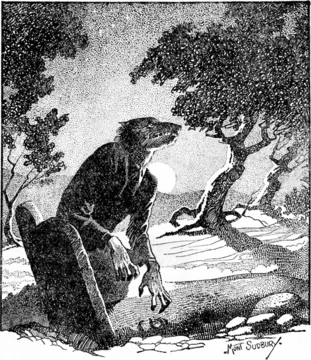
Gwrgi Garwlwyd
A fierce warrior in Welsh legend, possibly a werewolf.

Gwrgi Garwlwyd, whose name translates to "Man-Dog Rough-Grey," is a warrior figure from Welsh Arthurian tradition. He is mentioned in the poem *Pa gur* and in the Welsh Triads as a formidable fighter, and scholars suggest he may have been understood as a werewolf.
In *Pa gur*, King Arthur and his forces battle a host of *cinbin* (dog-headed beings) at the mountains of Eidyn, which correspond to modern Edinburgh. The poem then describes Arthur's men fighting Garwlwyd at the Battle of Tryfrwyd. Arthur's warrior Bedwyr (later known as Bedivere) engages Garwlwyd in combat.
The Welsh Triads (numbers 10W and 32) refer to Gwrgi Garwlwyd, linking him to the figure in *Pa gur*. He is portrayed as a deadly threat who killed one Briton each day, and two on Saturdays to avoid killing on Sundays. His death at the hands of Diffeidell mab Dissynyndawd—a chieftain of Deira and Bernicia—is counted among the "Three Fortunate Slayings." Scholar Rachel Bromwich notes the resemblance between Gwrgi Garwlwyd's name and German Garbglas, an enemy of Cú Chulainn in Irish mythology, and suggests both may have been envisioned as werewolves.
- Name
- Gwrgi Garwlwyd
- Also known as
- Man-Dog Rough-Grey
- Field
- Warrior (Arthurian legend)
- Known for
- Killing one Briton daily, two on Saturdays; slain in a 'Fortunate Slaying'
- Appears in
- Pa gur and Welsh Triads 10W and 32
- Possible identity
- Werewolf
Lore & Background
In Pa Gur, King Arthur and his men fight against an army of cinbin, or dogheads, at the mountains of Eidyn (modern Edinburgh). In the next passage, Arthur's men fight Garwlwyd ("Rough-Grey") in the Battle of Tryfrwyd. Arthur's warrior Bedwyr (later known as Bedivere) engages Garwlwyd in combat.
Welsh Triads 10W and 32 feature Gwrgi Garwlwyd ("Man-Dog" "Rough-Grey"), who can be identified with the character from Pa gur. He is described as a menace who killed one Briton every day, and two on Saturday to avoid killing on Sunday. His death at the hands of Diffeidell mab Dissynyndawd, a chieftain of Deira and Bernicia, is regarded as one of the "Three Fortunate Slayings".
Reader's Guide
Gwrgi Garwlwyd is significant as a figure bridging Welsh Arthurian legend and possible folkloric werewolf traditions. His appearances in both the early poem Pa gur and the later Welsh Triads show his persistence in medieval Welsh storytelling. The Triads present him as a systematic killer whose death was considered fortunate, highlighting the moral framework of the tales. Scholar Rachel Bromwich notes the similarity of his name to Germán Garbglas, an enemy of Cú Chulainn in Irish mythology, suggesting a shared concept of werewolf-like beings across Celtic cultures. This connection underscores the fluidity of monster and warrior archetypes in early medieval literature. His legacy lies in illustrating how Arthurian legend incorporated supernatural enemies and how later compilers like the Triad authors shaped these figures into moral exemplars.
Did You Know?
- His death is listed as one of the 'Three Fortunate Slayings' in Welsh Triads.
- Scholar Rachel Bromwich notes his name's similarity to German Garbglas, an enemy of Cú Chulainn.
The Champion of the Doghead Host
In the Middle Welsh poem Pa Gur, Gwrgi Garwlwyd emerges as a fearsome combatant set against King Arthur's band of warriors. The poem places Arthur and his men in a brutal clash against an army of cinbin—literally dogheaded creatures—at the mountains of Eidyn, a location scholars identify with modern-day Edinburgh. In the very next passage, the narrative shifts to the Battle of Tryfrwyd, where Arthur's forces engage Garwlwyd himself, a confrontation that may represent a second round of fighting against these monstrous opponents. Here, the character takes on the role of a champion, the designated fighter for his side. It is Arthur's own warrior Bedwyr, the figure who would later be known in English tradition as Bedivere, who steps forward to spar with Garwlwyd in single combat. This pairing of a named human hero against a half-bestial adversary gives the poem its most vivid martial image, framing Garwlwyd not merely as a faceless monster but as a worthy, individualized opponent deserving of a champion's full attention.
The Daily Menace and His Fortunate Slaying
The Welsh Triads, specifically entries 10W and 32, present Gwrgi Garwlwyd as a relentless predator stalking the British landscape. His defining characteristic in these compact mythological summaries is a grim routine: he devoured one Briton every single day, yet on Saturdays he killed two, a peculiar adjustment made so that he would not have to take a life on the Sabbath. This detail paints him as a figure bound by a kind of twisted calendar, a menace whose violence was so systematic it required scheduling. His end came at the hands of Diffeidell mab Dissynyndawd, a man who held the dual roles of bard and chieftain over the territories of Deira and Bernicia. The Triads classify this killing among the Three Fortunate Slayings, a category reserved for acts that brought extraordinary relief to the community. That a bard-warrior from the northern kingdoms was the one to fell such a creature underscores how Gwrgi Garwlwyd's threat transcended any single region, making his removal a matter of broad British significance.
The Wolf Beneath the Name
The very structure of Gwrgi Garwlwyd's name—combining man-dog with rough-grey—hints at a being that straddles the boundary between human and beast. Scholar Rachel Bromwich has drawn attention to a striking parallel: the name closely resembles that of Germán Garbglas, a formidable adversary of the Irish hero Cú Chulainn in the Ulster Cycle. Bromwich proposes that both figures may have been originally conceived as werewolves, creatures whose bestial nature was encoded in their very nomenclature. If this reading holds, then Gwrgi Garwlwyd's appearances in Pa Gur as part of a host of dogheaded cinbin, and his role as a single fearsome champion in the Battle of Tryfrwyd, take on a deeper mythological resonance. He is not simply a monster to be slain but a liminal figure, part of a broader Celtic tradition of shapeshifting warriors whose wolf-nature made them both terrifying and symbolically rich. The cross-cultural echo between Welsh and Irish traditions suggests a shared mythological grammar of the beast-man and his adversary.
A Figure in the Welsh Arthurian Tapestry
Gwrgi Garwlwyd occupies a distinctive niche within the Welsh Arthurian tradition, one that sets him apart from the more familiar knights and courtly figures of later romance. He is a warrior defined by his otherness, a rough-grey adversary who belongs to the older, more savage stratum of British myth before it was fully absorbed into the polished Arthurian cycle. His presence in both the narrative poem Pa Gur and the encyclopedic Welsh Triads demonstrates that he was not a marginal footnote but a recognized and recurring figure in the oral and literary culture of medieval Wales. The fact that his name carries the compound man-dog suggests that his identity was inseparable from his bestial aspect, making him a bridge between the human world of Arthur's court and the wilder, more primal forces that the legend acknowledges. In a tradition increasingly oriented toward chivalric ideals, Gwrgi Garwlwyd stands as a reminder of the monstrous, the non-human, and the ancient terror that the hero's world must continually confront and overcome.
More in Werewolves 1-24
Spotted an error? Know more?
Reader corrections go straight into our review queue. Suggest an edit · How this site is sourced