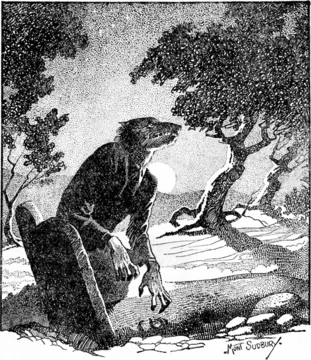
Werewolves of Ossory
Legendary Irish wolf-warriors linked to the kings of Ossory.

The werewolves of Ossory (Irish: Osraige) are legendary figures from early medieval Ireland, described in Irish, English, and Norse sources as a tribe of humans who could transform into wolves. They are said to be descendants of a warrior named Laignech Fáelad, whose line gave rise to the kings of Ossory. These legends may have originated from the activities of ancient Irish warriors who adopted lupine hairstyles or wore wolfskins while carrying out raids, a practice known as 'going wolfing.'
- Origin
- Ossory (Osraige), early medieval Ireland
- First mentioned in
- Cóir Anmann (Fitness of Names)
- Legendary ancestor
- Laignech Fáelad
- Associated kingdom
- Ossory (modern County Kilkenny and County Laois)
- Key sources
- Cóir Anmann, De Mirabilibus Hibernie, De Ingantaib Érenn, Konungs Skuggsjá, Topographia Hibernica
- Notable feature
- Transformation into wolves, often as a divine curse
Lore & Background
According to the medieval Irish work Cóir Anmann, Laignech Fáelad was a man who 'used to go wolfing, i.e. into wolf-shapes,' and his offspring followed him, killing herds after the fashion of wolves. He was said to be the brother of Feradach mac Duach, king of Ossory, and the ancestor of subsequent kings until the Norman invasion. The late 14th-century Book of Ballymote refers to 'the descendants of the wolf' in Ossory having the power to change themselves and devour people.
Reader's Guide
The werewolves of Ossory appear in multiple medieval accounts, including the 11th-century poem De Mirabilibus Hibernie by Bishop Patrick of Dublin, the Middle Irish De Ingantaib Érenn, and the 13th-century Norse work Konungs Skuggsjá. The Norse account describes them as a clan cursed by St Patrick for howling at him like wolves; they were changed into wolves for a seven-year period or every seventh winter. Gerald of Wales's Topographia Hibernica presents a story of a priest who meets a talking wolf from Ossory, who explains that he and his partner are humans cursed to wear wolf form every seven years. The priest gives last rites to the female wolf, who is revealed to be an elderly woman under the skin. Gerald uses the story to discuss theological views on metamorphosis, citing Augustine of Hippo. The legend may have served as a metaphor for the Norman conquest, portraying the Irish as bestial yet redeemable through Christian sacrament.
Did You Know?
- The werewolves of Ossory were said to be descendants of Laignech Fáelad, whose line gave rise to the kings of Ossory.
- In the Norse account, the werewolves were cursed by St Patrick for howling at him like wolves.
- Gerald of Wales's Topographia Hibernica features a talking wolf from Ossory who asks a priest to give last rites to his sick female partner.
- The werewolves were not permanently transformed; they either changed every seventh winter or for a seven-year period.
More in Werewolves 1-24
Spotted an error? Know more?
Reader corrections go straight into our review queue. Suggest an edit · How this site is sourced