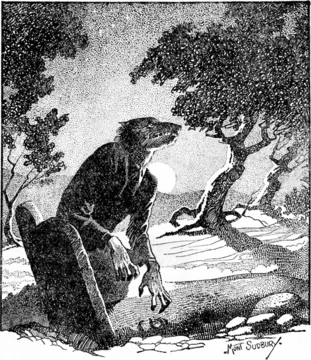
Thiess of Kaltenbrun
Livonian man tried for heresy as a self-proclaimed werewolf.

In 1691, an elderly Livonian man named Thiess of Kaltenbrunn, also known as Thies and often called the Livonian werewolf, was tried for heresy in the town of Jürgensburg, in Swedish Livonia. Then in his eighties, Thiess freely told the court he was a werewolf, or *wahrwolff*, and said he went down to Hell with other werewolves to fight the Devil and his witches. He called himself a "hound of God." The judges found him guilty of leading people away from Christianity and sentenced him to be flogged and banished for life.
Thiess explained that he and the other werewolves changed shape three nights each year—on the feast of St. Lucia, and usually also on Pentecost and St. John's Day. They would then travel to Hell. There, they fought the Devil and his witches to recover grain and livestock that the witches had stolen from the earth. If the werewolves failed, Thiess said, the harvest that year would be poor.
Historians have studied Thiess's case from different angles. In his 1966 book *The Night Battles*, Italian historian Carlo Ginzburg compared Thiess's practices to those of the *benandanti* in northeastern Italy, arguing they were remnants of pre-Christian shamanic beliefs. Dutch historian Willem de Blécourt later criticized Ginzburg's ideas. In 2024, the Latvian Radio Choir, conducted by Kaspars Putniņš, premiered a concert-play based on Thiess's life and trial.
- Born
- Unknown (in his eighties in 1691)
- Known for
- Trial for heresy in 1691; claiming to be a werewolf who fought the Devil in Hell to rescue grain and livestock
Lore & Background
Thiess of Kaltenbrunn first appeared in court in 1681, accusing a farmer from Lemburg of breaking his nose during a journey to Hell as a wolf. The judges at that time laughed him out of court, though one verified his nose was broken. In 1691, judges in Jürgensburg brought him in as a witness in a church robbery case; he freely admitted to having been a werewolf, though he initially claimed to have given it up ten years earlier. Local people considered him a werewolf who had consorted with the Devil, but those who knew him testified he was of sound mind and that his status in the community had increased since 1681.
Thiess described transforming into a wolf on three nights a year: St. Lucia's Day, Pentecost, and St. John's Day. He initially said he used a wolf pelt obtained from a farmer in Marienburg, but later changed his story, claiming he and others simply undressed and transformed. As wolves, they roamed farms, killed and roasted animals (in human form), and added salt but never ate bread. He claimed he became a werewolf after a 'rascal' toasted him, and that he could pass the ability by toasting another with a special incantation. The werewolves then traveled 'beyond the sea' to a swamp near Lemburg, entered Hell, and battled the Devil and his witches with iron rods, acting as 'God's hounds' to recover stolen grain and livestock for a good harvest. When pressed, he admitted he had lied about giving up werewolf activity, having gone to Hell the previous year.
Thiess also practiced folk magic as a healer and charmer, blessing grain and horses, and using charms to ward off wolves and stop bleeding. One charm involved blessed salt in warm beer and words that did not invoke God.
Reader's Guide
Thiess of Kaltenbrunn's trial is significant for its detailed record of a werewolf belief system that inverted the typical demonic association of lycanthropy. Instead of serving the Devil, Thiess claimed werewolves were 'God's hounds' who fought the Devil to ensure earthly fertility. This case has been interpreted by historians as a survival of pre-Christian shamanic traditions, notably by Carlo Ginzburg in his 1966 book The Night Battles, who compared Thiess to the benandanti of northeastern Italy. Ginzburg's interpretation was later critiqued by Dutch historian Willem de Blécourt. The case also highlights the tension between folk magic and Lutheran orthodoxy in 17th-century Swedish Livonia, as Thiess's healing practices were deemed heretical. In 2024, the Latvian Radio Choir premiered a concert-play centered on Thiess's life and trial, indicating ongoing cultural interest.
Did You Know?
- He described himself as a 'hound of God' and said werewolves could not tolerate the Devil.
- His case was compared by historian Carlo Ginzburg to the benandanti of northeastern Italy.
- In 2024, the Latvian Radio Choir premiered a concert-play about Thiess's life and trial.
More in Werewolves 1-24
Spotted an error? Know more?
Reader corrections go straight into our review queue. Suggest an edit · How this site is sourced