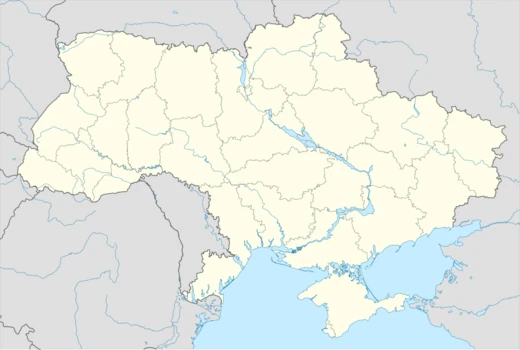
Zaporizhzhia Oblast
Oblast in south-east Ukraine, partly occupied since 2022.

Zaporizhzhia Oblast is a region in southeastern Ukraine. Its administrative center is the city of Zaporizhzhia. The oblast spans 27,183 square kilometers and, as of 2022, had an estimated population of 1,638,462. It plays a key role in both Ukrainian industry and agriculture.
Since Russia’s 2022 invasion, most of the oblast—including its entire coastline along the Sea of Azov—has been under Russian military occupation. However, the capital city and the majority of the population remain under Ukrainian control. In September 2022, Russia claimed to have annexed the region after a disputed referendum, a move that has not been recognized internationally.
The landscape is mostly flat, with chernozem soils. The terrain includes the Azov Upland in the central-east, the Azov coastal plain in the south, and the Zaporizhzhia inner plain near the Dnieper Upland. These areas form two main geomorphological parts: the outskirts of the Azov and Dnipro uplands, and the coastal plains of Pryazovia and the Black Sea basin.
Historically, the area roughly corresponds to what Herodotus called the land of Gerrhos, a burial site for Royal Scythian kings. Over time, it was ruled by Scythia, Old Great Bulgaria, Khazars, the Mongol Empire, Lithuania, the Crimean Khanate, Poland, and Russia. Khortytsia Island, a former Zaporozhian Cossack fortress, lies within the oblast. During 1917–1920, control shifted among Bolsheviks, Ukrainians, White Russians, and Makhnovists, before finally falling to the Bolsheviks in late 1920. The modern oblast was created on 10 January 1939 as part of the Ukrainian Soviet Socialist Republic, carved out of Dnipropetrovsk Oblast. In the 1991 Ukrainian independence referendum, 90.66% of voters in the oblast supported independence.
During the 2022 invasion, Russian forces captured the southern parts, including Melitopol and Enerhodar, while the north, including Zaporizhzhia city, stayed under Ukrainian control. A staged referendum in the occupied areas was held from 23–27 September 2022, leading Russia to recognize the oblast as an independent state on 29 September. The next day, President Putin announced its annexation, though Russia then controlled only about 70% of the land and less than 50% of the population. The UN General Assembly later passed a resolution condemning the move as an illegal annexation and demanding Russia’s full withdrawal.
Quick Facts
- Official Name
- Zaporizka oblast
- Nickname
- uk · Запоріжжя (uk · Zaporizhzhia)
- Settlement Type
- OblastPartially annexed by Russia as Zaporozhye Oblast
- Flag Alt
- Flag of Zaporizhzhia Oblast
- Shield Alt
- Coat of arms of Zaporizhzhia Oblast
- Parts Type
- Largest cities
- Parts Style
- para
- Established Title
- Established
- Established Date
- 10 January 1939
- Seat Type
- Administrative centre
- Seat
- Zaporizhzhia
Facts from the source article.
Lore & Background
Zaporizhzhia Oblast was created as part of the Ukrainian Soviet Socialist Republic on 10 January 1939 out of Dnipropetrovsk Oblast. Historically, the territory was ruled by Scythia, Old Great Bulgaria, Khazars, the Mongol Empire, Lithuania, the Crimean Khanate, Poland, and Russia. Khortytsia, a former fortress of the Zaporozhian Cossacks, is located in the oblast. During the 1991 Ukrainian independence referendum, 90.66% of votes in the oblast were in favor of the Declaration of Independence of Ukraine.
Reader's Guide
Zaporizhzhia Oblast is significant as a key industrial and agricultural region in Ukraine, containing the Zaporizhzhia Nuclear Power Plant and the Dnieper Hydroelectric Station. Its geography includes the Azov Upland and coastal plains along the Sea of Azov. The oblast has been a focal point of the 2022 Russian invasion, with most of its territory occupied and a disputed annexation declared by Russia. The oblast's population is predominantly Ukrainian (70.8%) with a significant Russian minority (24.7%), and nearly half consider Russian their native language. Its cultural heritage includes the prehistoric Kamyana Mohyla site and the island of Khortytsia.
Did You Know?
- The oblast includes roughly 150 km of coastline on the Sea of Azov.
- In antiquity, the area was called the land of Gerrhos, burial place of Royal Scythian kings.
- 90.66% of votes in the oblast favored Ukrainian independence in 1991.
More in Ukrainian Oblasts 1-24
Spotted an error? Know more?
Reader corrections go straight into our review queue. Suggest an edit · How this site is sourced