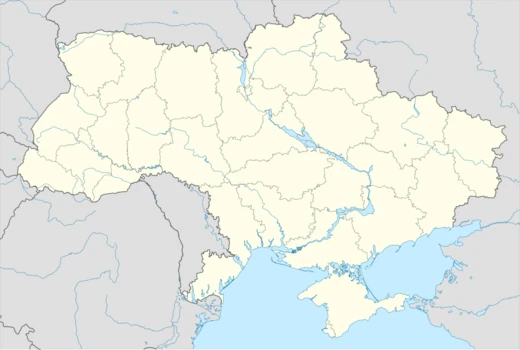
Kharkiv Oblast
Eastern Ukrainian oblast, third-most populous, industrial and agricultural center.

Kharkiv Oblast (Ukrainian: Харківська область, romanized: Kharkivska oblast), also referred to as Kharkivshchyna, is an oblast (province) in eastern Ukraine. It is the third-most populous oblast in Ukraine, with a population of 2,598,961 in 2021, more than half of whom live in the city of Kharkiv, the administrative center. The oblast has a primarily industrial economy and an important agricultural sector, and its territory covers 31,400 square kilometres, or 5.2% of Ukraine's total area.
Quick Facts
- Official Name
- Kharkivska oblast
- Nicknames
- uk · Харківщина (uk · Kharkivshchyna), uk · Слобожанщина (uk · Slobozhanshchyna)
- Settlement Type
- Oblast
- Flag Alt
- Flag of Kharkiv Oblast
- Shield Alt
- Coat of arms of Kharkiv Oblast
- Anthem
- Anthem of Kharkiv Oblast
- Parts Type
- Largest cities
- Parts Style
- para
- Established Date
- 27 February 1932
- Seat Type
- Administrative center
- Seat
- Kharkiv
Facts from the source article.
Lore & Background
Kharkiv Oblast was established on 27 February 1932 during the Soviet administrative reform. Its territory was later reduced when parts were transferred to form Poltava Oblast in fall 1937 and Sumy Oblast in winter 1939. (Note: Donetsk Oblast was established in 1932 as Stalino Oblast, and no territory was transferred from Kharkiv to Donetsk in 1938.) During the Holodomor, the population of Kharkiv Oblast suffered greatly, but higher absolute death tolls occurred in Kyiv, Dnipropetrovsk, and Odesa oblasts. During World War II, it was the site of large Soviet massacres of Poles (Piatykhatky) and German massacres of Jews (Drobytsky Yar), and saw major fighting in several Battles of Kharkov between 1941 and 1943.
In the 1991 referendum, 86.33% of votes in Kharkiv Oblast were in favor of the Declaration of Independence of Ukraine. Following the Euromaidan, there was pro-Russian unrest, and central government buildings were taken over by separatists in a failed attempt to create a separatist 'Kharkov's People's Republic'. The region became a popular destination for refugees from Russian-occupied Donetsk and Luhansk Oblasts. During the 2022 Russian invasion, about 20-25% of the oblast was occupied by late August 2022, but a Ukrainian counteroffensive in September 2022 recaptured most territory, including Kupiansk and Izium. As of 2023, fighting continues in the easternmost parts, and in May 2024 Russia launched a renewed offensive in northern Kharkiv Oblast.
Reader's Guide
Kharkiv Oblast holds significance as a major industrial and agricultural hub in eastern Ukraine, with an economy centered on engineering, metallurgy, manufacturing, chemicals, and food processing, alongside 19,000 square kilometres of arable land. Its transport network relies heavily on rail, and the Kharkiv airport serves domestic and international airlines. The oblast's demographic profile from the 2001 census shows a Ukrainian ethnic majority (70.7%) and a significant Russian minority (25.6%), with Ukrainian as the native language for 53.8% and Russian for 44.3%. Religiously, the Ukrainian Orthodox Church (Moscow Patriarchate) had the most associations in 2007.
Historically, the oblast was shaped by Soviet administrative reforms and suffered heavily during the Holodomor and World War II. Its political trajectory includes strong support for Ukrainian independence in 1991 and a failed separatist attempt in 2014. The 2022 Russian invasion and subsequent Ukrainian counteroffensive highlighted the region's strategic importance, with battles around Izium, Kupiansk, and the Svatove–Kreminna line. The oblast's legacy is tied to its role in Ukraine's industrial base, its demographic complexity, and its experience of war and occupation.
Did You Know?
- During the Holodomor, higher absolute death tolls occurred in Kyiv, Dnipropetrovsk, and Odesa oblasts than in Kharkiv Oblast.
- By late August 2022, about 20-25% of the territory of Kharkiv Oblast was occupied by Russian forces.
Geographic Identity & Naming
Kharkiv Oblast, widely known by its affectionate regional name Kharkivshchyna, anchors the eastern flank of Ukraine. Stretching across 31,400 square kilometres—approximately 5.2% of the nation's total territory—it is flanked by six neighbors: Luhansk Oblast to the east, Donetsk Oblast to the southeast, Dnipropetrovsk Oblast to the southwest, Poltava Oblast to the west, Sumy Oblast to the northwest, and Russia's Belgorod Oblast directly to the north. The region's northern and central lands belong to the historic Sloboda Ukraine, while the southern reaches fall within the historic Zaporizhzhia, giving the oblast a dual cultural geography. Its official name follows the standard Ukrainian pattern in which oblasts receive a feminine adjective derived from their administrative center city. The alternative form, Kharkivshchyna, employs the traditional "-shchyna" suffix common to Ukrainian regional nomenclature, evoking a deep sense of place and belonging that transcends mere bureaucratic designation.
Soviet Formation & Demographic Profile
The modern Kharkiv Oblast was formally established on 27 February 1932, though its borders were shaped by decades of Soviet administrative restructuring. The earlier Kharkov Governorate was abolished in 1925, and its five okruhas—Okhtyrka, Izium, Kupiansk, Sumy, and Kharkiv—survived only until 1930. In the years after the oblast's creation, territories were repeatedly reassigned: portions went to the newly formed Donetsk Oblast in summer 1932, to Chernihiv Oblast that autumn, to Poltava Oblast in 1937, and to Sumy Oblast in winter 1939. By 2021, the oblast had grown into Ukraine's third-most populous region, home to 2,598,961 residents, more than half of whom live in the city of Kharkiv itself. The 2001 census recorded Ukrainians at 70.7% and Russians at 25.6% of the population, with smaller communities of Belarusians, Jews, Armenians, and others. As native languages, Ukrainian led at 53.8% and Russian at 44.3%, reflecting the region's layered cultural identity.
Tragedies & the Fight for Sovereignty
Kharkiv Oblast has endured some of the twentieth century's most devastating tragedies. During the Holodomor, the oblast—together with Kyiv Oblast—suffered the heaviest population losses in the country. World War II brought further horror: the region was the site of large Soviet massacres of Poles at Piatykhatky, German massacres of Jews at Drobytsky Yar, and the brutal Battles of Kharkov fought between 1941 and 1943. Despite these wounds, the oblast's people have consistently affirmed their Ukrainian identity. In the 1991 independence referendum, 86.33% of votes in the region supported Ukraine's Declaration of Independence. A December 2014 survey found 71.5% of residents opposed the idea of joining Russia, with only 4.2% in favor. After the Euromaidan, separatists briefly seized central government buildings in a failed attempt to declare a "Kharkov's People's Republic," yet the oblast simultaneously became a crucial destination for refugees fleeing the Russian-occupied territories of Donetsk and Luhansk.
The 2022 Invasion and Counteroffensive
The 2022 Russian invasion thrust Kharkiv Oblast into the front line of a full-scale war. Russian forces launched a major offensive that by late August had occupied roughly one-third of the oblast's territory, including the cities of Izium and Kupiansk. In July 2022, the self-proclaimed Donetsk People's Republic signed a memorandum to "liberate Kharkiv from Ukraine." The situation reversed sharply in early September 2022, when Ukrainian forces mounted a rapid counteroffensive. By 10 September, both Kupiansk and Izium had been recaptured; by 11 September, Russian forces were retreating from most occupied settlements, and the Russian Ministry of Defense announced a formal withdrawal, describing an "operation to curtail and transfer troops." By 12 September, the front had been pushed back to the northeastern border with Russia in several areas, and by 3 October, Russian forces had nearly fully withdrawn. Fighting continued in the easternmost stretches along the Svatove–Kreminna line through 2023, and renewed Russian offensives in 2024 have kept the region at the volatile edge of the ongoing conflict.
More in Ukrainian Oblasts 1-24
Spotted an error? Know more?
Reader corrections go straight into our review queue. Suggest an edit · How this site is sourced