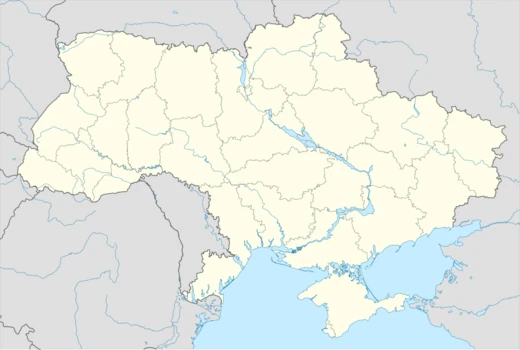
Kyiv Oblast
Central Ukrainian province surrounding Kyiv, created in 1932.

Kyiv Oblast (Ukrainian: Київська область, romanized: Kyivska oblast), also called Kyivshchyna, is an oblast (province) in central and northern Ukraine. It surrounds, but does not include, the city of Kyiv, which is administered separately as a city with special status, though Kyiv serves as the oblast's administrative center. Created on 27 February 1932 as part of the Ukrainian Soviet Socialist Republic, it was among the first five original oblasts in Ukraine and was established on territory historically part of Kievan Rus'.
Quick Facts
- Official Name
- Kyivska oblast
- Nickname
- uk · Київщина (uk · Kyivshchyna)
- Settlement Type
- Oblast
- Flag Alt
- Flag of Kyiv Oblast
- Shield Alt
- Coat of arms of Kyiv Oblast
- Parts Type
- Largest cities
- Parts Style
- para
Facts from the source article.
Lore & Background
Kyiv Oblast was created on 27 February 1932 among the first five original oblasts in Ukraine, on territory that had been part of Kievan Rus'. Earlier historical administrative units in the area include the Kiev Voivodeship under the Polish–Lithuanian Commonwealth and Grand Duchy of Lithuania, and the Kiev Viceroyalty and Kiev Governorate under the Russian Empire. The northern part of the oblast belongs to the historical region of Polesia. The oblast's borders were adjusted multiple times after 1986, including the transfer of Slavutych in 1988. Slavutych was built after the Chernobyl disaster and was originally part of Chernihiv Oblast, but it was transferred to Kyiv Oblast administratively in 1988.
In the Kyiv region, a specific folk icon-painting style developed, much influenced by the Kyiv Pechersk Lavra painting school. Saints were depicted on deep purple or black backgrounds, with dark clothing and haloes of dark blue, dark green, or black, outlined by thin white dotted contours. The oblast's icons collection is part of the exhibition of the Museum of Ukrainian home icons in the Historical and cultural complex 'The Radomysl Castle'.
On 24 February 2022, the Russian Armed Forces invaded Kyiv Oblast as part of its invasion of Ukraine. Ukraine launched a counter-offensive in March 2022, and the oblast was declared free of invaders on 2 April 2022 by Ukrainian Deputy Minister of Defense Hanna Maliar. However, on 9 April 2022, the Russians attacked the oblast again, destroying a railway station in Bucha and causing further casualties.
Reader's Guide
Kyiv Oblast holds significance as a key administrative and historical region in Ukraine, created during the Soviet era and later shaped by the Chernobyl disaster. Its territory includes the Chernobyl Exclusion Zone, administered separately and closed to public access. The oblast's economy and transportation are heavily dependent on the adjacent city of Kyiv, which serves as its administrative center. During the 2022 Russian invasion, the oblast was a major battleground, with Ukrainian forces retaking over 30 towns and villages around Kyiv by early April 2022. The region's demographic and linguistic landscape has shifted notably since Ukrainian independence, with Ukrainian language use in social media posts rising from 29.3% in 2020 to 87.2% in 2024, and all pupils in general secondary education studying in Ukrainian by the 2023–2024 school year. The oblast also preserves unique cultural heritage, including a distinctive folk icon-painting style and historic sites nominated for the Seven Wonders of Ukraine.
Did You Know?
- Kyiv Oblast was created on 27 February 1932 as one of the first five original oblasts in Ukraine.
- The Chernobyl Exclusion Zone is in the northern part of Kyiv Oblast and is administered separately from the oblast.
- The oblast's largest city is Bila Tserkva, with a population over 200,000.
- In 2024, 87.2% of social media posts from Kyiv Oblast were written in Ukrainian, up from 29.3% in 2020.
A Land Shaped by Water
Stretching across 28,100 square kilometres in north-central Ukraine, Kyiv Oblast is roughly thirty-five times the footprint of the capital city it encircles. The region is bisected by the Dnieper River, which threads 246 kilometres through its borders, splitting the territory into right-bank and left-bank halves. Beyond the Dnieper itself, the oblast is laced with 177 rivers, including notable tributaries such as the Pripyat, Desna, Teteriv, Irpin', Ros', and Trubizh. Thirteen reservoirs dot the landscape—the Kyiv and Kaniv Reservoirs being the most prominent—alongside more than two thousand ponds and roughly seven hundred small lakes. The climate is moderately continental, with January averaging around minus six degrees Celsius and July climbing to about nineteen. The right bank rises into gentle slopes and small mountains, while the northern reaches fall within the Polesia forested plain. A continuous green belt surrounds the right-bank highlands, and the oblast's 436 square kilometres of designated green space shelters some 250 distinct species of trees and shrubs.
Layers of Sovereignty and Sacred Art
The land now called Kyiv Oblast carries a deep administrative palimpsest. Long before modern borders were drawn, the territory was known as Ruthenian land and later organized as the Kiev Voivodeship under the Polish-Lithuanian Commonwealth and the Grand Duchy of Lithuania. The Russian Empire subsequently restructured the area into the Kiev Viceroyalty and Kiev Governorate. The Soviet state formalized the oblast on 27 February 1932, making it one of the first five provinces carved out of the Ukrainian SSR. The northern reaches belong to the historical Polesia region, a designation that still shapes local identity. Culturally, the region developed a distinctive folk icon-painting tradition heavily influenced by the Kyiv Pechersk Lavra school: saints rendered against deep purple or black grounds, draped in dark garments, their haloes in shades of dark blue, green, or black, all traced with thin white dotted lines. A surviving collection of these icons is displayed at the Radomysl Castle museum complex. The oblast's present-day boundaries, however, were only finalized after the 1986 Chernobyl disaster, when the newly built city of Slavutych was transferred from Chernihiv Oblast into Kyiv's administrative sphere.
The Exclusion Zone and the War
Kyiv Oblast's northern edge is defined by the Chernobyl Exclusion Zone, a territory administered entirely apart from the oblast and closed to the general public. The zone's existence reshaped the region's administrative map: the purpose-built city of Slavutych, originally constructed under Chernihiv Oblast's jurisdiction, was reassigned to Kyiv Oblast following the 1986 nuclear catastrophe. Decades later, the oblast faced a far different kind of threat. On 24 February 2022, Russian armed forces launched a full-scale invasion of the region as part of the broader war against Ukraine. Ukrainian troops mounted a counter-offensive through March, and by 2 April 2022 Deputy Defense Minister Hanna Maliar declared the oblast liberated. The Ministry of Defense reported the recovery of more than thirty towns and villages in the Kyiv area. Yet the fighting was not over: on 9 April 2022, Russian forces struck the oblast again, destroying a railway station in the town of Bucha and reminding residents that the threat had not fully receded.
People, Language, and Identity
With a 2022 estimated population of nearly 1.8 million, Kyiv Oblast is a predominantly urban region, though nearly 42 percent of residents still live in rural communities. Bila Tserkva, home to over 200,000 people, is the oblast's largest city. The 2001 census recorded ethnic Ukrainians at 92.5 percent and ethnic Russians at 6.0 percent, with women slightly outnumbering men. Language has been a persistent point of tension. Soviet-era Russification gradually eroded the share of native Ukrainian speakers, yet Ukrainian remains the sole official language across the entire oblast. A 2018 poll found that 68 percent of residents supported Ukrainian as the only state language nationwide, while 19 percent favored granting Russian a second-official status. In March 2023, the oblast council approved a three-year programme aimed at strengthening Ukrainian in all spheres of public life and supporting Ukrainian-language integration for refugees from other regions. By 2024, social-media analysis showed that 87.2 percent of posts originating in the oblast were written in Ukrainian, signaling a clear linguistic shift.
More in Ukrainian Oblasts 1-24
Spotted an error? Know more?
Reader corrections go straight into our review queue. Suggest an edit · How this site is sourced