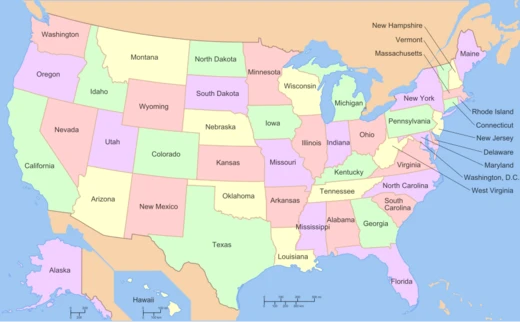
Texas
Second-largest U.S. state by area, but first in Fortune 500 headquarters and gross state product.

Texas is the most populous state in the Southern United States, known as the "Lone Star State" for the single star on its flag, which symbolizes its former status as the independent Republic of Texas. It is the second-largest U.S. state both by area and by population, covering 268,596 square miles with an estimated population of over 31.7 million residents in 2025. Texas has a diverse economy and landscape, and its history includes periods of Spanish and French colonization, Mexican rule, independence, and annexation by the United States.
Quick Facts
- Former
- Republic of Texas
- Flag Link
- Flag of Texas
- Seal Link
- Seal of Texas
- Nickname
- The Lone Star State
- Motto
- Friendship
- Anthem
- "Texas, Our Texas"
- Population Demonym
- Texan / Texian (archaic) / Tejano (usually only used for Hispanics)
- Seat
- Austin
- Largestcity
- Houston
- Largestmetro
- Dallas–Fort Worth (MSA) / Houston (UA)
- Largestcounty
- Harris
- Governor
- Greg Abbott (R)
Facts from the source article.
Lore & Background
The economy of Texas prior to World War II was shaped by bison, cattle, cotton, oil, and timber. The cattle industry created the traditional image of the Texas cowboy. In the later 19th century, cotton and lumber grew as major industries as cattle became less lucrative. The discovery of major petroleum deposits, particularly Spindletop, initiated an economic boom that drove the economy for much of the 20th century. Texas developed a diversified economy and high tech industry during the mid-20th century. As of 2024, it has the highest number (52) of Fortune 500 companies headquartered in the United States. Texas leads in industries including tourism, agriculture, petrochemicals, energy, computers and electronics, aerospace, and biomedical sciences. It has led the U.S. in state export revenue since 2002 and has the highest gross state product.
Reader's Guide
Texas holds a significant place in American history and culture as a former independent republic and a major economic powerhouse. Its annexation by the United States in 1845 triggered the Mexican–American War, reshaping the nation's borders. The state's economy, historically driven by cattle, cotton, and oil, has evolved into a diversified high-tech and industrial leader, with the second-highest number of Fortune 500 companies and the second-highest gross state product. Texas has led the U.S. in state export revenue since 2002. Its diverse landscapes, from coastal swamps to desert mountains, and its major urban centers—the Dallas–Fort Worth metroplex and Greater Houston, the fourth and fifth most populous in the nation—make it a demographic and economic anchor of the Southern United States. The state's nickname, the "Lone Star State," and its flag's single star recall its brief period as an independent republic, a legacy that remains central to its identity.
Did You Know?
- The name Texas comes from the Caddo word táy:shaʼ, meaning 'friend'.
- Texas was an independent country, the Republic of Texas, from 1836 until it joined the U.S. in 1845.
- The discovery of petroleum at Spindletop initiated an economic boom that drove the state's economy for much of the 20th century.
More in U.S. States 1-24
Spotted an error? Know more?
Reader corrections go straight into our review queue. Suggest an edit · How this site is sourced