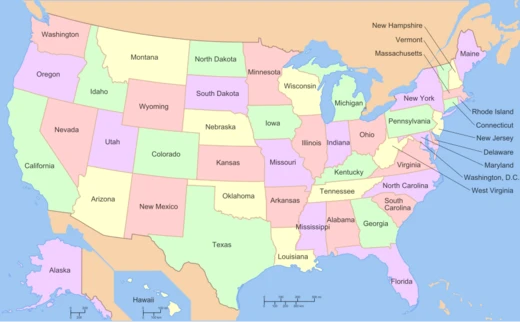
Illinois
Midwestern state, transportation hub, and cultural bellwether.

TylerKutschbach · CC BY-SA 4.0
Illinois is a state in the Midwestern United States, bordered by Lake Michigan to its northeast, the Mississippi River to its west, and the Wabash and Ohio rivers to its south. It has the fifth-largest gross domestic product, the seventh-largest population, and the 25th-most land area among U.S. states. Its capital is Springfield, and its largest city is Chicago. Illinois has been a major transportation hub since the mid-19th century, with Chicago becoming the world's fastest-growing city by the late 1800s. The state is a leading manufacturing center and a microcosm of American culture, often referenced with the phrase 'Will it play in Peoria?'.
Quick Facts
- Seal Link
- Flag and seal of Illinois
- Nicknames
- Land of Lincoln, Prairie State, The Inland Empire State
- Motto
- State Sovereignty, National Union
- Anthem
- "Illinois"
- Officiallang
- English
- Languages
- English (80.8%)Spanish (14.9%)Other (5.1%)
- Population Demonym
- Illinoisan
- Largestcity
- Chicago
- Seat
- Springfield
- Largestcounty
- Cook
- Largestmetro
- Chicagoland
- Area Rank
- 25th
Facts from the source article.
Lore & Background
Present-day Illinois was inhabited by Indigenous cultures for thousands of years. The French were the first Europeans to arrive, settling near the Mississippi and Illinois rivers in the 17th-century Illinois Country as part of New France. After U.S. independence in 1783, American settlers began arriving from Kentucky via the Ohio River. Illinois became part of the Northwest Territory and achieved statehood in 1818. The Erie Canal and John Deere's self-scouring steel plow transformed the state's prairie into productive farmland, attracting immigrant farmers from Germany, Sweden, Hungary, and elsewhere.
Reader's Guide
Illinois's significance lies in its role as a transportation and industrial hub for the United States. The Illinois and Michigan Canal and a sprawling railroad network made Chicago the nation's railroad hub by the 1860s, and O'Hare International Airport has been among the world's busiest for decades. The state's economy is highly diversified, with Chicago as a global city, agricultural hubs in the north and center, and natural resources in the south. Illinois is also a center of learning, with major universities including the University of Chicago, University of Illinois, and Northwestern University. Two World Heritage Sites are located in Illinois: the ancient Cahokia Mounds and part of the Wright architecture site. The state has produced three U.S. presidents elected while residents—Abraham Lincoln, Ulysses S. Grant, and Barack Obama—and Ronald Reagan was born and raised there. Illinois is one of the most tornadically active states in the U.S., with 136 tornadoes in 2023 alone.
Did You Know?
- The Chicago metropolitan area holds about 73% of Illinois's 12.8 million residents.
- Illinois produced 134 tornadoes in 2023, but Texas had over 200, the highest number of any state that year.
Geography, Economy & Transportation Dominance
Illinois sits at the crossroads of the American Midwest, bordered by Lake Michigan to the northeast, the Mississippi River to the west, and the Wabash and Ohio rivers to the south. Despite ranking only 25th in land area, the state punches far above its size economically, holding the fifth-largest GDP and sixth-largest population among all fifty states. Its central location and favorable geography have made it a national transportation nexus for over a century. The Port of Chicago connects to the Atlantic via the Great Lakes and Saint Lawrence Seaway, while the Illinois Waterway links it to the Gulf of Mexico through the Mississippi. Chicago has served as the nation's railroad hub since the 1860s, and O'Hare International Airport has remained among the world's busiest for decades. The state's economy is remarkably diversified: Chicago anchors global commerce in the northeast, industrial and agricultural hubs dominate the north and center, and coal, timber, and petroleum resources anchor the south. Illinois has long been viewed as a microcosm of the entire nation, a cultural bellwether captured in the old phrase 'Will it play in Peoria?'
Indigenous Roots & the Name Illinois
Long before European contact, Indigenous cultures inhabited the Illinois waterways for thousands of years. The Koster Site, now excavated, reveals 7,000 years of continuous habitation in the region. The most remarkable pre-Columbian achievement was Cahokia, a Mississippian chiefdom near present-day Collinsville, where builders raised more than 100 platform and burial mounds, a 50-acre plaza exceeding 35 football fields in size, and a sacred cedar woodhenge, all arranged in a planned design reflecting the culture's cosmology. Monks Mound, the site's centerpiece, stands 100 feet tall, spans nearly a thousand feet in length, and contains roughly 814,000 cubic yards of earth, making it the largest Pre-Columbian structure north of the Valley of Mexico. The state's very name traces back to the Illinois people themselves. French missionaries and explorers borrowed the Ojibwe rendering of the Miami-Illinois verb meaning 'he speaks the regular way,' spelling the /we/ ending as -ois. The modern spelling 'Illinois' appeared in early 1670s records, though the Illinois people called themselves Inoka, a word of unknown meaning.
From Prairie to Industrial Powerhouse
The transformation of Illinois from open prairie into one of America's most industrialized states unfolded over roughly two centuries. French settlers first arrived in the 17th century, establishing the Illinois Country as part of New France. After American independence in 1783 made the Mississippi a national boundary, settlers from Kentucky poured in via the Ohio River, and by 1818 the territory achieved statehood. The Erie Canal and John Deere's self-scouring steel plow, invented by an Illinoisan, converted the state's rich prairie into some of the world's most productive farmland, drawing immigrant farmers from Germany, Sweden, and Hungary. In the mid-19th century, the Illinois and Michigan Canal and an expanding railroad network turned the state into a national transportation hub, propelling Chicago into the world's fastest-growing city by the late 1800s. By 1900, industrial jobs in northern cities and coal mining in central and southern regions drew immigrants from Eastern and Southern Europe. The Great Migration from the South then established a large Black community, particularly in Chicago, cementing the city as a leading cultural and economic center.
Presidential Legacy & Cultural Institutions
No other state can claim the presidential lineage Illinois holds. Three U.S. presidents were elected while residents of the state: Abraham Lincoln, Ulysses S. Grant, and Barack Obama. Ronald Reagan was born and raised in Illinois, though he later represented California. The state honors Lincoln with its official slogan, 'Land of Lincoln,' and houses the Abraham Lincoln Presidential Library and Museum in Springfield, while Chicago is home to the Barack Obama Presidential Center. Beyond politics, Illinois anchors major centers of learning, including the University of Chicago, the University of Illinois, and Northwestern University. Two UNESCO World Heritage Sites call the state home: the ancient Cahokia Mounds and a portion of the Wright architecture site. A wide variety of protected areas work to conserve the state's natural and cultural resources. Illinois also shares with Texas the distinction of being among the most tornadically active states in the nation; in 2023 alone, the state recorded 136 tornadoes, the highest count of any state by a significant margin.
Gallery
Frequently Asked Questions
Who is Illinois?
Illinois is a Midwestern state whose capital is Springfield and whose largest city is Chicago. It ranks seventh in population and sixth in GDP among all U.S. states, sitting along the shores of Lake Michigan and bordered by the Mississippi, Wabash, and Ohio rivers.
What are Illinois's powers or role?
The state has functioned as a major transportation hub since the mid-1800s, with Chicago becoming the world's fastest-growing city by the late 19th century. It also serves as a leading manufacturing center and holds the sixth-largest gross domestic product of any state.
Where does Illinois live?
Illinois occupies a stretch of the Midwest, with Lake Michigan forming its northeastern edge and the Mississippi River marking its western boundary. The Wabash and Ohio rivers define its southern border, giving it the 25th-most land area among the states.
Which notable presidents are tied to Illinois?
Two U.S. presidents are closely associated with the state: Abraham Lincoln, who lived and practiced law there before the presidency, and Barack Obama, who represented Illinois in the Senate before becoming president.
Why is Illinois considered important in the bigger American story?
Often described as a microcosm of American culture, the state blends major urban energy with agricultural heartland. Its combination of economic output, transportation infrastructure, and cultural influence makes it a bellwether for the nation as a whole.
More in U.S. States 1-24
Spotted an error? Know more?
Reader corrections go straight into our review queue. Suggest an edit · How this site is sourced