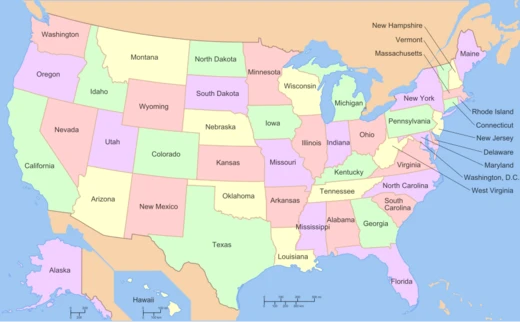
Indiana
Midwestern state known as the Hoosier State, admitted in 1816.

Riker, Dorothy Lois, 1904; Indiana. Governor · Public domain
Indiana is a state in the Midwestern region of the United States, admitted to the Union as the 19th state on December 11, 1816. Its name means 'Land of the Indians,' and its residents are known as Hoosiers, a term whose etymology is disputed but likely originated in the Upland South as a word for a backwoodsman. Indiana played a key role in the early frontier, with indigenous resistance broken at the Battle of Tippecanoe in 1811 and the collapse of Tecumseh's confederacy in 1813. The state later became a center for manufacturing and automobile production, and today it is counted as a 'red state' with a diverse economy.
Quick Facts
- Flag Link
- Flag of Indiana
- Anthem
- "On the Banks of the Wabash, Far Away"
- Nickname
- "The Hoosier State"
- Former
- Indiana Territory
- Population Demonym
- Hoosier
- Motto
- "Crossroads of America"
- Seat
- Indianapolis
- Largestcity
- capital
- Largestcounty
- Marion
- Governor
- Mike Braun (R)
- Lieutenant Governor
- Micah Beckwith (R)
- Legislature
- General Assembly
Facts from the source article.
Lore & Background
Indiana's name dates from 1768, when a Philadelphia-based trading company gave its land claim in present-day West Virginia the name 'Indiana' in honor of its previous owners, the Iroquois. The first recorded use of the word 'Indiana' came with the Indiana Land Company, though the U.S. government rejected the company's claim before the Supreme Court case Johnson v. McIntosh (1823) later established broader principles regarding Native land titles. The state's territorial history began on May 7, 1800, when Congress divided the Northwest Territory and named the western section the Indiana Territory. In 1816, Congress passed an Enabling Act to begin statehood, and part of that territorial land became the new state.
The first inhabitants were Paleo-Indians, arriving about 10,000 BC or earlier. Later cultures included the Archaic, Woodland, and Mississippian peoples, the last building large urban settlements such as Angel Mounds before collapsing in the mid-15th century. European exploration began in 1679 with French explorer René-Robert Cavelier, Sieur de La Salle. French fur traders established posts, and conflict with British colonists led to the French and Indian War. After British victory in 1763, the Royal Proclamation of 1763 designated the area as Indian Territory, a contributing factor to the American Revolution. During the war, George Rogers Clark took Vincennes and Fort Sackville on February 25, 1779, cutting off British troops and changing the war's course.
After the war, the Northwest Territory was defined in 1787, and the Indiana Territory was created in 1800. Native American land titles were extinguished through battles and treaties, including the Treaty of St. Mary's in 1818 and the Treaty of Mississinewas in 1826. Settler migration came via flatboat on the Ohio River and wagon trails. After the Civil War, natural gas attracted heavy industry and European immigrants to northern counties. In the first half of the 20th century, northern and central sections boomed in goods manufacture and automobile production, while southern Indiana remained largely rural. After the rise and fall of the Klan in the 1920s, the state swung to the Democratic Party in the New Deal 1930s, but today it has a decades-long record of returning Republican majorities.
Reader's Guide
Indiana's significance lies in its role as a frontier state that bridged the early American expansion and industrial growth. Its admission in 1816 marked the incorporation of a territory shaped by indigenous resistance, European colonial rivalry, and post-Revolutionary settlement. The state's name and the term 'Hoosier' reflect its cultural roots in the Upland South and its territorial history. Indiana's economy evolved from fur trading and agriculture to heavy industry and automobile manufacturing, particularly in the northern and central regions, while southern Indiana remained rural. The state's political trajectory—from Republican dominance in the early 20th century, through a Democratic shift during the New Deal, to its current status as a 'red state'—illustrates broader national trends. Indianapolis, the capital and largest city, hosts major professional sports teams and the Indianapolis 500, contributing to the state's cultural identity. Indiana's legacy includes its role in the American Revolution through George Rogers Clark's campaign, its part in the displacement of Native American tribes, and its later industrial boom fueled by natural gas and European immigration.
Did You Know?
- Indiana's name means 'Land of the Indians' and dates from 1768, when a Philadelphia-based trading company used it for a land claim in present-day West Virginia.
- The first European to cross into Indiana was French explorer René-Robert Cavelier, Sieur de La Salle in 1679.
- The state's largest city, Indianapolis, hosts the Indianapolis 500 at Indianapolis Motor Speedway.
- The term 'Hoosier' for a native or resident of Indiana likely originated in the Upland South as a word for a backwoodsman or country bumpkin.
Indigenous Heritage & Pre-Colonial Civilizations
The first people to inhabit what is now Indiana were Paleo-Indians who arrived around 8000 BC after the glaciers melted at the end of the Ice Age. Divided into small groups, they were nomadic hunters of large game such as mastodons, crafting stone tools from chert through chipping, knapping, and flaking. By the Archaic period between 5000 and 4000 BC, communities developed new ground-stone tools and began building earthwork mounds and middens, signaling more permanent settlements. The Woodland period, beginning around 1500 BC, introduced ceramics, pottery, and the extended cultivation of plants including corn and squash, while the Hopewell people developed long-distance trade networks. The Mississippian culture, lasting from 1000 AD until the 15th century, represented the pinnacle of pre-European settlement, producing large urban complexes designed according to cosmological principles. Angel Mounds is a notable example, featuring plazas and platform mounds where leaders lived or conducted rituals. These concentrated settlements depended on agricultural surpluses. The Mississippian civilization in Indiana collapsed in the mid-15th century for reasons that remain unclear. At the time of European contact, the region's historic tribes—Shawnee, Miami, Illini, and later Delaware refugees who settled in the White and Whitewater River Valleys—spoke different languages of the Algonquian family.
European Exploration & Colonial Contest
In 1679, René-Robert Cavelier, Sieur de La Salle, became the first European to cross into Indiana, reaching present-day South Bend at the St. Joseph River. French-Canadian fur traders quickly followed, exchanging blankets, jewelry, tools, whiskey, and weapons for Native American furs. By 1702, Sieur Juchereau established the first trading post near Vincennes, and in 1715, Fort Miami was built at Kekionga, now Fort Wayne. In 1717, Picote de Beletre constructed Fort Ouiatenon on the Wabash River to control Native American trade routes stretching from Lake Erie to the Mississippi. The 1730s saw British colonists arrive from the East, contending with the Canadians for control of the lucrative fur trade. Fighting between the French and British colonists intensified throughout the 1750s. Indiana's Native American tribes sided with the French Canadians during the French and Indian War, an episode of the broader Seven Years' War between European great powers. Britain's victory in 1763 forced France to cede all its North American lands east of the Mississippi River. Tribal resistance continued through Pontiac's Rebellion, which saw the capture of forts Ouiatenon and Miami.
Naming, Identity & the Hoosier Legacy
The name Indiana literally means 'Land of the Indians' or simply 'Indian Land,' rooted in the territory's colonial past. On May 7, 1800, the United States Congress passed legislation dividing the Northwest Territory into two areas, naming the western section the Indiana Territory. When Congress passed an Enabling Act in 1816 to begin the statehood process, a portion of that territorial land became the geographic area for the new state, which was admitted to the Union as the 19th state on December 11, 1816. The word Indiana has even earlier roots: in 1768, a Philadelphia-based trading company gave its land claim in present-day West Virginia the name Indiana in honor of its previous owners, the Iroquois. Ownership was later transferred to the Indiana Land Company, the first recorded use of the word. Virginia argued it was the rightful owner because the land fell within its geographic boundaries, and the U.S. Supreme Court denied the land company's claim in 1798. As for the nickname Hoosier, its origin is disputed, but the leading theory, advanced by the Indiana Historical Bureau and the Indiana Historical Society, traces it to the Upland South—Virginia, Kentucky, the Carolinas, and Tennessee—as a term for a backwoodsman, a rough countryman, or a country bumpkin.
Economic Evolution & Modern Indiana
Indiana's economy has undergone dramatic transformations across centuries. After the Civil War, in which the state fought for the Union, natural gas discoveries attracted heavy industry and waves of new European immigrants to its northern counties. The first half of the 20th century brought a boom in goods manufacture and automobile production to northern and central sections, while southern Indiana remained largely rural. Today, the state boasts a diverse economy with a 2023 gross state product of $404.3 billion. Indianapolis, the capital and largest city, anchors the state's biggest metropolitan area with a population of over two million, while the Fort Wayne metro area follows with 645,000 residents. The city is also a sports and racing powerhouse, home to the NFL's Indianapolis Colts, the NBA's Indiana Pacers, the WNBA's Indiana Fever, and the legendary Indianapolis 500 held at the Indianapolis Motor Speedway. Politically, after the rise and fall of the Klan in the 1920s, Indiana swung from the Republican to the Democratic Party during the New Deal era of the 1930s, before settling into a decades-long record of returning Republican majorities that earns it the label of a red state.
Gallery
Frequently Asked Questions
Who is Indiana?
Indiana is a Midwestern state that entered the Union as the 19th member on December 11, 1816, with Indianapolis serving as both its capital and largest city. Its residents are called Hoosiers, a nickname that likely traces back to Upland South slang for a backwoodsman.
What is Indiana's role in the broader story?
The state ranks 17th in population and 38th in area among the fifty states, positioning it as a solid mid-sized player in the national lineup. Its 2023 gross state product of roughly $404.3 billion underscores a steady industrial and economic footprint.
How did Indiana's backstory begin?
The name itself translates to 'Land of the Indians,' reflecting the region's deep indigenous heritage before European settlement took hold. The early frontier arc was shaped by the 1811 Battle of Tippecanoe and the 1813 collapse of Tecumseh's confederacy, both of which cleared the path toward statehood.
What are Indiana's signature abilities?
The state built a defining identity around heavy manufacturing and, most prominently, automobile production, which anchored its industrial economy for generations. That manufacturing heritage remains a core part of its economic character to this day.
Why does Indiana matter to the overall narrative?
It served as a critical frontier gateway in the early republic and later reinvented itself as a manufacturing powerhouse, giving it a dual legacy of westward expansion and industrial growth. Its distinctive Hoosier identity and central Midwestern position make it a recognizable fixture in the American story.
More in U.S. States 1-24
Spotted an error? Know more?
Reader corrections go straight into our review queue. Suggest an edit · How this site is sourced