Georgia (U.S. state)
Southern state, last of the Thirteen Colonies, civil rights hub.

TylerKutschbach · CC BY-SA 4.0
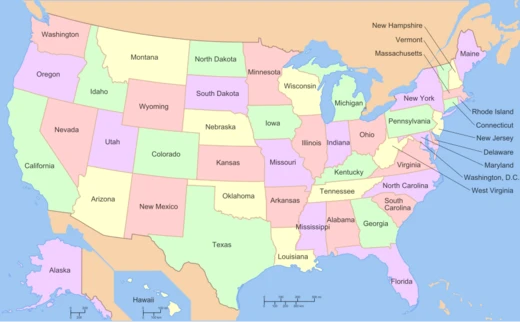
Georgia is a state in the Southeastern, South Atlantic, and Deep South regions of the United States. It is the 24th-largest by area and eighth-most populous among the 50 U.S. states, with an estimated 2024 population of 11,302,748. Atlanta, a global city, serves as both the state's capital and its largest city, and its metropolitan area contains about 57% of Georgia's entire population. Georgia was the last and southernmost of the original Thirteen Colonies, established as a British colony in 1732 and becoming a royal colony in 1754. It was the fourth state to ratify the U.S. Constitution on January 2, 1788, and later seceded from the Union on January 19, 1861, joining the Confederate States. After the Civil War, it was the last state readmitted to the Union on July 15, 1870.
Quick Facts
- Flag Link
- Flag of Georgia (U.S. state)
- Seal Link
- Seal of Georgia (U.S. state)
- Nicknames
- Peach State; Empire State of the South
- Motto
- "Wisdom, Justice & Moderation"
- Anthem
- "Georgia on My Mind"
- Former
- Province of Georgia
- Largestcity
- capital
- Largestcounty
- Fulton
- Largestmetro
- Atlanta
- Governor
- Brian Kemp (R)
- Lieutenant Governor
- Burt Jones (R)
- Legislature
- Georgia General Assembly
Facts from the source article.
Lore & Background
After Reconstruction, Georgia's economy changed under the 'New South' ideology promoted by Henry W. Grady. In the mid-20th century, Martin Luther King Jr., born in Atlanta, emerged as a national civil rights leader, co-founding the Southern Christian Leadership Conference in Atlanta in 1957. The state experienced significant population and economic growth after 1945, aligning with the Sun Belt trend. Georgia's landscape includes the Blue Ridge Mountains and the Piedmont plateau, with a predominantly humid subtropical climate.
Reader's Guide
Georgia's significance lies in its role as a foundational American colony and state, its central part in the Civil War and Reconstruction, and its leadership in the civil rights movement. As the last of the Thirteen Colonies and the last Confederate state readmitted to the Union, it embodies the tensions and transformations of American history. The state's economy shifted from agrarian to industrial in the late 19th century under the 'New South' vision, while Atlanta became a major metropolitan center. The civil rights movement, led by Martin Luther King Jr., had deep roots in Georgia, particularly in Atlanta, which hosted the Southern Christian Leadership Conference. Georgia's diverse geography—from the Blue Ridge Mountains to the Atlantic coast—and its humid subtropical climate contribute to its identity. The state's population growth after 1945 reflects broader Sun Belt trends, and its metropolitan areas, especially Atlanta, drive economic and cultural influence. The legacy of forced Native American removal, the Civil War's devastation, and the struggle for civil rights remain central to understanding Georgia's past and present.
Did You Know?
- Georgia was the last of the original Thirteen Colonies, established in 1732 and becoming a royal colony in 1754.
- Martin Luther King Jr., born in Atlanta, co-founded the Southern Christian Leadership Conference in Atlanta in 1957.
- In 1958, a Mark 15 nuclear bomb, known as the Tybee Bomb, was lost off the coast of Tybee Island near Savannah.
The Current Flag and Its Legal Architecture
The flag that flies over Georgia today was formally adopted on February 19, 2003, and its composition is governed by Georgia Code § 50-3-1 (2024). The design features three horizontal bands of equal width—scarlet on top, white in the middle, and scarlet along the bottom—while the lower stripe runs the full length of the flag. In the upper-left corner sits a square blue canton, twice the width of a single band, within which a ring of thirteen white five-pointed stars encircles a gold rendering of the state's coat of arms. Directly beneath that emblem, the words "IN GOD WE TRUST" appear in capital letters. The overall layout draws on the First National Flag of the Confederacy, historically called the "Stars and Bars." Since Mississippi voted to retire its own Confederate-linked flag in 2020, Georgia's banner stands among the very few state flags still carrying such imagery. It also ranks as one of only three state flags—alongside Florida and Mississippi—to display the national motto. The Secretary of State is tasked with establishing precise color codes, typography, and dimensional standards for official production.
Banners of Secession: The Pre-Official Era
Georgia went without a designated state flag for much of its early history, and no official banner existed until 1879. Following the state's secession from the Union on January 19, 1861, several competing designs circulated as de facto symbols. The most famous was the "Bonnie Blue Flag," a deep blue field bearing a single white star. Another banner was raised over the Savannah Custom House on February 1 of that year; a local newspaper described it as a white field bordered in red, centered on the state coat of arms, with five red stars and a blue star at the apex, an arch of glory, and the All-Seeing Eye overhead. The 1861 Georgia Code mandated that militia regiments deployed outside the state carry regimental colors bearing the state's arms, inscribed with the unit's name, though the flag's color was left unspecified. A surviving example in the American Civil War Museum in Richmond places the arms on a red field, offering a glimpse of how these early military standards actually appeared.
The Perry Flag: Georgia's First Official Banner (1879–1956)
The first officially adopted state flag emerged from the 1879 General Assembly, championed by state senator Herman H. Perry, a former Confederate colonel. The banner was explicitly meant to honor soldiers who had fought for the Confederacy, and its triband-and-canton structure clearly echoes the First National Flag of the Confederacy, the "Stars and Bars." The original 1879 version featured a plain blue vertical band at the hoist with no additional emblems. Over the decades the design shifted: a 1902 militia-law amendment added the coat of arms to that blue band, yet a 2000 Georgia Senate research report found no surviving flags showing the arms painted directly on the band, implying no such version was ever manufactured. By 1904, the arms appeared on a white shield, sometimes gold-outlined, with a red ribbon reading "GEORGIA" beneath. The year inscribed changed from 1799 to 1776 in 1914, and sometime in the 1910s or 1920s the coat of arms was supplanted by the state seal—a transition first reflected in the 1927 Georgia Official Register.
The 1956 Flag and the Confederate Legacy
In early 1955, John Sammons Bell—chairman of the State Democratic Party and an attorney for the Association County Commissioners of Georgia, who would later sit on the Georgia Court of Appeals—proposed a new state flag incorporating the Confederate Battle Flag. The idea gained legislative traction when senators Jefferson Lee Davis and Willis Harden introduced Senate Bill 98 during the 1956 session. The bill was signed into law on February 13, 1956, taking effect on July 1 of that year. A flag displayed at the signing ceremony reveals subtle differences from the version most commonly produced afterward: the stars are noticeably larger, and only the center point of the central star points straight upward. Those early 1956 examples also carried the 1920 version of the Georgia State Seal rather than the design seen on later productions. The flag's Confederate imagery would remain a point of sustained controversy for decades, and even after Mississippi's 2020 decision to replace its own banner, Georgia's flag persists as one of the last state flags retaining a direct reference to the Confederacy.
Gallery


Frequently Asked Questions
What is Georgia (U.S. state)?
Georgia is a southeastern U.S. state situated in the South Atlantic and Deep South regions, ranking 24th in land area and 8th in population with roughly 11.3 million residents as of 2025. It was the last of the original Thirteen Colonies to be chartered (1732) and the fourth state to ratify the Constitution in January 1788.
What are Georgia's powers and role in the U.S. system?
Like every state, Georgia elects its own governor and bicameral legislature, operates an independent court system, and sends representatives to both houses of Congress plus a fixed number of electoral-vote delegates. Beyond those constitutional duties, its deep involvement in the 20th-century civil rights movement and its position as a major logistics and finance corridor give it a national influence well beyond its raw size.
Why is Georgia important to U.S. history and culture?
Georgia was the southernmost of the original colonies, a bellwether of antebellum agrarian politics, and a flashpoint during the civil rights movement, making it a recurring stage for pivotal national struggles. Its capital, Atlanta, now concentrates about 57% of the state's population in its metro area and serves as a major international business and transportation crossroads.
What is Georgia's capital, and how big is the state?
Atlanta holds both the capital and the largest-city titles, functioning as a global city for aviation, broadcasting, and corporate headquarters. In terms of sheer size, Georgia is the 24th-largest state by area, stretching from the Atlantic coast westward to the Appalachian foothills.
More in U.S. States 1-24
Spotted an error? Know more?
Reader corrections go straight into our review queue. Suggest an edit · How this site is sourced