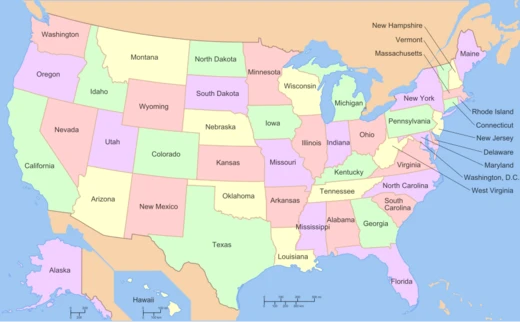
Kentucky
Landlocked Southeastern U.S. state, known for horses, bourbon, and coal.

TylerKutschbach · CC BY-SA 4.0
Kentucky, officially the Commonwealth of Kentucky, is a landlocked state in the Southeastern region of the United States. It was admitted into the Union as the fifteenth state on June 1, 1792, having previously been part of Virginia. Known as the 'Bluegrass State,' it is noted for its thoroughbred horse industry, tobacco plantations, and diverse economy including auto manufacturing and energy production.
Quick Facts
- Official Name
- Commonwealth of Kentucky
- Flag Link
- Flag of Kentucky
- Nickname
- The Bluegrass State
- Former
- Part of Virginia (District of Kentucky)
- Population Demonym
- Kentuckian
- Motto
- United we stand, divided we fall / Deo gratiam habeamus / (Let us be grateful to God)
- Anthem
- My Old Kentucky Home
- Seat
- Frankfort
- Officiallang
- English
- Largestcity
- Louisville
- Largestcounty
- Jefferson
- Governor
- Andy Beshear (D)
Facts from the source article.
Lore & Background
Kentucky's fertile soil supported large tobacco plantations using slave labor before the Thirteenth Amendment. The state typically ranks first or second nationally in goat meat production, eighth in beef cattle production, and fourteenth in corn production. Its economy has diversified into auto manufacturing, energy, and medicine, ranking third among U.S. states in automobile and truck assembly.
Reader's Guide
Kentucky holds significance as a border state between the Upper South and the Midwest, with a history shaped by Native American cultures, European exploration, and agricultural development. Its entry into the Union as the fifteenth state marked the expansion of the United States beyond the original thirteen colonies. The state's identity is deeply tied to its 'Bluegrass' nickname, derived from Kentucky bluegrass introduced by European settlers, which supported a thoroughbred horse industry that remains iconic.
Economically, Kentucky transitioned from a tobacco-based plantation economy—dependent on enslaved labor—to a diversified modern economy including auto manufacturing, energy production, and medicine. It is a leading state in automobile assembly and ranks high in goat, beef, and corn production. Culturally, Kentucky is associated with horse racing, bourbon, moonshine, coal mining, bluegrass music, college basketball, Louisville Slugger baseball bats, and Kentucky Fried Chicken. The state also contains Mammoth Cave National Park, the world's longest known cave system, and the two largest artificial lakes east of the Mississippi River. Its legacy includes both the preservation of Native American archaeological sites and the complex history of settlement and displacement.
Did You Know?
- Kentucky's northern border is defined by the Ohio River.
- The state is home to the world's longest known cave system in Mammoth Cave National Park.
- Kentucky typically ranks first or second among US states in goat meat production.
- Kentucky ranks third among US states in the number of automobiles and trucks assembled.
- The name 'Kentucky' may derive from an Iroquoian word meaning '(on) the meadow' or from an Algonquian term meaning 'Land of Our Fathers.'
Geography & State Identity
Kentucky is a landlocked state in the Southeastern United States, bordered by Illinois, Indiana, and Ohio to the north, with the Ohio River defining that northern edge, West Virginia to the northeast, Virginia to the east, Tennessee to the south, and Missouri to the west. Its capital is Frankfort, while Louisville holds the distinction of being the state's most populous city. As of 2024, roughly 4.6 million people call the state home. Officially styled the "Commonwealth of Kentucky," it is one of several states grouped under the broader Upland South regional designation. The beloved nickname "Bluegrass State" traces back to Kentucky bluegrass, a species of grass introduced by European settlers that went on to underpin the state's celebrated thoroughbred horse industry. Admitted into the Union as the fifteenth state on June 1, 1792, Kentucky had previously been part of Virginia before carving out its own distinct identity in the young republic.
From Tobacco Fields to Assembly Lines
The fertile soils of central and western Kentucky gave rise to large tobacco plantations modeled on those of Virginia and North Carolina, operations that relied on enslaved labor until the Thirteenth Amendment ended that system. Beyond tobacco, the state ranks fifth nationally in goat farming, eighth in beef cattle production, and fourteenth in corn output, reflecting a deep agricultural tradition. Yet Kentucky's economic story stretches well beyond the farm and the plantation. The state has diversified into non-agricultural sectors including energy production, medicine, and notably automobile manufacturing, where it ranks fourth among all US states in the number of cars and trucks assembled. This blend of deep agricultural roots and modern industrial capacity gives Kentucky a distinctive economic profile, one where the legacy of plantation labor sits alongside a workforce assembling vehicles and producing energy, and where the state's agricultural rankings coexist with automotive manufacturing and medical innovation.
Indigenous Roots & the Myth of the Empty Land
Archaeological evidence places the first human presence in Kentucky around 9500 BCE, with Clovis culture hunter-gatherers using primitive stone tools. By roughly 1800 BCE, a gradual shift toward agriculture began, and by 900 CE, the Mississippian culture had taken root in western and central Kentucky while the Fort Ancient culture emerged in the east. The Fort Ancient people practiced sophisticated crop rotation, burned sections of forest to attract wild game, and relocated their villages every ten to thirty years to maintain ecological balance. A persistent and damaging myth, perpetuated in many popular and scholarly works, claims Native Americans never lived permanently in Kentucky, treating it merely as a "hunting ground." Early European settlers, however, encountered extensive evidence of settled communities: numerous burial mounds, copper and stone artifacts, and massive stone-walled fortifications atop bluffs and cliffs. More recent scholarship attributes the mound builders to the Mississippian and Fort Ancient peoples, descendants of Paleoindian groups who inhabited the region for at least twelve thousand years.
A Cultural Mosaic
Kentucky's cultural landscape is remarkably varied and deeply rooted in both natural wonder and human tradition. The state is home to Mammoth Cave National Park, which contains the world's longest known cave system, and it hosts the nation's two largest artificial lakes east of the Mississippi River. Its cultural identity weaves together horse racing, bourbon production, moonshine, coal mining, and bluegrass music into a distinctive tapestry. Southern cuisine and barbecue hold a prominent place in the state's culinary tradition, while college basketball and Louisville Slugger baseball bats anchor its sporting culture. The Kentucky Fried Chicken brand originated here, and My Old Kentucky Home State Park preserves a piece of the state's musical heritage. The name "Kentucky" itself derives from the Kentucky River, a tributary of the Ohio, with etymological roots possibly in Iroquoian languages meaning "the meadow" or "the prairie," or in Algonquian languages where "aki" means "land," yielding translations like "Land of Our Fathers" or "The Land of Those Who Became Our Fathers."
Gallery
Frequently Asked Questions
What is Kentucky?
Kentucky is a landlocked state in the southeastern United States, officially styled as a 'Commonwealth' rather than a state. It sits between the Appalachian Mountains to the east and the Ohio River to the north, and is best known for its horse culture, bourbon distilleries, and coal-mining heritage.
Why is Kentucky called the Bluegrass State?
The nickname comes from the lush, bluish-green grass that thrived in the fertile soil of the central region, which proved ideal for grazing livestock. Over time, that association with premium pastureland cemented the name, especially as the state became synonymous with thoroughbred horse breeding.
What is Kentucky most famous for?
Kentucky is widely recognized for its thoroughbred horse industry, its bourbon whiskey production, and its coal and energy sectors. Louisville, the most populous city, and the Frankfort capital anchor a diverse economy that also includes auto manufacturing.
What is Mammoth Cave and why is it significant to Kentucky?
Mammoth Cave, located in the state's southern region, is the longest known cave system on Earth and is protected as a national park. It has been a major draw for geology enthusiasts and tourists for well over a century.
When did Kentucky join the Union?
Kentucky was admitted as the fifteenth state on June 1, 1792, after separating from Virginia. Its early status as a frontier region made it one of the last territories carved out of the original colonies to achieve full statehood.
More in U.S. States 1-24
Spotted an error? Know more?
Reader corrections go straight into our review queue. Suggest an edit · How this site is sourced