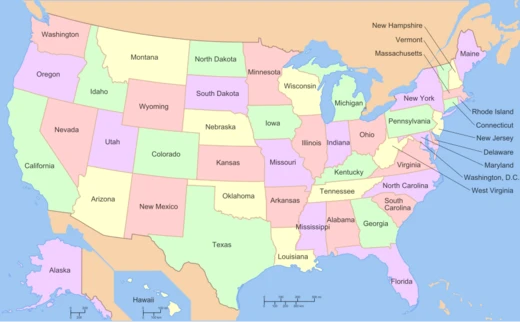
South Dakota
Landlocked Great Plains state named after the Dakota Sioux.

South Dakota is a landlocked state in the North Central region of the United States, part of the Great Plains. Named after the Dakota Sioux tribe, it became the 39th or 40th state on November 2, 1889, simultaneously with North Dakota, with the order of admission left unrecorded. The state is bisected by the Missouri River into two distinct halves, East River and West River, and its history includes early Native American habitation, European-American settlement, gold rushes, and conflicts such as the Wounded Knee Massacre.
Quick Facts
- Native Name
- dak · Dakȟóta itókaga
- Flag Link
- Flag of South Dakota
- Nickname
- The Mount Rushmore State (official)
- Motto
- Under God, the People Rule
- Anthem
- "Hail, South Dakota!"
- Former
- Dakota Territory
- Seat
- Pierre
- Officiallang
- English, Sioux (official indigenous language)
- Languages
- English, Spanish (2.06%), Dakota (1.39%), German (1.37%)
- Population Demonym
- South Dakotan
- Largestcity
- Sioux Falls
- Governor
- Larry Rhoden (R)
Facts from the source article.
Lore & Background
South Dakota was part of the Dakota Territory until 1889, when it was admitted as a state. The 20th century brought the Dust Bowl and Great Depression, causing population decline, followed by economic recovery during World War II. The state's economy has historically been agricultural, with East River focused on crops and West River on ranching, tourism, and defense spending. The Black Hills contain Mount Rushmore, a major tourist destination.
Reader's Guide
South Dakota's significance lies in its role as a site of major Native American history, particularly the Sioux tribes, and as a symbol of westward expansion and conflict. The state's admission alongside North Dakota, with the order deliberately obscured, reflects political maneuvering in the late 19th century. The Wounded Knee Massacre remains a pivotal event in U.S.-Native relations. Economically, South Dakota transitioned from a frontier agricultural society to a more diversified economy, though its rural character persists. The state's ecology and climate, ranging from moderate to semiarid, shape its agricultural practices. Politically, South Dakota has leaned Republican in recent decades, though Democrats have held congressional seats. Its cultural identity is deeply tied to its history and landscape, including the Black Hills and the Missouri River.
Did You Know?
- South Dakota is named after the Dakota Sioux tribe, which has a significant historical and cultural presence in the state, though today Native Americans make up about 8-9% of the population.
- The Missouri River bisects the state into two geographically and socially distinct halves known as 'East River' and 'West River'.
- President Benjamin Harrison shuffled the statehood papers for North and South Dakota so that no one could tell which became a state first.
- The Wounded Knee Massacre in 1890 resulted in the deaths of at least 146 Sioux, many of them women and children.
More in U.S. States 1-24
Spotted an error? Know more?
Reader corrections go straight into our review queue. Suggest an edit · How this site is sourced