Rhode Island
Smallest U.S. state, founded as a haven for religious liberty.

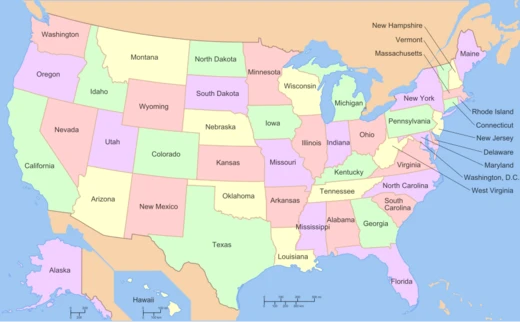
Rhode Island is a state in New England, in the northeastern part of the United States. It shares land borders with Connecticut to the west and Massachusetts to the north and east, while the Atlantic Ocean lies to its south through Rhode Island Sound and Block Island Sound. It also has a small maritime boundary with New York, east of Long Island. By area, it is the smallest U.S. state, and with just over 1.11 million people as of 2025, it is the eighth least populous. However, its population has grown in every census since 1790, and it is the second most densely populated state, behind only New Jersey. The state gets its name from the island of Rhode Island, even though most of its territory is on the mainland. Providence serves as both the capital and the largest city.
Before English settlers arrived in the early 1600s, Native Americans lived around Narragansett Bay. Unlike the other Thirteen British Colonies, Rhode Island was started by a refugee. Roger Williams, fleeing religious persecution in the Massachusetts Bay Colony, came to establish a place for religious freedom. In 1636, he founded Providence on land bought from local tribes, creating a settlement with a government that was explicitly secular—though not the first in North America (St. Augustine was founded in 1565, and Jamestown in 1607). The Colony of Rhode Island and Providence Plantations then became a haven for religious and political dissenters and social outcasts, earning the nickname "Rogue's Island."
In 1774, Rhode Island was the first colony to propose a Continental Congress, and on May 4, 1776, it was the first to break its allegiance to the British Crown. During the American Revolution, the area was heavily occupied and saw much fighting. Afterward, on February 9, 1778, it became the fourth state to ratify the Articles of Confederation. Because its people preferred a weaker central government, Rhode Island boycotted the 1787 convention that wrote the U.S. Constitution and initially refused to ratify it. It finally did so on May 29, 1790, making it the last of the original 13 states to join.
Quick Facts
- Flag Link
- Flag of Rhode Island
- Nicknames
- The Ocean State / Little Rhody
- Motto
- Hope
- Anthem
- "Rhode Island's It for Me"
- Former
- Colony of Rhode Island and Providence Plantations
- Population Demonym
- Rhode Islander
- Seat
- Providence
- Largestcity
- capital
- Largestmetro
- Greater Boston (combined) / Providence (metro and urban)
- Governor
- Dan McKee (D)
- Lieutenant Governor
- Sabina Matos (D)
- Legislature
- Rhode Island General Assembly
Facts from the source article.
Lore & Background
Native Americans lived around Narragansett Bay before English settlers began arriving in the early 17th century. Roger Williams founded Providence in 1636 on land purchased from local tribes, creating a settlement with an explicitly secular government—though not the first in North America (St. Augustine was founded in 1565, and Jamestown in 1607). The Colony of Rhode Island and Providence Plantations subsequently became a destination for religious and political dissenters and social outcasts, earning it the moniker 'Rogue's Island'. The state was officially named the State of Rhode Island and Providence Plantations since the colonial era but came to be commonly known as 'Rhode Island'. On November 3, 2020, voters approved an amendment to the state constitution formally changing the official name to the State of Rhode Island.
Reader's Guide
Rhode Island's significance lies in its role as a pioneer of religious freedom and secular governance in North America, founded by Roger Williams after his banishment from Massachusetts Bay Colony. It was the first colony to call for a Continental Congress and the first to renounce allegiance to the British Crown, yet it was the last to ratify the U.S. Constitution due to its citizens' preference for a weaker central government. The state's name change in 2020, removing 'and Providence Plantations', reflected a reckoning with the word's association with slavery and racism, following a 2010 referendum that had retained the original name. Despite its small size, Rhode Island is the second-most densely populated state after New Jersey and has recorded population growth in every decennial census since 1790. Its official nickname, the 'Ocean State', references its 400 miles of coastline and large bays and inlets that make up about 14% of its area.
Did You Know?
- Rhode Island is the smallest U.S. state by area and the second-most densely populated state after New Jersey.
- It was the first colony to renounce allegiance to the British Crown, on May 4, 1776.
- The state's official name was changed from 'State of Rhode Island and Providence Plantations' to 'Rhode Island' in 2020 after a voter referendum.
- The origin of the name 'Rhode Island' is uncertain; it may derive from explorer Giovanni da Verrazzano likening an island to Rhodes, or from Dutch words meaning 'red island'.
More in U.S. States 1-24
Spotted an error? Know more?
Reader corrections go straight into our review queue. Suggest an edit · How this site is sourced