Oregon
33rd state, known for Crater Lake and Mount Hood.

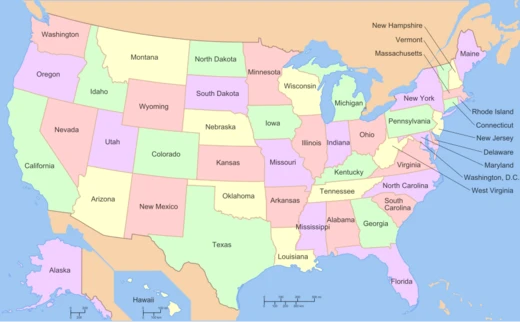
Oregon is a state in the Pacific Northwest region of the United States, admitted to the Union on February 14, 1859, as the 33rd state. It is known for its geographic diversity, including volcanoes, dense forests, high deserts, and Crater Lake, the deepest lake in the U.S. The state's name first appeared in 1765 in a petition by Robert Rogers, though its origin remains obscure.
Quick Facts
- Nickname
- The Beaver State
- Motto
- Alis volat propriis / (English: She flies with her own wings)
- Anthem
- Oregon, My Oregon
- Former
- Oregon Territory
- Capital
- Salem
- Largestcity
- Portland
- Largestcounty
- Multnomah
- Population Demonym
- Oregonian
- Governor
- Tina Kotek (D)
- Lieutenant Governor
- Tobias Read (D)If the governor dies, resigns or is (via impeachment conviction) removed from office, the secretary of state is first in line to become governor.
- Lieutenant Governor Alt
- Secretary of State
- Legislature
- Legislative Assembly
Facts from the source article.
Lore & Background
Oregon has been home to indigenous nations for thousands of years, with evidence of habitation dating back at least 15,000 years. The first documented European exploration of the Oregon coast was by Juan Rodríguez Cabrillo in 1542–1543. The Lewis and Clark Expedition traversed Oregon in the early 19th century, and the first permanent European settlement was established by John Jacob Astor's Pacific Fur Company at Fort Astoria in 1811.
The United States gained joint occupation rights through the Treaty of 1818, and the Oregon Treaty of 1846 brought the region under American sovereignty. The Oregon Territory was created in 1848, and statehood followed in 1859. The state's economy has historically relied on agriculture, fishing, logging, and hydroelectric power, with lumber dominating the 20th century. Technology became a major force in the 1970s with the Silicon Forest, and Nike, headquartered in Beaverton, is the state's largest public corporation.
Reader's Guide
Oregon's significance lies in its role as a key territory in the westward expansion of the United States, its unique geographic features, and its economic evolution from resource extraction to technology and manufacturing. The state's name, of uncertain origin, was popularized by Jonathan Carver's 1778 work and later applied to the Oregon Country by Hall J. Kelley. Oregon's admission as the 33rd state marked the culmination of decades of dispute and settlement. Today, it is the ninth-largest state by area and 27th-most populous, with a diverse economy that includes the world's largest sportswear company, Nike. Its natural landmarks, such as Crater Lake and Mount Hood, and the largest known organism, a fungus in Malheur National Forest, underscore its environmental uniqueness. The Portland metropolitan area, the 26th largest in the nation, serves as a cultural and economic hub.
Did You Know?
- Oregon's name first appeared in 1765 in a petition by Robert Rogers, but its origin is obscure and disputed.
- Crater Lake, in Oregon's only national park, is the deepest lake in the United States.
- The state is home to the single largest organism in the world, Armillaria ostoyae, a fungus spanning 2,200 acres in Malheur National Forest.
More in U.S. States 1-24
Spotted an error? Know more?
Reader corrections go straight into our review queue. Suggest an edit · How this site is sourced