Oklahoma
A state shaped by Indigenous heritage, land runs, and oil.

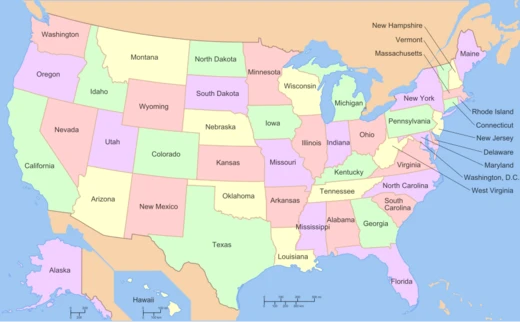
Oklahoma is a landlocked state in the South Central, Southern, and Southwestern regions of the United States. Its name derives from the Choctaw words 'okla' (people) and 'humma' (red), and it is known informally as 'The Sooner State.' It became the 46th state on November 16, 1907, and its capital and largest city is Oklahoma City.
Quick Facts
- Native Name
- cho · Oklahumma / chr · ᎣᎦᎳᎰᎹ
- Flag Link
- Flag of Oklahoma
- Seal Link
- Great Seal of Oklahoma
- Nickname
- Native America (official) · Land of the Red Man · Sooner State
- Motto
- la · Labor omnia vincit / (English: "Work conquers all")
- Anthem
- "Oklahoma" and / "Oklahoma Hills"
- Officiallang
- English, Choctaw, CherokeeChoctaw official within Choctaw Nation, Cherokee official within Cherokee Nation and UKB
- Population Demonym
- Oklahoman; / Okie (colloq., historically derogatory); / Sooner (historically)
- Seat
- Oklahoma City
- Largestcity
- capital
- Largestcounty
- Oklahoma
- Largestmetro
- Greater Oklahoma City
Facts from the source article.
Lore & Background
Oklahoma's history begins with Indigenous peoples present by the last ice age, including ancestors of the Wichita, Tonkawa, Caddo, and Plains Apache. The Spiro Mounds, a major Mississippian complex, flourished between AD 850 and 1450. European exploration began with Spaniard Francisco Vázquez de Coronado in 1541, and French colonists claimed the area until the Louisiana Purchase of 1803. During the 19th century, the U.S. government forcibly removed tens of thousands of American Indians to the region, including the Cherokee, whose forced removal in the 1830s became known as the 'Trail of Tears.' The area became Indian Territory, and by 1890 more than 30 Native American nations were concentrated there.
Reader's Guide
Oklahoma's significance lies in its role as a crossroads of American Indian, Southern, and Western cultures. It was a government-sanctioned territory for displaced Indigenous peoples, a route for cattle drives from Texas, and a destination for Southern settlers. The Land Rush of 1889 opened millions of acres to white settlement, giving rise to the state's nickname. The state became a focal point for the oil industry, with Tulsa known as the 'Oil Capital of the World.' Today, Oklahoma is a major producer of natural gas, oil, and agricultural products, with an economic base in aviation, energy, telecommunications, and biotechnology. Its 25 Indigenous languages and the highest percentage of American Indian residents of any state underscore its enduring Indigenous heritage.
Did You Know?
- The name Oklahoma comes from the Choctaw words 'okla' (people) and 'humma' (red), suggested by Choctaw Nation Chief Allen Wright in 1865.
- Oklahoma has one of the highest American Indian population percentages in the U.S., though Alaska's percentage is higher, according to the 2020 census.
- The Land Rush of 1889 gave rise to the term 'Sooners' for settlers who crossed into the territory before the official opening time.
- Tulsa was known as the 'Oil Capital of the World' for most of the 20th century.
More in U.S. States 1-24
Spotted an error? Know more?
Reader corrections go straight into our review queue. Suggest an edit · How this site is sourced