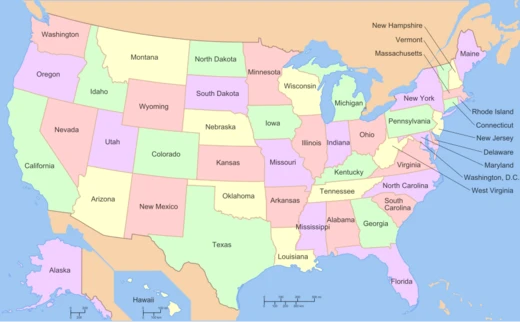
North Dakota
Landlocked Great Plains state with a state-run bank.

North Dakota sits in the Upper Midwest, a landlocked state named for the Dakota and Sioux peoples. It belongs to the Great Plains, with landscapes of wide prairies, steppe, temperate savanna, badlands, and farmland. Its capital is Bismarck, while Fargo is the largest city, holding nearly a fifth of the state’s population. Though it ranks 19th in size among U.S. states, its population is just under 800,000, making it the fourth-least populous and sixth-least densely populated. About half of its residents live in rural areas. The state claims North America’s geographic center in Rugby, though the exact location is disputed and not officially established. It once held the Western Hemisphere’s tallest artificial structure, the KVLY-TV mast.
For thousands of years before Europeans arrived, Native American tribes lived here. Along the Missouri River, the Mandan, Hidatsa, and Arikara built villages; the Ojibwe and Cree occupied the northeast; and various Sioux groups—Nakota, Dakota, and Lakota—spread across the rest. European explorers and traders, mainly after furs, first came in the early 1700s. The U.S. took control in the early 1800s, and settlement grew as native peoples were increasingly displaced. The Dakota Territory was created in 1861, and the Homestead Act of 1862 sparked a population surge. Farming, especially wheat, replaced the fur trade. From 1878 to 1886, the Dakota Boom brought enormous farms across the prairies, making the territory an economic force. Rival railroads—the Northern Pacific and Great Northern—competed for grain traffic, and farmers formed political alliances that fueled the Midwest’s Populist Movement. North and South Dakota became states on November 2, 1889, as the 39th and 40th states; President Benjamin Harrison signed the statehood proclamations in alphabetical order, making North Dakota the first of the two, though they are officially numbered alphabetically. Later, radical agrarian movements and cooperatives led to the Bank of North Dakota, the only state-run bank in the nation. The pioneer era wound down, and the state was fully settled by about 1920.
From the mid-1900s, North Dakota’s natural resources grew more important. In the 21st century, oil extraction from the Bakken formation in the northwest has driven prosperity, boosting population growth (along with high birth rates) and cutting unemployment.
Quick Facts
- Flag Link
- Flag of North Dakota
- Seal Link
- Great Seal of North Dakota
- Nicknames
- Peace Garden State, / Roughrider State, Flickertail State, Heaven on Earth
- Motto
- Liberty and Union, Now and Forever, One and Inseparable / la · Serit ut alteri saeclo prosit / "One sows for the benefit of another age"
- Anthem
- North Dakota Hymn
- Former
- Dakota Territory
- Population Demonym
- North Dakotan
- Capital
- Bismarck
- Largestcity
- Fargo
- Largestcounty
- Cass
- Largestmetro
- Fargo-Moorhead
- Officiallang
- English
Facts from the source article.
Lore & Background
The area of North Dakota was inhabited for thousands of years by Native American tribes, including the Mandan, Hidatsa, and Arikara along the Missouri River; the Ojibwe and Cree in the northeast; and several Sioux groups. European explorers and traders first arrived in the early 18th century, mostly in pursuit of furs. The United States acquired the region in the early 19th century, gradually settling it amid growing resistance by increasingly displaced natives. The Dakota Territory, established in 1861, became central to American pioneers, with the Homestead Act of 1862 precipitating significant population growth and development. The Dakota Boom of 1878 to 1886 saw giant farms stretched across the rolling prairies, with the territory becoming a regional economic power. North Dakota was admitted to the Union on November 2, 1889, as the 39th state, with President Harrison signing its proclamation before South Dakota's in alphabetical order.
Reader's Guide
North Dakota's significance lies in its role as a frontier agricultural powerhouse and a center of populist and cooperative movements. The Non Partisan League, active around World War I, established the nation's only state-run bank, the Bank of North Dakota, and the North Dakota Mill and Elevator, both still in existence. The state's anti-corporate laws, still in force, virtually prohibit corporations or banks from owning title to farmland, making foreclosure nearly impossible. In the 21st century, oil extraction from the Bakken formation in the northwest has driven population growth, reduced unemployment, and contributed to the state's prosperity. North Dakota's admission to the Union on November 2, 1889, alongside South Dakota, was marked by President Benjamin Harrison shuffling the statehood papers so that no one could tell which became a state first; consequently, the two states are officially numbered in alphabetical order.
Did You Know?
- The KVLY-TV mast in North Dakota was once the tallest artificial structure in the Western Hemisphere.
- North Dakota is believed to contain North America's geographic center, in Rugby.
- President Benjamin Harrison shuffled the statehood papers for North and South Dakota so that no one could tell which became a state first.
More in U.S. States 1-24
Spotted an error? Know more?
Reader corrections go straight into our review queue. Suggest an edit · How this site is sourced